Quantitative testing semantics for non-interleaving
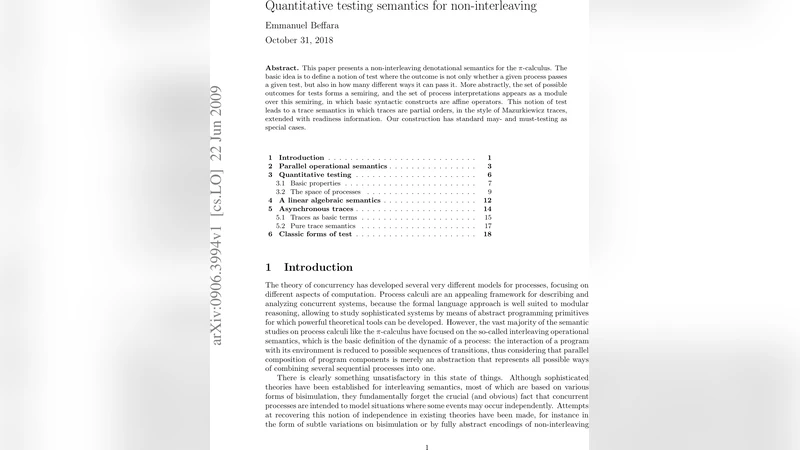
This paper presents a non-interleaving denotational semantics for the ?-calculus. The basic idea is to define a notion of test where the outcome is not only whether a given process passes a given test, but also in how many different ways it can pass it. More abstractly, the set of possible outcomes for tests forms a semiring, and the set of process interpretations appears as a module over this semiring, in which basic syntactic constructs are affine operators. This notion of test leads to a trace semantics in which traces are partial orders, in the style of Mazurkiewicz traces, extended with readiness information. Our construction has standard may- and must-testing as special cases.
💡 Research Summary
The paper introduces a novel denotational semantics for the π‑calculus that departs from the traditional interleaving view of concurrency and instead embraces a truly non‑interleaving perspective. The central innovation is to enrich the notion of a test: rather than answering a binary “pass/fail” question, a test now yields a quantitative outcome that records how many distinct ways a process can satisfy the test. To capture this quantitative information, the authors model the set of possible outcomes as a semiring (S, +, ·, 0, 1). The addition operation aggregates alternative successful executions, while multiplication composes sequential or concurrent executions.
Processes are interpreted as elements of a module over this semiring, and each syntactic constructor of the π‑calculus (parallel composition, restriction, replication, etc.) is represented by an affine operator on the module. This algebraic setting provides a clean, compositional framework: the semantics of a compound process can be obtained by applying the corresponding affine transformations to the semantics of its components.
To give substance to the semiring‑valued tests, the authors define a non‑interleaving notion of test based on Mazurkiewicz traces. A trace is not a linear word but a partially ordered set of events equipped with readiness information that indicates which actions are enabled at each point. Formally, a trace τ is a triple (E, ≤, R) where E is a finite set of events, ≤ is a partial order expressing causal dependencies, and R maps each event to a set of actions that could be performed next. This representation preserves the true concurrency of the system, avoiding the artificial serialization imposed by interleaving semantics.
The quantitative semantics is obtained by considering the interaction of a process P with a test T as a labelled transition system (LTS). Each maximal execution path of the combined LTS yields a concrete trace τ. The semantics of (P,T) is then the sum, in the semiring, of the contributions of all such τ. If a particular trace can be realized in n distinct ways (for example, due to different scheduling choices that do not affect the partial order), its contribution is the semiring element n·1. The overall result is an element of S that simultaneously records which traces are possible and how many realizations each has.
Crucially, the authors show that the classic testing preorders—may‑testing and must‑testing—are recovered as special cases of their framework. May‑testing corresponds to checking whether the semiring result is non‑zero (i.e., at least one successful execution exists). Must‑testing corresponds to verifying that every maximal execution yields a non‑zero contribution, which translates to the semiring element being “total” (no zero components). Thus, the new semantics subsumes the traditional binary testing notions while providing strictly more information.
The paper includes a detailed example to illustrate the construction. The example process offers two input actions a and b that can occur concurrently, followed by an output c. The test observes whether both inputs can be accepted and then whether c can be emitted. The analysis shows that the trace (a‖b)·c can be realized in two independent ways, leading to a semiring value of 2, whereas a strictly sequential version a·b·c yields a value of 1. This demonstrates that the quantitative, non‑interleaving semantics distinguishes behaviours that interleaving semantics would collapse.
Beyond the core technical development, the authors discuss several implications. Because processes form a module over a semiring, one can instantiate the semiring with different concrete structures—natural numbers for counting, polynomials for symbolic analysis, or probability distributions for stochastic extensions. This flexibility opens avenues for quantitative performance analysis, reliability estimation, and compositional verification. Moreover, the affine nature of the syntactic operators suggests that the semantics can be integrated into compiler optimizations or model‑checking tools that need to reason about concurrency without losing information about independence.
In summary, the paper provides a mathematically elegant and practically powerful framework that generalizes may‑ and must‑testing to a quantitative, non‑interleaving setting. By combining semiring‑valued outcomes with Mazurkiewicz‑style partial‑order traces enriched with readiness, it captures both the existence and multiplicity of successful interactions, preserving true concurrency and enabling richer reasoning about concurrent processes.
Comments & Academic Discussion
Loading comments...
Leave a Comment