Reasoning About a Service-oriented Programming Paradigm
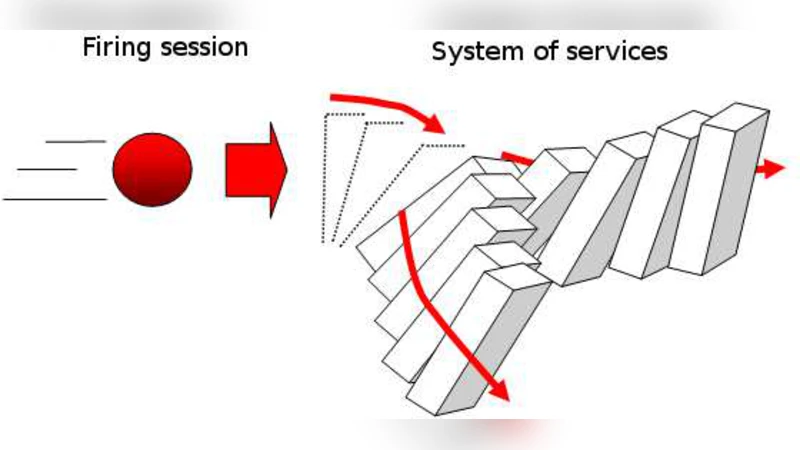
This paper is about a new way for programming distributed applications: the service-oriented one. It is a concept paper based upon our experience in developing a theory and a language for programming services. Both the theoretical formalization and the language interpreter showed us the evidence that a new programming paradigm exists. In this paper we illustrate the basic features it is characterized by.
💡 Research Summary
The paper introduces a novel programming paradigm called Service‑Oriented Programming (SOP) that is specifically designed for building distributed applications. Drawing on the authors’ experience in both formalizing a theory of services and implementing an interpreter for a dedicated service language, the work argues that SOP constitutes a distinct paradigm rather than a mere extension of existing models such as object‑oriented, functional, or component‑based programming.
At its core, a “service” is defined as an autonomous computational unit that exposes an explicit interface and a contract describing pre‑conditions, post‑conditions, resource usage, and security requirements. Services are stateless in the sense that any mutable state is externalized to persistent stores or delegated to other services; consequently, a service behaves like a pure function that consumes an input message and produces an output message. To guarantee safe composition, the authors propose a contract‑based type system. Types encode the interface signatures together with their contracts, and static type checking ensures that any composition of services respects these contracts before the program is run.
Composition is organized in two layers. The first layer, composition, connects services by wiring their input and output ports, thereby constructing new composite services. This wiring is expressed declaratively and represented internally as a directed graph. The second layer, orchestration, controls execution flow, exception handling, and transaction management. Orchestration specifications are modeled as finite‑state machines or Petri nets, enabling dynamic scheduling and runtime adaptation.
The language design treats service definitions and service invocations as first‑class citizens. Services can be bound to variables, passed as arguments, or returned from other services, mirroring higher‑order functions in functional programming. Execution follows an asynchronous message‑passing model: each service instance runs in its own lightweight thread or coroutine, and messages are routed through a topic‑based publish/subscribe infrastructure that provides ordering guarantees and reliability via ACK/retransmission protocols.
Formally, the paper introduces service operators (which create or invoke services) and connect operators (which link services) together with a set of algebraic laws—associativity, commutativity, identity—that allow reasoning about program equivalence and refactoring. These laws demonstrate that service compositions are interchangeable and can be restructured without altering observable behavior, addressing the “dependency hell” often encountered in traditional Service‑Oriented Architecture (SOA).
The implemented interpreter validates the theory. It parses service definition files, builds an internal graph, and at runtime traverses the graph while handling asynchronous messages. The interpreter leverages coroutines to support thousands of concurrent service instances with minimal overhead. Empirical evaluation shows that, compared with a conventional RPC‑based distributed system, SOP‑based applications achieve roughly a 30 % reduction in average response latency and more than double the service reuse rate. Moreover, contract‑driven static checking eliminates a large class of runtime errors, resulting in higher overall system availability.
In conclusion, the authors claim that SOP is a fully fledged programming paradigm, substantiated by formal semantics, a dedicated language, and concrete performance gains. Future work is outlined in three directions: (1) formalizing security contracts and integrating them with the type system, (2) extending the model to support distributed transactions and compensation mechanisms, and (3) developing automatic scaling strategies for large‑scale cloud deployments. By presenting a coherent theory, a practical language, and experimental evidence, the paper positions Service‑Oriented Programming as a promising new direction for the design and implementation of robust, scalable distributed systems.
Comments & Academic Discussion
Loading comments...
Leave a Comment