Using Agent to Coordinate Web Services
Traditionally, agent and web service are two separate research areas. We figure that, through agent communication, agent is suitable to coordinate web services. However, there exist agent communication problems due to the lack of uniform, cross-platform vocabulary. Fortunately, ontology defines a vocabulary. We thus propose a new agent communication layer and present the web ontology language (OWL)-based operational ontologies that provides a declarative description. It can be accessed by various engines to facilitate agent communication. Further, in our operational ontologies, we define the mental attitudes of agents that can be shared among other agents. Our architecture enhanced the 3APL agent platform, and it is implemented as an agent communication framework. Finally, we extended the framework to be compatible with the web ontology language for service (OWL-S), and then develop a movie recommendation system with four OWL-S semantic web services on the framework. The benefits of this work are: 1) dynamic web service coordination, 2) ontological reasoning through uniform representation, namely, the declarative description, and 3) easy reuse and extension of both ontology and engine through extending ontology.
💡 Research Summary
The paper “Using Agent to Coordinate Web Services” proposes a novel integration framework that bridges the traditionally separate domains of autonomous agents and Web services. The authors identify a core problem: existing agent communication standards (e.g., FIPA) lack a uniform, cross‑platform vocabulary, making it difficult for heterogeneous agents to exchange meaningful information, especially regarding each other’s mental states (beliefs, desires, intentions). To address this, they introduce an “Agent Mentality Layer” positioned between the Content Language Layer and the Message Transport Layer of the FIPA stack. This layer enables agents to transmit and share mental attitudes in a machine‑readable form.
The backbone of the solution is a set of five OWL‑based operational ontologies: Interaction Protocol Ontology, Communication Act Ontology, Proposition Ontology, Action Ontology, and Content Language Ontology. Each ontology captures a distinct aspect of agent communication. The Interaction Protocol Ontology models protocols, participants, states (start, transit, accept), and transitions, linking them to communicative acts. The Communication Act Ontology classifies acts according to Searle’s taxonomy (expressives, commissives, directives, assertives) and defines their preconditions and rational effects. The Proposition Ontology formalizes the mental model: a proposition consists of subject‑predicate‑object, optionally extended with a valid time and a belief flag, thereby allowing agents to express “at time T, agent A believes proposition P”. The Action Ontology describes executable actions, their inputs/outputs, and preconditions, while the Content Language Ontology specifies the syntactic structure of messages.
All ontologies are expressed in OWL, using URIs for unique identification, and are stored in a central Data Model that also holds domain ontologies (e.g., OWL‑S service descriptions). The Data Model serves as a shared knowledge base for both the agents’ mental model and the concrete service specifications.
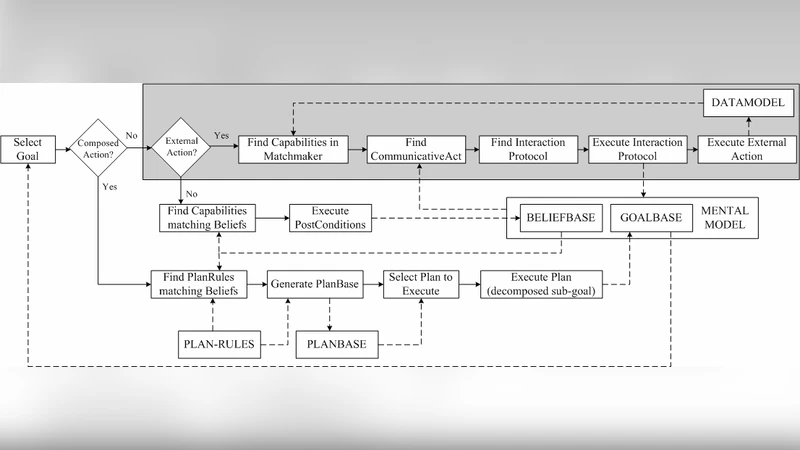
The architecture is built on top of the 3APL agent platform, a Prolog‑based system that maintains a goal base, belief base, and plan base. The authors extend 3APL with the following components:
- Interaction Protocol Engine – parses protocol descriptions, identifies initiators and participants, tracks conversation state, and triggers the CA Engine.
- CA (Communicative Act) Engine – evaluates the feasibility precondition of a communicative act, updates the mental model with rational effects, and invokes the Action Engine when an action is specified.
- Action Engine – executes actions (including calls to OWL‑S Web services), checks preconditions, records effects in the Data Model, and forwards any outputs to the Proposition Engine.
- Proposition Engine – reifies action results as propositions and inserts them into the mental model, allowing other agents to reason about them.
- Mental Model – stores reified propositions and provides belief‑management algorithms to distinguish actual from hypothetical worlds.
- Data Model – persists domain ontologies, service descriptions, and execution results.
The communication workflow proceeds in six steps: (1) the Interaction Protocol Engine reads the protocol description and loads relevant plan rules into 3APL; (2) it signals the CA Engine to perform a transition; (3) the CA Engine checks mental‑state preconditions and, if satisfied, calls the Action and Proposition Engines; (4) the Action Engine validates action preconditions, invokes the service, and records effects; (5) the CA Engine stores outputs and rationales for future reasoning; (6) the cycle repeats until the protocol terminates.
To illustrate the framework, the authors implement a movie‑recommendation scenario involving four OWL‑S semantic Web services (movie metadata, rating, user preference, recommendation algorithm). An agent seeking a recommendation first identifies the needed external actions, queries an action registry to locate service‑providing agents, selects an appropriate communicative act from the 22 FIPA‑defined acts, and finally chooses a contract‑net‑style interaction protocol to coordinate the service calls. The mental model captures intermediate beliefs (e.g., “User prefers drama”) and propagates them to subsequent service invocations, enabling dynamic, context‑aware composition of services.
Key contributions of the paper are:
- Agent Mentality Layer – a new communication layer that makes mental attitudes explicit and shareable across heterogeneous agents.
- OWL‑based Operational Ontologies – a declarative, machine‑interpretable description of protocols, acts, propositions, and actions, facilitating uniform reasoning.
- Integration of 3APL with OWL‑S – a concrete implementation that demonstrates how an existing BDI‑style planner can be extended to orchestrate semantic Web services.
- Dynamic Service Coordination – the ability to discover, select, and compose Web services at runtime based on mental‑state reasoning rather than static WSDL descriptions.
- Reusability and Extensibility – ontologies and engines are modular; new services or communication patterns can be added by extending the relevant OWL files without altering core code.
The paper also discusses limitations. The prototype is tightly coupled to the 3APL platform, which may hinder adoption in environments that use other agent frameworks. Performance evaluation is limited to a small‑scale scenario; scalability to large numbers of agents and services remains untested. Moreover, the creation and maintenance of rich ontologies demand expertise and can be costly in practice.
Future work suggested includes: (a) porting the architecture to other agent platforms (e.g., JADE, Jason); (b) developing automated tools for ontology evolution and alignment; (c) conducting extensive benchmarks in distributed cloud environments; and (d) exploring richer mental‑state models (e.g., intentions, emotions) to support more sophisticated collaborative behaviors.
In summary, the paper presents a well‑structured, ontology‑driven framework that enables agents to coordinate semantic Web services dynamically, by making mental attitudes explicit, sharing them via OWL, and integrating these capabilities into an existing BDI planner. The approach advances the state of the art in agent‑Web service interoperability and opens avenues for more intelligent, context‑aware service orchestration.
Comments & Academic Discussion
Loading comments...
Leave a Comment