Spanning connectivity games
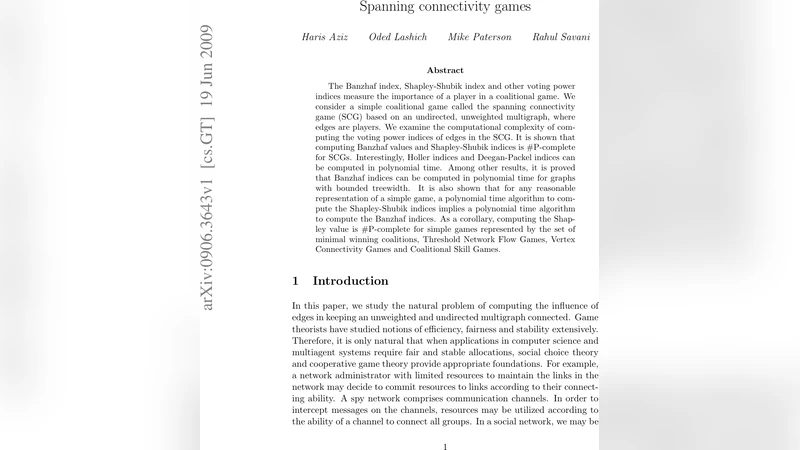
The Banzhaf index, Shapley-Shubik index and other voting power indices measure the importance of a player in a coalitional game. We consider a simple coalitional game called the spanning connectivity game (SCG) based on an undirected, unweighted multigraph, where edges are players. We examine the computational complexity of computing the voting power indices of edges in the SCG. It is shown that computing Banzhaf values and Shapley-Shubik indices is #P-complete for SCGs. Interestingly, Holler indices and Deegan-Packel indices can be computed in polynomial time. Among other results, it is proved that Banzhaf indices can be computed in polynomial time for graphs with bounded treewidth. It is also shown that for any reasonable representation of a simple game, a polynomial time algorithm to compute the Shapley-Shubik indices implies a polynomial time algorithm to compute the Banzhaf indices. As a corollary, computing the Shapley value is #P-complete for simple games represented by the set of minimal winning coalitions, Threshold Network Flow Games, Vertex Connectivity Games and Coalitional Skill Games.
💡 Research Summary
The paper introduces the spanning connectivity game (SCG), a simple cooperative game derived from an undirected, unweighted multigraph where each edge acts as a player. A coalition of edges is winning precisely when it contains a spanning tree of the underlying graph. This natural formulation links graph connectivity directly to voting power analysis. The authors investigate the computational difficulty of several classic power indices—Banzhaf, Shapley‑Shubik, Holler, and Deegan‑Packel—within this setting. By constructing a parsimonious reduction from #SAT to the problem of counting winning coalitions in an SCG, they prove that computing both Banzhaf values and Shapley‑Shubik indices is #P‑complete. The reduction maps Boolean variables to edges and encodes clause satisfaction as the existence of a spanning tree, so the number of satisfying assignments equals the number of winning coalitions. Consequently, any exact evaluation of these indices would solve a #P‑hard counting problem. In contrast, the Holler and Deegan‑Packel indices depend only on the set of minimal winning coalitions (MWCs). The authors show that MWCs in an SCG correspond to minimal spanning trees, which can be enumerated in polynomial time using classic MST algorithms; thus both indices are computable in P. A further contribution is an algorithmic result for graphs of bounded treewidth. By employing a tree‑decomposition and dynamic programming over the bags, the Banzhaf values can be obtained in O(n·2^k) time, where k is the treewidth. Hence, for series‑parallel graphs, trees, and other low‑treewidth networks, the Banzhaf index is tractable. Finally, the paper establishes a general reduction: for any “reasonable” representation of a simple game, a polynomial‑time algorithm for Shapley‑Shubik indices yields a polynomial‑time algorithm for Banzhaf values. Using this reduction, the authors derive #P‑completeness of the Shapley value for several well‑studied game families, including games given by minimal winning coalitions, Threshold Network Flow Games, Vertex Connectivity Games, and Coalitional Skill Games. Overall, the work delineates a clear complexity landscape for power‑index computation in graph‑based cooperative games, identifies the structural properties that make certain indices tractable, and extends hardness results to a broad class of related games.
Comments & Academic Discussion
Loading comments...
Leave a Comment