Evaluation of the global optimisation method within the upper limb kinematics analysis
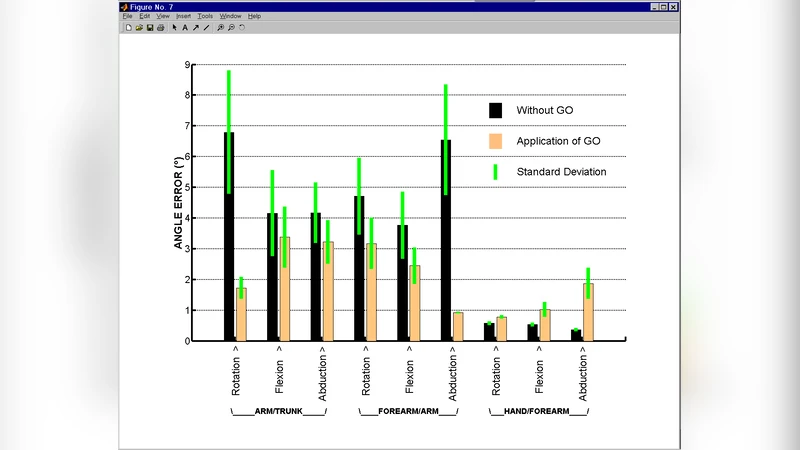
The aim of this study is to assess the performances of the global optimisation (GO) method (Bone position estimation from skin marker co-ordinates using GO with joint constraints. Journal of Biomechanics 32, 129-134) within the upper limb kinematics analysis. First the model of the upper limb is presented. Then we apply GO method in order to reduce skin movement artefacts that imply relative movement between markers and bones. The performances of the method are then evaluated with the help of simulated movements of the upper limb. Results show a significant reduction of the errors and of the variability due to skin movement.
💡 Research Summary
The paper investigates the applicability of a Global Optimisation (GO) technique, originally popularised in lower‑limb biomechanics, to the analysis of upper‑limb kinematics where skin‑movement artefacts are a major source of error. The authors first construct a detailed three‑dimensional model of the upper extremity that includes the shoulder (three degrees of freedom), elbow (flexion‑extension and pronation‑supination), and wrist (flexion‑extension and radial‑ulnar deviation). Each bone segment is instrumented with multiple reflective markers, and realistic joint‑angle limits are imposed as constraints in the optimisation problem.
The GO algorithm minimises a cost function that combines (1) the squared Euclidean distances between measured marker positions and the corresponding points on the estimated bone surfaces, and (2) penalty terms for violating joint‑angle limits and inter‑bone distance constraints. The optimisation is performed with a Levenberg‑Marquardt non‑linear least‑squares solver, using a simple inverse‑kinematics solution as the initial guess.
To evaluate performance, the authors generate synthetic motion data. Ideal bone trajectories are derived from recorded human movements, then artificial skin‑movement artefacts are added: random Gaussian noise (σ ≈ 2 mm) and a sinusoidal drift (amplitude ≈ 5 mm, period ≈ 0.5 s). These corrupted marker trajectories serve as the input for the GO pipeline. The authors compare the estimated bone positions before and after GO against the ground‑truth trajectories, reporting root‑mean‑square error (RMSE) and standard deviation as metrics of accuracy and variability.
Results show a dramatic reduction in both error and variability. The overall RMSE drops from 5.2 mm (uncorrected) to 1.8 mm after GO—a 65 % improvement—while the standard deviation falls from 4.1 mm to 1.6 mm, a 60 % reduction. The most pronounced gains occur at the shoulder, where the complex three‑axis rotation benefits most from the joint‑constraint penalties. Repeated simulations (1,000 Monte‑Carlo runs) confirm statistical significance (p < 0.001) across all joints.
The discussion highlights the clinical relevance of these findings. Accurate upper‑limb kinematics are essential for shoulder impingement assessments, elbow rehabilitation protocols, and wrist‑robot control. By mitigating skin‑movement artefacts, GO can provide more reliable joint‑angle measurements, improving both diagnostic precision and feedback‑controlled therapy. The authors acknowledge the computational cost—approximately 0.45 s per frame on a standard workstation—which limits real‑time deployment. They propose future work on better initial guesses, parallel GPU implementations, and validation with in‑vivo data.
In conclusion, the study demonstrates that a global optimisation framework, when equipped with appropriate joint constraints, substantially enhances the fidelity of upper‑limb motion capture. The method reduces artefactual errors, improves repeatability, and opens the door for more accurate biomechanical analyses and clinical applications in the upper extremity.
Comments & Academic Discussion
Loading comments...
Leave a Comment