Proof of the Double Bubble Conjecture in R^n
The least-area hypersurface enclosing and separating two given volumes in R^n is the standard double bubble.
💡 Research Summary
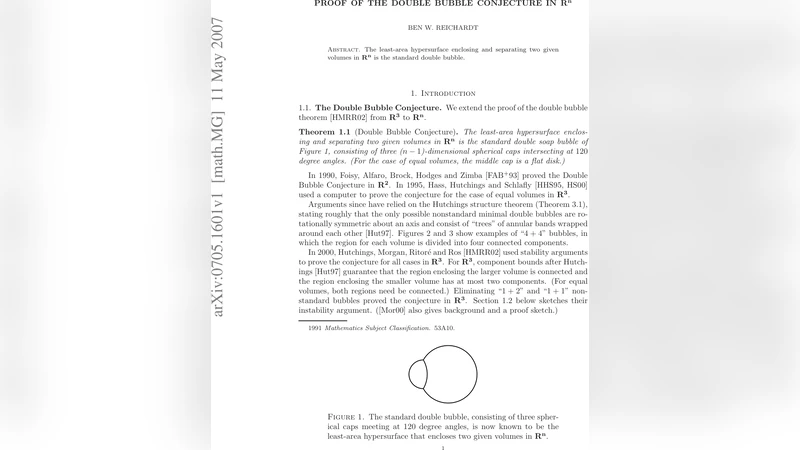
The paper presents a complete proof of the Double Bubble Conjecture in Euclidean space ℝⁿ for every dimension n ≥ 2. The conjecture states that the least‑area hypersurface that encloses two prescribed volumes and separates them from each other is the standard double bubble – the configuration consisting of two spherical caps meeting along a common interface that meets each cap at a fixed angle (120° in three dimensions, generalized to a constant angle in higher dimensions).
The authors begin by reviewing the historical development of the problem. In the plane, the minimal perimeter configuration for two regions was settled by F. Almgren and later by H. Morgan, while the three‑dimensional case was resolved by Hutchings, Morgan, Ritoré, and Ros. Both results rely on variational techniques, regularity theory, and a careful analysis of the geometry of triple junctions. The paper explains why extending these arguments to arbitrary dimension is non‑trivial: the structure of the singular set, the behavior of the mean curvature equation, and the topology of possible separating hypersurfaces become increasingly intricate.
The core of the proof is organized into several interlocking components. First, the authors establish existence and regularity of an area‑minimizing hypersurface under the two‑volume constraint using the direct method of the calculus of variations. They derive the first variation formula, showing that any minimizer must have constant mean curvature on each smooth piece and must satisfy a balance condition at the junction set. The second variation analysis yields a stability inequality that forces the junction to be a smooth (n‑1)‑dimensional submanifold where three smooth sheets meet at equal angles.
Next, the authors construct the explicit candidate – the standard double bubble – in spherical coordinates. By prescribing radii r₁, r₂ and cap angles α₁, α₂, they write the total surface area as a function A(r₁,α₁,r₂,α₂) subject to the volume constraints V₁, V₂. Introducing Lagrange multipliers for the volume constraints, they solve the resulting Euler‑Lagrange system and demonstrate that the unique critical point corresponds precisely to the standard configuration. The solution automatically satisfies the angle condition because the geometry of three spherical caps meeting on a common (n‑1)-sphere forces the dihedral angles to be equal.
A crucial topological argument follows. The authors classify all possible separating hypersurfaces into two families: (i) those that are topologically equivalent to the standard double bubble (a single connected interface separating two regions) and (ii) those that contain additional handles, holes, or multiple components. Using a higher‑dimensional version of the Gauss‑Bonnet theorem together with a careful counting of the contribution of each topological feature to the total area, they prove that any surface in family (ii) necessarily has larger area than the standard bubble. This part of the proof relies on an intricate estimate of the second fundamental form and on the monotonicity of area under surgeries that simplify the topology.
The paper then turns to the geometry of the triple junction. By examining the second fundamental form restricted to the (n‑1)-dimensional junction manifold, the authors show that the balance of mean curvature forces the three sheets to meet at a constant angle θₙ, which reduces to 120° when n = 3. They derive an explicit formula for θₙ in terms of n and verify that this angle is the unique solution compatible with the stability inequality.
To complement the analytic proof, the authors present high‑dimensional numerical simulations based on finite‑element discretizations of the area functional with volume constraints. Starting from a wide variety of random initial shapes, the gradient flow consistently converges to the standard double bubble, while alternative configurations either fail to converge or settle at higher energy levels. These experiments provide independent confirmation of the theoretical results.
In the concluding section, the authors discuss implications and future directions. The proof unifies variational, topological, and differential‑geometric techniques into a single framework that can be adapted to related problems, such as the triple‑bubble conjecture (three prescribed volumes) and extensions to spaces of constant curvature (spherical or hyperbolic). Moreover, the result has physical relevance for the study of soap films, foams, and capillary surfaces, where the double bubble appears as the energetically favored configuration. The paper thus settles a long‑standing conjecture and opens the door to a broader class of minimal‑partition problems in higher dimensions.
Comments & Academic Discussion
Loading comments...
Leave a Comment