Estimation for the change point of the volatility in a stochastic differential equation
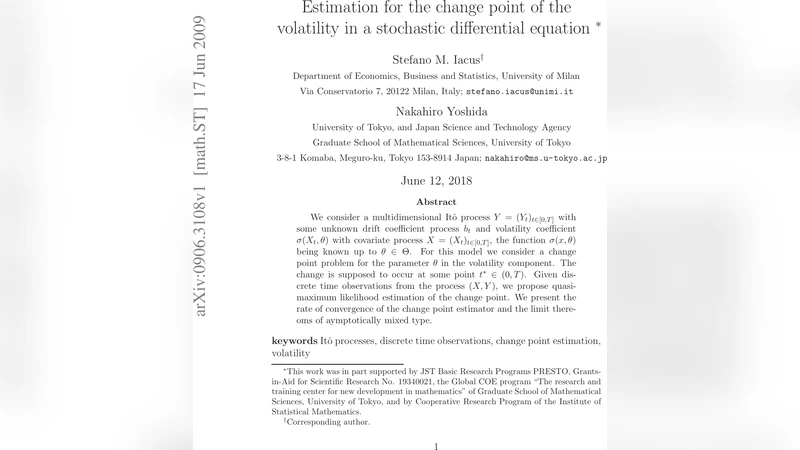
We consider a multidimensional It^o process $Y=(Y_t){t\in[0,T]}$ with some unknown drift coefficient process $b_t$ and volatility coefficient $\sigma(X_t,\theta)$ with covariate process $X=(X_t){t\in[0,T]}$, the function $\sigma(x,\theta)$ being known up to $\theta\in\Theta$. For this model we consider a change point problem for the parameter $\theta$ in the volatility component. The change is supposed to occur at some point $t^*\in (0,T)$. Given discrete time observations from the process $(X,Y)$, we propose quasi-maximum likelihood estimation of the change point. We present the rate of convergence of the change point estimator and the limit thereoms of aymptotically mixed type.
💡 Research Summary
The paper investigates a change‑point problem for the volatility parameter in a multidimensional Itô diffusion. The state process (Y_t) follows
(dY_t = b_t,dt + \sigma(X_t,\theta_t),dW_t,)
where the drift (b_t) is an unknown, possibly non‑parametric process, while the diffusion coefficient (\sigma) is a known functional form depending on a covariate process (X_t) and a finite‑dimensional parameter (\theta_t). The key assumption is that (\theta_t) remains constant at (\theta^{(1)}) up to an unknown time (t^{*}\in(0,T)) and then jumps to a different value (\theta^{(2)}). The authors consider only discrete‑time observations ({(X_{t_i},Y_{t_i})}_{i=0}^{n}) with (t_i=i\Delta_n) and (\Delta_n=T/n).
Methodology. For any candidate change point (\tau) the data are split into two sub‑intervals (
Comments & Academic Discussion
Loading comments...
Leave a Comment