Predicate Transformers, (co)Monads and Resolutions
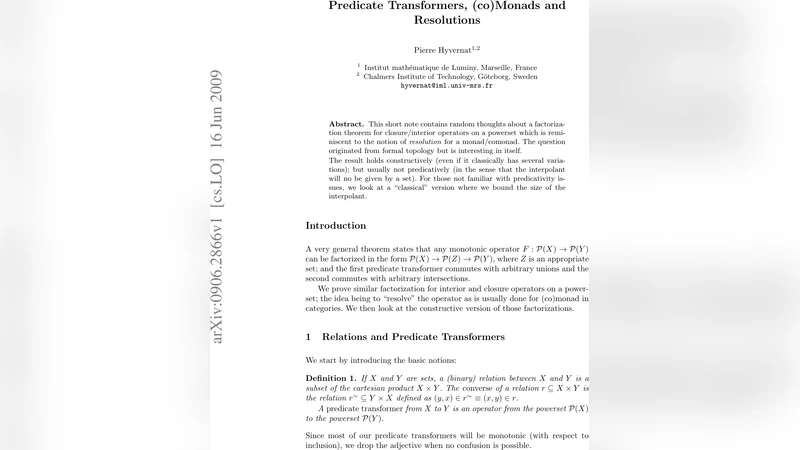
This short note contains random thoughts about a factorization theorem for closure/interior operators on a powerset which is reminiscent to the notion of resolution for a monad/comonad. The question originated from formal topology but is interesting in itself. The result holds constructively (even if it classically has several variations); but usually not predicatively (in the sense that the interpolant will no be given by a set). For those not familiar with predicativity issues, we look at a ``classical’’ version where we bound the size of the interpolant.
💡 Research Summary
The paper investigates a factorisation theorem for closure and interior operators on a powerset, drawing a parallel with the notion of a resolution for monads and comonads. After a brief motivation from formal topology—where such operators encode the “closed” and “open” aspects of a point‑free space—the author formalises the setting: a closure operator c on ℘(X) is monotone, extensive, and idempotent, while an interior operator i is monotone, reductive, and idempotent. The central result states that any closure operator can be expressed as a two‑step transformation: first a “pre‑transfer” given by a family of subsets f(a) indexed by a set A (the interpolant), and then the ordinary closure applied to the union of those subsets that lie inside the input. Dually, any interior operator admits a similar decomposition.
The proof is carried out constructively, i.e. without invoking the law of excluded middle or the axiom of choice. The construction proceeds by defining, for each element x∈X, the collection of all “potential witnesses” that force x into the closure of a given set. This collection yields the interpolant A and the map f, but the resulting A is in general a proper class rather than a set. Consequently, the factorisation is not predicative: it cannot be carried out inside a predicative set theory where only sets may be quantified over.
To address this limitation, the author presents a classical variant. By assuming a sufficiently large cardinal κ (for instance κ≥|X|⁺) and invoking a choice principle, one can bound the size of the interpolant: there exists a set A with |A|≤κ and a map f:A→℘(X) that realises the same factorisation. This yields a fully predicative version at the cost of classical reasoning.
The paper then connects the factorisation to monad/comonad theory. In categorical terms a monad T comes equipped with unit η and multiplication μ; a resolution of a monad is an expression of a given endofunctor as μ∘Tη. The author observes that the closure factorisation mirrors this pattern: the pre‑transfer f plays the role of η (injecting raw data into the monadic context), while the final closure step corresponds to μ (collapsing the monadic structure). Dually, interior operators correspond to comonadic resolutions. The interpolant thus behaves like a “coreflector” or “co‑inducer” mediating between the raw powerset and the algebraic structure imposed by c or i.
The discussion returns to formal topology, noting that the interpolant can be interpreted as a basis of opens that generate the closure. Bounding its size corresponds to choosing a small basis, a familiar technique in point‑free topology. The author also mentions connections to Kock–Zöberlein monads and bi‑monads, suggesting that the present factorisation may provide a concrete example of such enriched structures.
In conclusion, the paper offers a constructive factorisation theorem for closure/interior operators, highlights the predicative obstacle posed by a class‑sized interpolant, and supplies a classical workaround by bounding the interpolant’s cardinality. It situates the result within the broader landscape of monad/comonad resolutions, thereby opening avenues for further research in categorical topology, type‑theoretic semantics, and computational interpretations of closure‑based reasoning.
Comments & Academic Discussion
Loading comments...
Leave a Comment