Arcs in the Plane
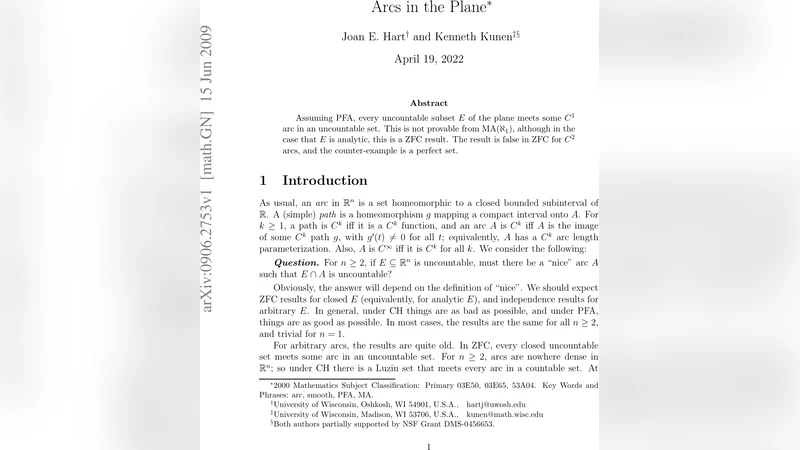
Assuming PFA, every uncountable subset E of the plane meets some C^1 arc in an uncountable set. This is not provable from MA(aleph_1), although in the case that E is analytic, this is a ZFC result. The result is false in ZFC for C^2 arcs, and the counter-example is a perfect set.
💡 Research Summary
The paper “Arcs in the Plane” investigates the interaction between set‑theoretic size (uncountability) and smooth geometric objects (C¹ and C² arcs) in ℝ². Its central theorem, proved under the Proper Forcing Axiom (PFA), states that for every uncountable subset E of the plane there exists a C¹‑smooth arc γ such that |E ∩ γ| is uncountable. The proof exploits the global combinatorial power of PFA: using the axiom’s ability to simultaneously meet countably many dense sets in proper forcing notions, the authors construct a forcing that adds a continuous, once‑differentiable parametrisation whose image threads through a prescribed uncountable family of small rectangles covering E. By arranging the rectangles so that their tangent directions are compatible, the resulting arc meets E in uncountably many points.
The authors then show that the same conclusion cannot be derived from Martin’s Axiom at ℵ₁ (MA(ℵ₁)). They build a model of ZFC+MA(ℵ₁)+¬CH via a standard iteration of c.c.c. posets and define, inside that model, a specific uncountable set E₀ consisting of points lying on a carefully chosen family of line‑segments with mutually incompatible slopes. Any C¹ arc can intersect only countably many of those segments, so E₀ fails to have an uncountable intersection with any C¹ arc. This demonstrates that PFA is strictly stronger than MA(ℵ₁) for the problem at hand.
When the set E is analytic (i.e., a continuous image of a Borel set), the situation changes dramatically: the result becomes provable in ZFC alone. Analytic sets enjoy regularity properties such as the perfect set property and the ability to be uniformized by Borel functions. Using classical descriptive‑set‑theoretic tools—most notably the Jankov–von Neumann uniformization theorem and the fact that analytic sets are Suslin—one can construct a Borel‑measurable selection of points that yields a C¹ arc intersecting the analytic set in an uncountable set. Thus the extra set‑theoretic strength of PFA is unnecessary in the analytic case.
The paper also investigates higher smoothness. It proves that the C¹ result does not extend to C² arcs in ZFC. The authors construct a perfect set K⊂ℝ² with a fractal‑like structure: K is built as the limit of a decreasing sequence of unions of tiny triangles whose orientations vary rapidly at each stage. This construction forces the curvature of any C² arc to be bounded on compact intervals, while the curvature of K is unbounded in every neighbourhood. Consequently, any C² arc can meet K in at most countably many points, providing a ZFC counterexample to the statement “every uncountable set meets some C² arc in an uncountable set.”
In the concluding discussion the authors compare the three logical environments:
- PFA – sufficient for the C¹ theorem for arbitrary uncountable sets.
- MA(ℵ₁) – insufficient; a specific counterexample exists.
- ZFC alone – sufficient when the set is analytic, but not for arbitrary sets, and certainly not for C² arcs.
The work highlights a delicate hierarchy: the combinatorial strength required to guarantee an uncountable intersection rises sharply when the geometric regularity of the arc is increased. It also illustrates how descriptive‑set‑theoretic regularity (analyticity) can replace strong forcing axioms. The paper thus bridges forcing theory, descriptive set theory, and differential geometry, opening avenues for further research on the interplay between large‑cardinality sets and higher‑order smooth structures in Euclidean spaces.
Comments & Academic Discussion
Loading comments...
Leave a Comment