Hybrid Coding for Gaussian Broadcast Channels with Gaussian Sources
This paper considers a degraded Gaussian broadcast channel over which Gaussian sources are to be communicated. When the sources are independent, this paper shows that hybrid coding achieves the optimal distortion region, the same as that of separate source and channel coding. It also shows that uncoded transmission is not optimal for this setting. For correlated sources, the paper shows that a hybrid coding strategy has a better distortion region than separate source-channel coding below a certain signal to noise ratio threshold. Thus, hybrid coding is a good choice for Gaussian broadcast channels with correlated Gaussian sources.
💡 Research Summary
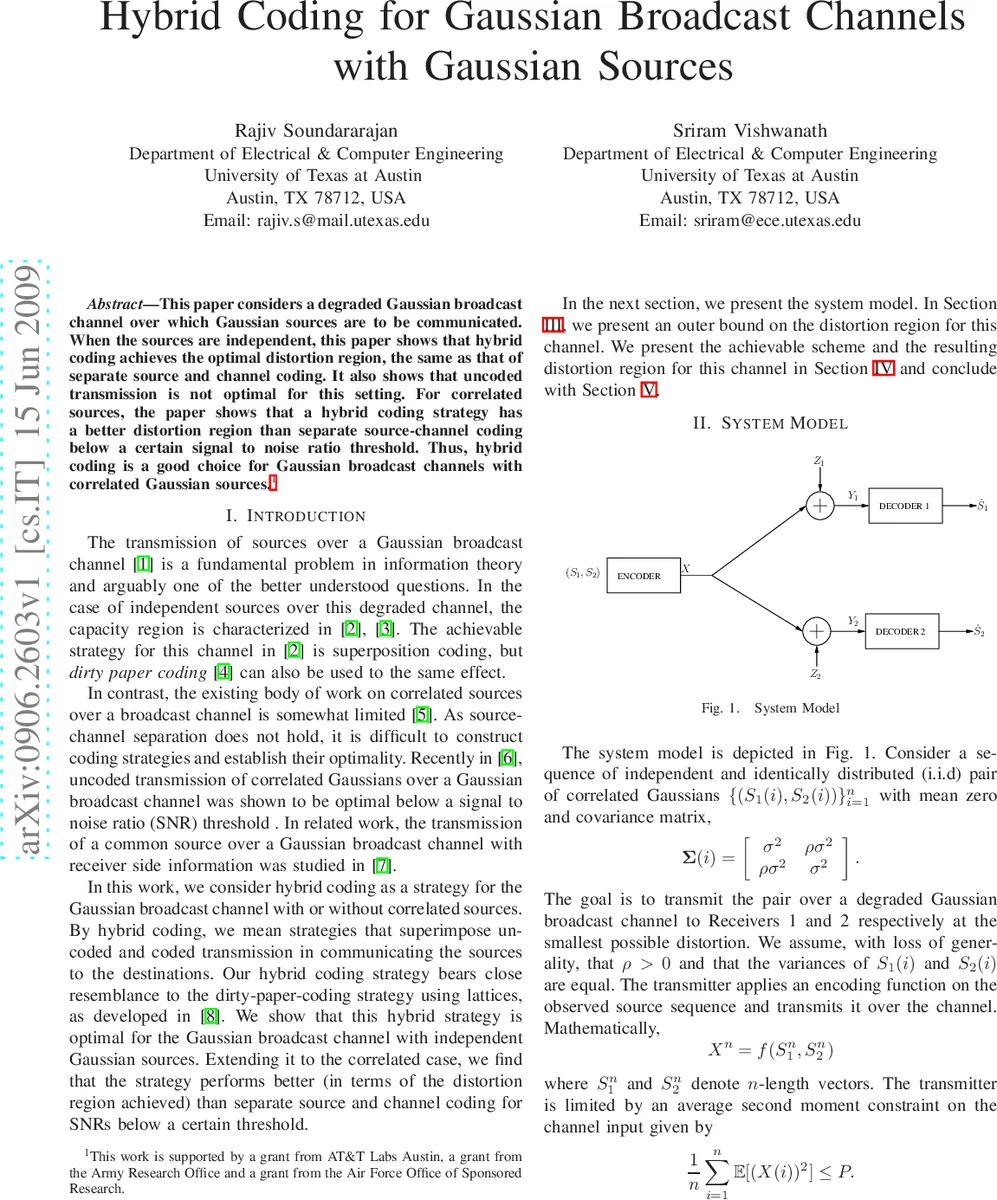
The paper studies the transmission of Gaussian sources over a physically degraded Gaussian broadcast channel. A transmitter with average power constraint P wishes to send a pair of zero‑mean Gaussian sources (S₁,S₂) with variance σ² and correlation coefficient ρ to two receivers. Receiver 1 observes Y₁=X+Z₁ with noise variance N₁, while Receiver 2 observes Y₂=X+Z₂ with N₂>N₁, reflecting the degraded nature of the channel. The performance metric is the pair of mean‑squared errors (D₁,D₂) achieved at the two receivers; the goal is to characterize the achievable distortion region D(σ²,ρ,P,N₁,N₂).
Outer bound. Using the data‑processing inequality and the entropy‑power inequality, the authors derive a converse (Theorem 1) that any achievable (D₁|₂,D₂) must satisfy
D₁|₂ ≥ σ²(1‑ρ²)·(1+αP/N₁),
D₂ ≥ σ²·(1+(1‑α)P/(αP+N₂)),
for some α∈
Comments & Academic Discussion
Loading comments...
Leave a Comment