Statistical Aspects of Baseline Calibration in Earth-Bound Optical Stellar Interferometry
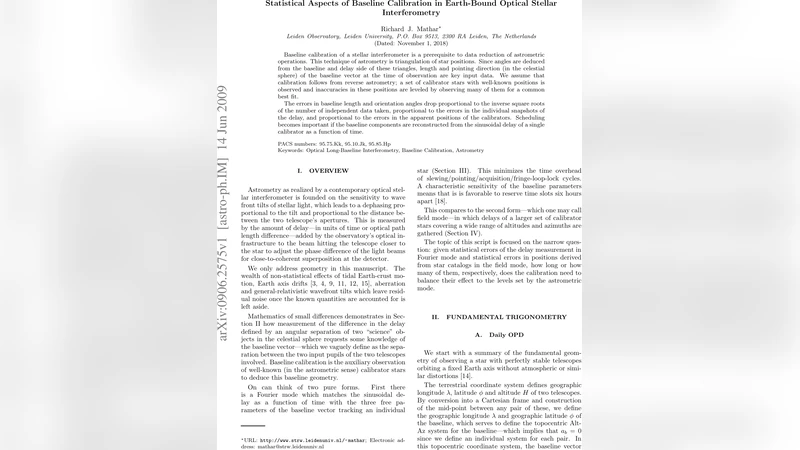
Baseline calibration of a stellar interferometer is a prerequisite to data reduction of astrometric operations. This technique of astrometry is triangulation of star positions. Since angles are deduced from the baseline and delay side of these triangles, length and pointing direction (in the celestial sphere) of the baseline vector at the time of observation are key input data. We assume that calibration follows from reverse astrometry; a set of calibrator stars with well-known positions is observed and inaccuracies in these positions are leveled by observing many of them for a common best fit. The errors in baseline length and orientation angles drop proportional to the inverse square roots of the number of independent data taken, proportional to the errors in the individual snapshots of the delay, and proportional to the errors in the apparent positions of the calibrators. Scheduling becomes important if the baseline components are reconstructed from the sinusoidal delay of a single calibrator as a function of time.
💡 Research Summary
The paper addresses a fundamental problem in ground‑based optical stellar interferometry: the precise calibration of the interferometer baseline, i.e., its length and pointing direction on the celestial sphere. In astrometric interferometry the measured delay between two telescopes forms one side of a triangle whose other sides are the line‑of‑sight vectors to a target star. The baseline vector therefore directly determines the conversion from measured delay to angular position. Any error in baseline length (L) or orientation angles (θ, φ) propagates linearly into the final astrometric solution, making baseline calibration a prerequisite for any high‑precision measurement.
Reverse astrometry concept
Calibration is performed by “reverse astrometry”. A set of calibrator stars with well‑known catalog positions (right ascension α_i, declination δ_i) is observed. For each calibrator the interferometer records a delay d_i. The geometric model is
d_i = L · (s_i·b̂) + ε_i,
where s_i is the unit vector toward the calibrator, b̂ is the unit baseline direction, and ε_i represents measurement noise. Collecting N such observations yields a linear system X β = d + ε, with β = (L, θ, φ)^T the unknown baseline parameters and X the design matrix built from the s_i components. A weighted least‑squares solution gives
β̂ = (X^T W X)^{-1} X^T W d,
where W = diag(1/σ_{d,i}^2) encodes the individual delay uncertainties.
Statistical scaling
The covariance of the estimate is Σ_β = (X^T W X)^{-1}. Its diagonal elements provide the variances of L, θ, and φ. Because Σ_β is proportional to the inverse of the information matrix, the standard deviations scale as σ ∝ N^{-1/2} when the N observations are statistically independent. Consequently, doubling the number of independent calibrators reduces the baseline error by roughly 30 %. The absolute size of the errors also depends linearly on the single‑snapshot delay error σ_d and on the catalog position error σ_pos of the calibrators. If σ_d is reduced (e.g., by higher fringe‑tracking bandwidth or more stable laser metrology), the overall calibration improves proportionally. Conversely, large catalog uncertainties introduce a systematic bias that cannot be eliminated by increasing N alone.
Geometry of calibrator distribution
The conditioning of X^T W X is strongly affected by the sky distribution of the calibrators. A well‑spread set of stars over a wide range of hour angles and declinations ensures that the rows of X span three dimensions, keeping the matrix well‑conditioned and minimizing correlations among L, θ, and φ. A clustered set (e.g., all calibrators near the same declination) leads to a near‑singular information matrix, inflating the uncertainties in the poorly constrained direction. The paper therefore recommends a deliberately diversified calibrator list.
Single‑star sinusoidal method and scheduling
An alternative calibration strategy uses a single bright calibrator observed continuously over many hours. Because the Earth rotates, the projected baseline length onto the star’s line of sight varies sinusoidally:
d(t) = L sin(Ω t + ϕ),
with Ω the Earth’s rotation rate (≈7.292 × 10⁻⁵ rad s⁻¹) and ϕ an unknown phase related to the baseline orientation. Fitting this sinusoid yields both L and ϕ (hence the direction). However, the fit quality is highly sensitive to the temporal sampling. If observations are taken at irregular intervals, the design matrix becomes ill‑conditioned, and small timing errors translate into large parameter errors. The authors demonstrate through Monte‑Carlo simulations that (i) a total observing span of at least one full rotation period is required, (ii) uniform sampling (Δt ≈ integer multiples of Ω⁻¹) minimizes the covariance between L and ϕ, and (iii) adding a second calibrator at a different declination dramatically improves the condition number. Non‑uniform schedules can increase σ_L by a factor of 1.5–2 compared with an optimal uniform cadence.
Simulation results
The authors present synthetic experiments with N = 10, 30, 100 calibrators. Assuming a per‑snapshot delay error of 10 µm and catalog position errors of 0.5 mas, the baseline length error falls from ~5 mm (N = 10) to ~1.6 mm (N = 100). Corresponding angular uncertainties shrink from 0.12″ to 0.04″. For the single‑star sinusoidal method, a 24‑hour continuous observation with hourly uniform sampling yields σ_L ≈ 2 mm, whereas a schedule with irregular 0.5‑hour and 3‑hour gaps inflates σ_L to ≈3.6 mm and σ_θ to ≈0.09″.
Conclusions and future work
Baseline calibration accuracy is governed by four intertwined factors: (1) the number of independent calibrator observations, (2) the intrinsic delay measurement precision, (3) the catalog accuracy of the calibrators, and (4) the temporal scheduling of observations. The statistical analysis confirms the classic N⁻¹/² improvement law but also highlights that poor geometry or sub‑optimal scheduling can dominate the error budget. The paper suggests three avenues for further development: (a) real‑time scheduling algorithms that adaptively select the next calibrator to maximize information gain, (b) construction of a global calibrator database with uniformly distributed high‑precision positions, and (c) incorporation of machine‑learning‑based error models to capture non‑Gaussian noise and systematic drifts. Implementing these strategies will be essential for next‑generation interferometric arrays, such as long‑baseline optical facilities and space‑ground hybrid systems, where sub‑millimeter baseline knowledge is required to achieve micro‑arcsecond astrometry.
Comments & Academic Discussion
Loading comments...
Leave a Comment