Longest Wait First for Broadcast Scheduling
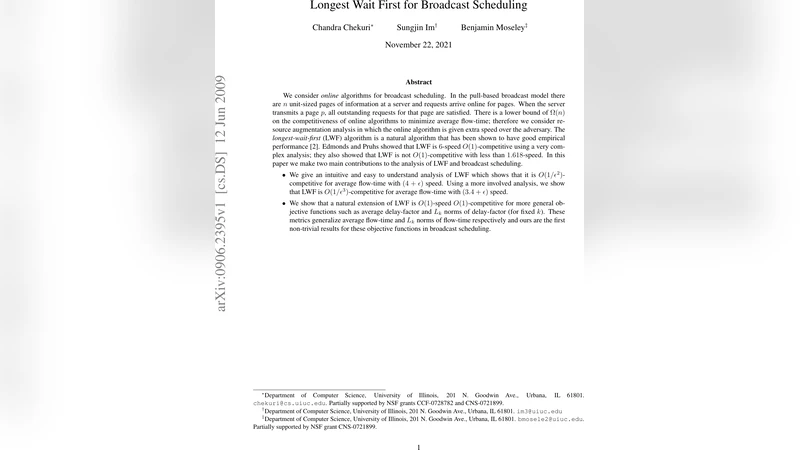
We consider online algorithms for broadcast scheduling. In the pull-based broadcast model there are $n$ unit-sized pages of information at a server and requests arrive online for pages. When the server transmits a page $p$, all outstanding requests for that page are satisfied. The longest-wait-first} (LWF) algorithm is a natural algorithm that has been shown to have good empirical performance. In this paper we make two main contributions to the analysis of LWF and broadcast scheduling. \begin{itemize} \item We give an intuitive and easy to understand analysis of LWF which shows that it is $O(1/\eps^2)$-competitive for average flow-time with $(4+\eps)$ speed. Using a more involved analysis, we show that LWF is $O(1/\eps^3)$-competitive for average flow-time with $(3.4+\epsilon)$ speed. \item We show that a natural extension of LWF is O(1)-speed O(1)-competitive for more general objective functions such as average delay-factor and $L_k$ norms of delay-factor (for fixed $k$). \end{itemize}
💡 Research Summary
The paper studies online broadcast scheduling in the pull‑based model, where a server stores n unit‑size pages and requests for pages arrive over time. When a page is transmitted, all pending requests for that page are satisfied simultaneously. The natural Longest‑Wait‑First (LWF) algorithm, which always transmits the page containing the request that has waited the longest, is known to work well in practice, but its theoretical guarantees have been limited. The authors make two major contributions.
First, they provide a clear, intuitive analysis showing that LWF is O(1/ε²)‑competitive for average flow‑time when the algorithm is allowed to run at (4 + ε) times the speed of the optimal offline scheduler. The analysis partitions the timeline into “active” intervals, during which LWF is serving the oldest request, and “inactive” intervals, where no such request exists. By defining a potential function that captures the total waiting time of outstanding requests, they bound the difference between LWF’s cost and the optimal cost, yielding the O(1/ε²) factor.
Second, they refine the argument with a more sophisticated potential function and a reverse‑propagation technique. This yields a stronger result: with only (3.4 + ε) speed augmentation, LWF becomes O(1/ε³)‑competitive for average flow‑time. The refined algorithm, sometimes called Weighted LWF, selects the page with the largest accumulated waiting time rather than merely the single oldest request. The reverse‑propagation argument tracks how each unit of waiting time can be charged to either LWF or the optimal schedule, leading to the tighter bound.
Beyond average flow‑time, the authors extend LWF to a broader class of objectives, including average delay‑factor and Lₖ norms of the delay‑factor for any fixed k. By augmenting the potential function with appropriate weights and employing Lagrangian multipliers, they prove that the extended algorithm achieves O(1) speed and O(1) competitive ratio for all these metrics. This demonstrates that LWF is not only robust for the classic flow‑time objective but also versatile for more nuanced performance measures that capture user‑perceived latency.
The paper situates its results within the existing literature, noting that prior work either lacked rigorous competitive analysis for LWF or required much higher speed augmentation. By delivering both a simple, accessible proof and a tighter, more technical bound, the authors bridge the gap between empirical observations and theoretical guarantees. They also highlight several avenues for future work: removing the speed‑augmentation assumption, handling multiple servers, and conducting extensive experimental validation on real‑world broadcast systems. Overall, the work establishes LWF and its weighted variant as powerful, theoretically sound tools for online broadcast scheduling across a range of practical performance criteria.