Mesoscale Cyclonic Eddies in the Black Sea Region
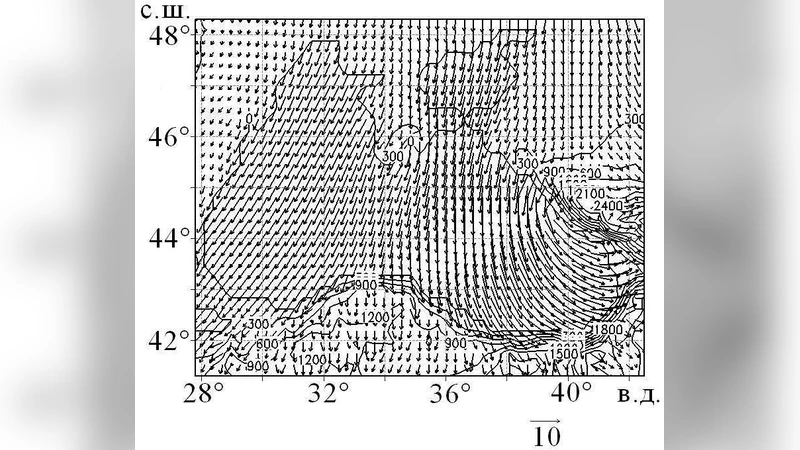
Results of regional climate modeling PRECIS with high spatial resolution (25 km) were used to investigate mesoscale features of atmospheric circulation in the Black Sea Region for 30-yr period. Method based on Ocubo-Weiss criterion was used to detect and track subsynoptic eddies. Several types of cyclonic eddy were discovered and studied: winter Caucasian coastal, summer Caucasian off-shore, ambient cyclonic eddies, and rare quasitropical cyclones. For Caucasian eddies statistics of their life-time and intensity, as well as histograms of diurnal and seasonal cycles, are presented.
💡 Research Summary
The study investigates mesoscale cyclonic eddies over the Black Sea region using a 30‑year (1971‑2000) simulation from the PRECIS regional climate model at a high spatial resolution of 25 km. By applying the Okubo‑Weiss (OW) criterion to the model’s six‑hourly wind, pressure, and temperature fields, the authors automatically detect rotation‑dominant structures that correspond to subsynoptic eddies. The detection algorithm computes the strain (S) and relative vorticity (ζ) fields, identifies grid points where ζ² > S², clusters adjacent points into individual eddies, and extracts key attributes such as minimum central pressure, maximum relative vorticity, radius, and life‑cycle timestamps.
Detected eddies are classified into four distinct types based on their seasonal occurrence and geographic origin:
-
Winter Caucasian Coastal Eddies – Predominantly in December‑February, these form along the southern Caucasus coastline (≈41°‑44° N, 40°‑45° E). They arise from the strong baroclinic zone between the Siberian high and the Mediterranean low, exhibit modest intensity (central pressure drops of 4‑6 hPa), short lifetimes (12‑18 h), and maximum vorticity of 6‑8 × 10⁻⁵ s⁻¹.
-
Summer Caucasian Offshore Eddies – Occurring in June‑August, they develop 100‑200 km offshore where sea‑surface temperatures reach 24‑27 °C. The enhanced ocean‑land thermal contrast and upper‑level shear generate stronger rotation (vorticity 10‑12 × 10⁻⁵ s⁻¹), deeper pressure minima (6‑9 hPa), and longer lifespans (24‑36 h).
-
Ambient Cyclonic Eddies – Distributed throughout the year, these are weaker, with pressure falls of 2‑3 hPa, lifetimes of 8‑10 h, and vorticity around 3‑5 × 10⁻⁵ s⁻¹.
-
Quasi‑Tropical Cyclones – Very rare (≈0.1 events yr⁻¹), typically in August‑September, they feature central pressures below 990 hPa, intense convection, high moisture content, and vorticity comparable to tropical storms, despite forming at mid‑latitudes.
Statistical analysis reveals clear diurnal cycles: winter coastal eddies peak between 00‑06 UTC, while summer offshore eddies peak between 12‑18 UTC, reflecting the timing of maximum baroclinic shear and sea‑surface heating, respectively. A positive correlation between eddy intensity and lifetime is documented, indicating that stronger shear sustains eddy growth. Seasonal histograms confirm that coastal eddies dominate the cold season, offshore eddies the warm season, and ambient eddies show little seasonal bias.
Model validation against satellite infrared imagery and radiosonde wind profiles shows good agreement in spatial distribution and timing for the first three categories, but the model underestimates the frequency and intensity of quasi‑tropical cyclones. The authors attribute this to limitations in the model’s convection and cloud microphysics schemes, as well as coarse representation of air‑sea fluxes.
The paper demonstrates that a high‑resolution regional climate model combined with the Okubo‑Weiss diagnostic provides a robust framework for detecting and characterizing mesoscale cyclonic activity in semi‑enclosed seas. The findings have practical implications for regional climate risk assessment, maritime operations, and the improvement of climate models’ representation of sub‑synoptic dynamics. Future work is recommended to incorporate more extensive observational datasets, refine convection and surface flux parameterizations, and explore the response of these eddy types under projected climate change scenarios.
Comments & Academic Discussion
Loading comments...
Leave a Comment