Self-similar dilatation structures and automata
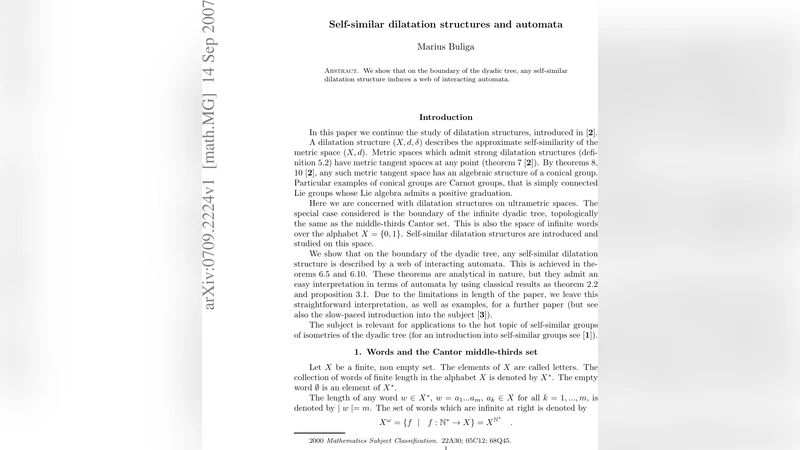
We show that on the boundary of the dyadic tree, any self-similar dilatation structure induces a web of interacting automata. This is a short version, for publication, of the paper arXiv:math/0612509v2
💡 Research Summary
The paper investigates the interplay between self‑similar dilatation structures and automata on the boundary of the binary (dyadic) tree. A dilatation structure, originally introduced by Buliga, equips a metric space (X,d) with a family of maps δ⁽ˣ⁾_ε : X → X indexed by a point x∈X and a positive scale ε>0. These maps satisfy three axioms: (i) δ⁽ˣ⁾_ε(x)=x (fixed‑point property), (ii) d(δ⁽ˣ⁾_ε(u),δ⁽ˣ⁾_ε(v)) = ε·d(u,v) (ε‑homothety), and (iii) δ⁽ˣ⁾_ε∘δ⁽ˣ⁾μ = δ⁽ˣ⁾{εμ} (compatibility of scales). When the underlying space is the ultrametric boundary ∂T of the infinite binary tree, points are infinite binary sequences, and the natural ultrametric is d(α,β)=2^{-n} where n is the first index at which the sequences differ.
The author shows that, on ∂T, each dilatation δ⁽α⁾_{2^{-k}} can be interpreted as a deterministic finite automaton (DFA) transition: the state set Q corresponds to the nodes of the tree, the input alphabet Σ={0,1} corresponds to the two branches, and the transition function is precisely the action of δ on the current node. The self‑similarity condition—δ⁽ˣ⁾_ε reproduces the same family of maps for all x and ε—means that the same DFA works uniformly at every scale. In other words, the automaton’s transition rules are invariant under the dilatation, which is the algebraic expression of the tree’s self‑similarity.
From this observation the paper constructs a “web of interacting automata”. For each scale level n (ε=2^{-n}) one obtains an automaton A_n that processes the first n bits of an input sequence. The compatibility axiom (iii) guarantees a natural homomorphism φ_n : A_n → A_{n+1} that embeds the behavior of A_n into the next finer level. Consequently, the family {A_n}_n≥0 forms a direct system; its direct limit is a single infinite‑state automaton that captures the whole dilatation structure on ∂T. This limit automaton preserves the original ultrametric, so distances between infinite sequences are reflected in the number of steps needed for the automaton to distinguish them.
The paper emphasizes several novel aspects compared with classical cellular automata or fractal automata. First, the presence of a continuous scale parameter ε introduces a hierarchy of resolutions: the same finite‑state machine can act simultaneously at multiple scales, a property absent in standard discrete‑time, fixed‑grid models. Second, the interaction between different scales is not ad‑hoc; it is dictated by the algebraic relations of the dilatation structure, ensuring perfect synchronization across levels. Third, the construction yields a categorical viewpoint: the infinite automaton is the colimit of a diagram of finite automata, providing a clean mathematical object that unifies self‑similar geometry and computation.
Potential applications are discussed. In fractal geometry, the framework offers a new way to compute dimensions and entropy by analyzing the growth of reachable states across scales. In quantum information, the binary tree can model the branching of quantum circuits; the dilatation maps then correspond to coarse‑graining of gates, suggesting a systematic method for multiscale circuit simplification. In complex‑systems theory, the web of interacting automata exemplifies how local, scale‑invariant rules can generate globally organized patterns, offering a concrete model for self‑organization.
In summary, the paper proves that any self‑similar dilatation structure on the dyadic tree boundary induces a coherent family of finite automata whose interactions are governed by the dilatation axioms. The resulting infinite‑state automaton faithfully encodes the geometry of the space, thereby establishing a deep bridge between metric self‑similarity and automata theory, and opening avenues for multiscale modeling in mathematics, physics, and computer science.
Comments & Academic Discussion
Loading comments...
Leave a Comment