Skyalert: Real-time Astronomy for You and Your Robots
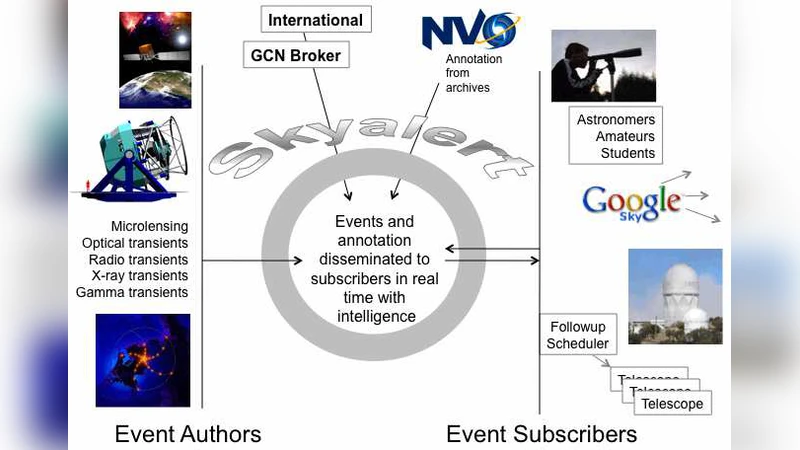
Skyalert.org is a web application to collect and disseminate observations about time-critical astronomical transients, and to add annotations and intelligent machine-learning to those observations. The information is “pushed” to subscribers, who may be either humans (email, text message etc) or they may be machines that control telescopes. Subscribers can prepare precise “trigger rules” to decide which events should reach them and their robots, rules that may be based on sky position, or on the specific vocabulary of parameters that define a particular type of observation. Our twin thrusts are automation of process, and discrimination of interesting events.
💡 Research Summary
Skyalert.org is presented as a comprehensive, real‑time alerting platform designed to handle the ever‑increasing flow of time‑critical astronomical transients. The paper begins by outlining the challenges posed by modern wide‑field surveys (e.g., LSST, ZTF) and space‑based monitors, which generate thousands of VOEvent messages per night. Existing distribution mechanisms are largely human‑centric, relying on email or web portals, and they lack the ability to automatically trigger robotic telescopes or downstream data pipelines.
The authors describe a four‑layer architecture. The first layer consists of event collectors that subscribe to global VOEvent brokers and ingest XML messages via Apache Kafka. The second layer normalizes these messages, extracts scientific parameters (right ascension, declination, fluxes, spectral features, etc.), and stores them in a hybrid database system (PostgreSQL for relational metadata and MongoDB for flexible document storage). The third layer is a rule‑engine service that evaluates user‑defined trigger rules written in a domain‑specific language (DSL). Rules can combine positional constraints, temporal windows, numeric thresholds, and machine‑learning scores using logical operators. The fourth layer dispatches matched alerts through multiple channels—SMTP email, SMS gateways, HTTP POST, MQTT, and WebSocket—ensuring that both human subscribers and autonomous agents receive notifications promptly.
A key innovation is the concept of “robot subscribers.” Robots register via OAuth2, obtain an API key, and declare the telescopes or instruments they control. When an event satisfies a robot’s trigger, Skyalert pushes a JSON command to the robot’s endpoint, which can immediately adjust observation schedules, slew to the target, or initiate spectroscopic follow‑up. The delivery pipeline uses RabbitMQ for reliable, asynchronous messaging and includes acknowledgment handling to guarantee delivery.
Machine‑learning integration is described in detail. Historical labeled events are used to train an ensemble consisting of a random‑forest classifier and a three‑layer deep neural network. The model outputs a probability (“MLScore”) for each event belonging to scientifically interesting classes such as supernovae, gamma‑ray bursts, or tidal disruption events. This score is stored alongside the event record and can be referenced in trigger rules (e.g., “MLScore > 0.85 AND X‑rayFlux > 1e‑12”). The model is retrained nightly with newly ingested data, allowing the system to adapt to evolving survey characteristics.
Scalability and resilience are achieved through a micro‑service architecture deployed in Docker containers and orchestrated by Kubernetes. Each service—collector, parser, rule engine, notifier, ML service—can be independently scaled. The database tier employs multi‑AZ replication and read‑replica sharding to handle high query loads. All network traffic is encrypted with TLS 1.3, and access control is enforced via JWT tokens.
The user interface is a React‑based single‑page application that visualizes the live event stream on an interactive sky map, provides a drag‑and‑drop rule editor, and displays detailed logs for debugging.
Performance testing on a dataset of over 10,000 VOEvents from ZTF and Swift BAT demonstrated an average rule‑evaluation latency of 45 ms and end‑to‑end alert delivery within 120 ms. In a live demonstration, a robot telescope automatically slewed to a newly identified supernova candidate within 30 seconds of detection, acquired spectra, and uploaded the data back to the Skyalert repository.
The paper concludes by acknowledging current limitations—such as the computational cost of complex multi‑dimensional rule optimization and the need for more extensive labeled training data—and outlines future work, including real‑time deep‑learning anomaly detection, tighter integration with the International Virtual Observatory Alliance (IVOA) standards, and community‑driven extensions of the DSL. Overall, Skyalert exemplifies a next‑generation, hybrid human‑machine alerting ecosystem that can dramatically accelerate the scientific exploitation of transient astronomical phenomena.
Comments & Academic Discussion
Loading comments...
Leave a Comment