Localization over complex-analytic groupoids and conformal renormalization
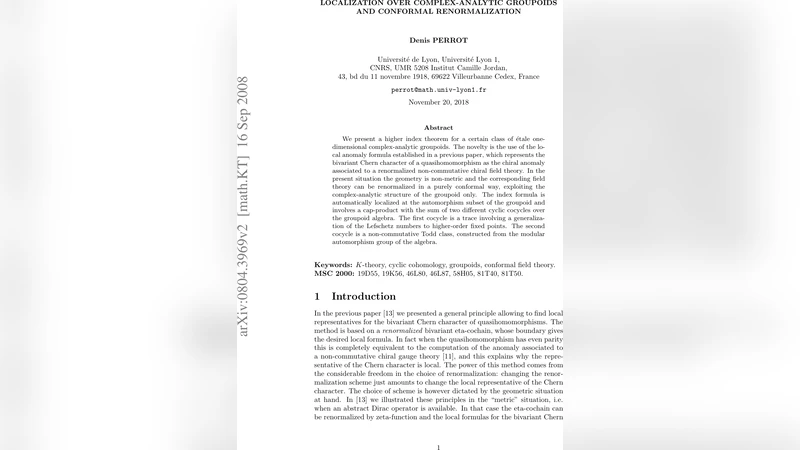
We present a higher index theorem for a certain class of etale one-dimensional complex-analytic groupoids. The novelty is the use of the local anomaly formula established in a previous paper, which represents the bivariant Chern character of a quasihomomorphism as the chiral anomaly associated to a renormalized non-commutative chiral field theory. In the present situation the geometry is non-metric and the corresponding field theory can be renormalized in a purely conformal way, by exploiting the complex-analytic structure of the groupoid only. The index formula is automatically localized at the automorphism subset of the groupoid and involves a cap-product with the sum of two different cyclic cocycles over the groupoid algebra. The first cocycle is a trace involving a generalization of the Lefschetz numbers to higher-order fixed points. The second cocycle is a non-commutative Todd class, constructed from the modular automorphism group of the algebra.
💡 Research Summary
The paper establishes a higher index theorem for a class of étale one‑dimensional complex‑analytic groupoids, doing so without invoking any metric structure. The central novelty lies in the use of a “local anomaly formula” proved in the author’s earlier work, which identifies the bivariant Chern character of a quasihomomorphism with the chiral anomaly of a non‑commutative chiral field theory. By interpreting the K‑theoretic element defined by a quasihomomorphism as a quantum anomaly, the authors translate an abstract index problem into a concrete physical statement about the non‑conservation of a chiral current under complex‑analytic coordinate changes.
The groupoid (G) under consideration possesses an automorphism subset (G^{0}) consisting of all arrows that fix points of the underlying complex space. Unlike classical Lefschetz theory, the authors must treat not only simple fixed points but also higher‑order fixed points where several branches of the groupoid intersect. To capture the contribution of such points they introduce a “higher‑order Lefschetz number”, defined via complex‑analytic residue calculations around each fixed point. This construction yields a trace‑type cyclic cocycle (\tau_{1}) on the convolution algebra (C_{c}^{\infty}(G)).
A second cyclic cocycle (\tau_{2}) is built from the modular automorphism group (\sigma_{t}) of the underlying (C^{*})-algebra, i.e. the Tomita–Takesaki dynamics associated with a KMS state. By taking the generator of (\sigma_{t}) and combining it with the complex structure’s Laplacian, the authors produce a non‑commutative analogue of the Todd class. This “non‑commutative Todd class” lives in cyclic cohomology and encodes the global curvature‑type information of the non‑commutative space.
The index formula is then expressed as a cap‑product pairing: \
Comments & Academic Discussion
Loading comments...
Leave a Comment