Generalization of a going-down theorem in the category of Chow-Grothendieck motives due to N. Karpenko
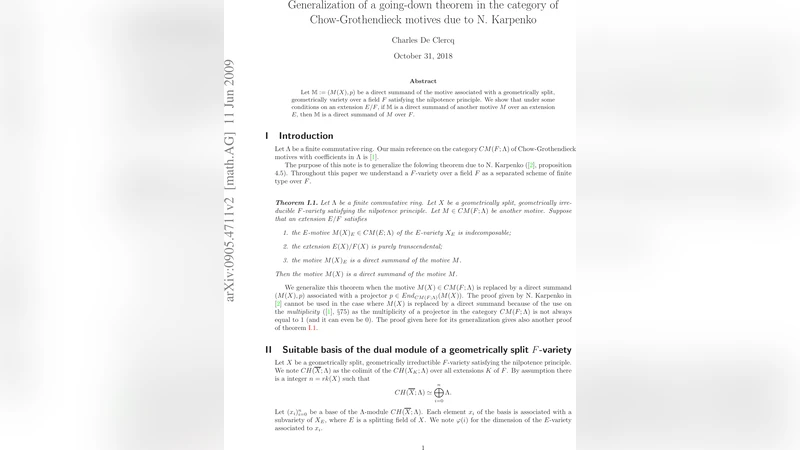
Let $\mathbb{M}:=(M(X),p)$ be a direct summand of the motive associated with a geometrically split, geometrically variety over a field $F$ satisfying the nilpotence principle. We show that under some conditions on an extension $E/F$, if $\mathbb{M}$ is a direct summand of another motive $M$ over an extension $E$, then $\mathbb{M}$ is a direct summand of $M$ over $F$.
💡 Research Summary
The paper extends N. Karpenko’s “going‑down” theorem from the setting of Chow groups to the full category of Chow–Grothendieck motives. The authors consider a smooth projective variety X over a base field F that is geometrically split and satisfies the nilpotence principle. For such an X the motive M(X) admits a decomposition into indecomposable summands, and any idempotent p in the endomorphism ring of M(X) defines a direct summand 𝔐 = (M(X), p).
The main question addressed is: if a field extension E/F has certain special properties and the summand 𝔐 appears as a direct summand of another motive M over E, does 𝔐 already occur as a direct summand of M over the ground field F? Karpenko’s original result answered this affirmatively for primitive summands under rather restrictive hypotheses. Here the authors prove a far more general statement: for any direct summand 𝔐 of M(X), provided that (i) X is geometrically split, (ii) M(X) satisfies the nilpotence principle, and (iii) E/F is either a purely transcendental extension or a p‑primary finite extension, the existence of 𝔐 as a summand of M over E forces its existence over F.
The proof proceeds in three stages. First, using the assumption that 𝔐 is a summand of M over E, the authors construct morphisms f : M → M(X) and g : M(X) → M defined over E such that the composition g ∘ f is homotopic to the idempotent p. Second, they invoke Rost’s nilpotence theorem: because M(X) satisfies the nilpotence principle, a sufficiently high power of g ∘ f becomes zero, which forces g ∘ f itself to be an idempotent lifting p. This step shows that the idempotent p can be defined already over F. Third, the special nature of the extension E/F ensures that Chow groups behave well under base change: for purely transcendental extensions the pull‑back is an isomorphism, while for p‑primary extensions the transfer maps are injective on the relevant components. Consequently the morphisms f and g descend to F, establishing that 𝔐 is a direct summand of M over F.
Key technical tools include the Krull–Schmidt theorem for motives (guaranteeing uniqueness of indecomposable summands), the Rost nilpotence principle, and a careful analysis of the behavior of Chow groups under the two types of field extensions. The authors also discuss how the result interacts with the theory of splitting patterns for projective homogeneous varieties, showing that the “going‑down” phenomenon is stable under passage to motives.
Applications are presented for Severi–Brauer varieties, Pfister quadrics, and more generally for projective homogeneous varieties under semisimple algebraic groups. In each case the motive of the variety satisfies the required hypotheses, and the theorem yields concrete descent statements: if a motive becomes a direct summand after extending scalars to a splitting field, it was already present over the original field.
In conclusion, the paper provides a robust descent criterion for direct summands of motives, substantially broadening the scope of Karpenko’s original theorem. It opens the way for further investigations into descent for motives over arbitrary finite extensions, as well as potential connections with derived categories of motives and motivic decompositions in the broader context of algebraic cycles.
Comments & Academic Discussion
Loading comments...
Leave a Comment