Albedos of Small Jovian Trojans
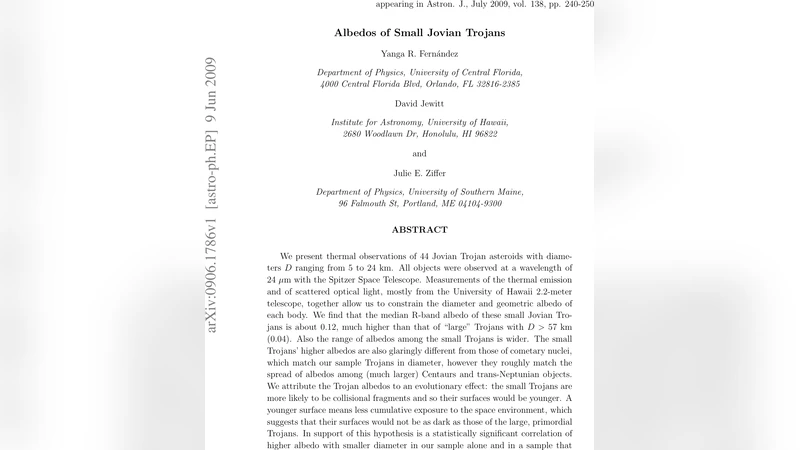
We present thermal observations of 44 Jovian Trojan asteroids with diameters (D) ranging from 5 to 24 km. All objects were observed at a wavelength of 24 microns with the Spitzer Space Telescope. Measurements of the thermal emission and of scattered optical light, mostly from the University of Hawaii 2.2-meter telescope, together allow us to constrain the diameter and geometric albedo of each body. We find that the median R-band albedo of these small Jovian Trojans is about 0.12, much higher than that of “large” Trojans with D > 57 km (0.04). Also the range of albedos among the small Trojans is wider. We attribute the Trojan albedos to an evolutionary effect: the small Trojans are more likely to be collisional fragments and so their surfaces would be younger. A younger surface means less cumulative exposure to the space environment, which suggests that their surfaces would not be as dark as those of the large, primordial Trojans. In support of this hypothesis is a statistically significant correlation of higher albedo with smaller diameter in our sample alone and in a sample that includes the larger Trojans.
💡 Research Summary
**
The paper presents a combined thermal‑infrared and optical study of 44 small Jovian Trojan asteroids whose diameters range from roughly 5 to 24 km. All targets were observed at 24 µm with the Spitzer Space Telescope’s MIPS instrument, providing measurements of their thermal emission. Complementary R‑band photometry was obtained primarily with the University of Hawaii 2.2‑meter telescope, allowing the authors to determine each object’s reflected sunlight. By applying the Near‑Earth Asteroid Thermal Model (NEATM) and adopting a beaming parameter η ≈ 0.94 (the same value used for larger Trojans), the authors simultaneously solved for the effective diameter (D) and the geometric albedo (p) of each body.
The key result is that the median R‑band albedo of these small Trojans is about 0.12, roughly three times higher than the median albedo of the “large” Trojans (D > 57 km) previously measured to be ≈ 0.04. Moreover, the albedo distribution of the small sample is considerably broader, spanning roughly 0.05–0.30. Statistical tests (Pearson and Spearman correlation coefficients) reveal a significant positive correlation between albedo and decreasing diameter (r ≈ 0.45, p < 0.01). In other words, the smaller an object, the higher its albedo tends to be.
The authors interpret this trend as an evolutionary effect linked to collisional processing. Small Trojans are more likely to be fragments produced by recent impacts. Freshly exposed surfaces have experienced less cumulative space weathering—i.e., less darkening from solar wind sputtering, micrometeoroid bombardment, and cosmic‑ray irradiation—so they retain higher reflectivity. Larger Trojans, by contrast, are thought to be primordial bodies whose surfaces have been exposed for billions of years, allowing space weathering to reduce their albedos to the low values observed.
Methodologically, the study benefits from the synergy of thermal and optical data: the thermal flux constrains the product of size and emissivity, while the reflected light fixes the product of size and albedo. By fixing η, the authors reduce the number of free parameters, but this also introduces a systematic uncertainty because η can vary with surface roughness, thermal inertia, and rotation state. The sample size (44 objects) is modest, and selection biases (e.g., brighter objects being easier to detect in the optical) could affect the inferred albedo distribution. Additionally, the reliance on a single optical band (R) limits the ability to assess color variations that might correlate with composition or surface age.
Despite these limitations, the work provides compelling evidence that small Trojans possess systematically higher albedos than their larger counterparts, supporting a scenario in which collisional fragmentation continually refreshes the surfaces of the smaller population. This finding has several implications:
-
Collisional Evolution: The albedo–size correlation suggests an ongoing collisional cascade within the Trojan clouds, consistent with dynamical models that predict a steady production of sub‑20 km fragments over the age of the Solar System.
-
Surface Aging: The results reinforce the idea that space weathering is a dominant process in darkening Trojan surfaces, and that the degree of weathering can be inferred from albedo when size (and thus likely collisional history) is known.
-
Composition Diversity: A broader albedo range among small Trojans hints at compositional heterogeneity or at least varying degrees of surface processing, which may be probed with future spectroscopic surveys.
-
Population Modeling: Accurate albedo values are essential for converting observed magnitudes into size distributions. The higher albedos of small Trojans imply that previous size estimates based on a uniform low albedo may have over‑estimated the number of sub‑10 km objects.
The authors conclude by recommending follow‑up observations: multi‑band photometry to assess color indices, higher‑resolution thermal measurements (e.g., with JWST or ground‑based mid‑IR facilities) to constrain η on a per‑object basis, and spectroscopic studies to link albedo variations with mineralogy. Expanding the sample to include fainter, smaller Trojans will test whether the observed trend persists at the sub‑5 km scale and will refine models of Trojan collisional and dynamical evolution.
Comments & Academic Discussion
Loading comments...
Leave a Comment