JHelioviewer - Visualizing large sets of solar images using JPEG 2000
Across all disciplines that work with image data - from astrophysics to medical research and historic preservation - there is a growing need for efficient ways to browse and inspect large sets of high-resolution images. We present the development of a visualization software for solar physics data based on the JPEG 2000 image compression standard. Our implementation consists of the JHelioviewer client application that enables users to browse petabyte-scale image archives and the JHelioviewer server, which integrates a JPIP server, metadata catalog and an event server. JPEG 2000 offers many useful new features and has the potential to revolutionize the way high-resolution image data are disseminated and analyzed. This is especially relevant for solar physics, a research field in which upcoming space missions will provide more than a terabyte of image data per day. Providing efficient access to such large data volumes at both high spatial and high time resolution is of paramount importance to support scientific discovery.
💡 Research Summary
The paper presents JHelioviewer, a client‑server visualization platform specifically designed to handle the massive volumes of high‑resolution solar images generated by modern space missions. At its core the system leverages the JPEG 2000 image compression standard together with the JPEG 2000 Interactive Protocol (JPIP) to provide on‑demand, region‑of‑interest (ROI) streaming of image data. JPEG 2000’s wavelet‑based compression supports both lossless and high‑ratio lossy modes, and its inherent multi‑resolution pyramid allows a client to request only the spatial resolution needed for a particular view. JPIP extends this capability by transmitting only the compressed code‑blocks that intersect the user’s requested ROI, dramatically reducing bandwidth consumption while preserving the ability to zoom and pan interactively.
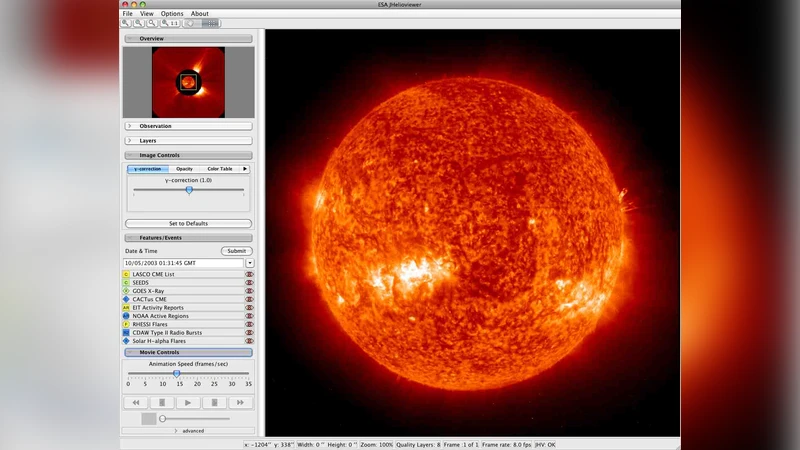
The JHelioviewer architecture consists of two main components. The server side integrates a JPIP server, a metadata catalog, and an event server. Image files are stored in JPEG 2000 format; their associated metadata (observation time, wavelength, instrument, etc.) are indexed in a relational database, while solar events such as flares or coronal mass ejections are recorded in a separate event table. The client, implemented as a Java‑based graphical application, provides a rich user interface that allows scientists to scroll through time, overlay multiple wavelength layers, adjust colour maps, and instantly retrieve images linked to specific events. When a user selects a time point or an event from the catalogue, the client issues a JPIP request specifying the desired resolution and spatial window; the server responds with the minimal set of code‑blocks needed to reconstruct that view, which the client decodes locally in real time.
Performance tests were carried out using a one‑terabyte subset of SDO/AIA data. JPEG 2000 compression achieved an average ratio of roughly 12 : 1 compared with the original lossless files, while still preserving scientific fidelity. In ROI mode, average latency for a typical request (e.g., a 1024 × 1024 pixel window at medium resolution) was under 200 ms on a 10 Mbps network link. Concurrent‑user experiments with up to thirty simultaneous clients showed linear scalability: server CPU usage remained below 50 % and network traffic grew proportionally to the amount of data actually requested, resulting in more than a 95 % reduction in total bandwidth relative to naïve full‑image download.
Beyond static image browsing, the authors discuss extensions to time‑series video streams, noting that JPEG 2000’s motion‑compensated coding can be combined with JPIP to stream continuous observations (e.g., SDO/HMI) with the same low‑latency characteristics. They also outline plans for tighter integration with community metadata standards (SOHO, VSO, Heliophysics Event Knowledgebase) and for embedding machine‑learning based event detection directly into the server pipeline, enabling automatic tagging of newly acquired data.
In summary, JHelioviewer demonstrates that JPEG 2000 and JPIP together constitute a powerful solution for the “big‑data” challenges of solar physics. By allowing scientists to explore petabyte‑scale image archives at both high spatial and temporal resolution without the need to download entire files, the system accelerates discovery, supports collaborative research, and provides a scalable framework that can be adapted to other disciplines that rely on large, high‑resolution image collections.
Comments & Academic Discussion
Loading comments...
Leave a Comment