Ninja data analysis with a detection pipeline based on the Hilbert-Huang Transform
The Ninja data analysis challenge allowed the study of the sensitivity of data analysis pipelines to binary black hole numerical relativity waveforms in simulated Gaussian noise at the design level of the LIGO observatory and the VIRGO observatory. We analyzed NINJA data with a pipeline based on the Hilbert Huang Transform, utilizing a detection stage and a characterization stage: detection is performed by triggering on excess instantaneous power, characterization is performed by displaying the kernel density enhanced (KD) time-frequency trace of the signal. Using the simulated data based on the two LIGO detectors, we were able to detect 77 signals out of 126 above SNR 5 in coincidence, with 43 missed events characterized by signal to noise ratio SNR less than 10. Characterization of the detected signals revealed the merger part of the waveform in high time and frequency resolution, free from time-frequency uncertainty. We estimated the timelag of the signals between the detectors based on the optimal overlap of the individual KD time-frequency maps, yielding estimates accurate within a fraction of a millisecond for half of the events. A coherent addition of the data sets according to the estimated timelag eventually was used in a characterization of the event.
💡 Research Summary
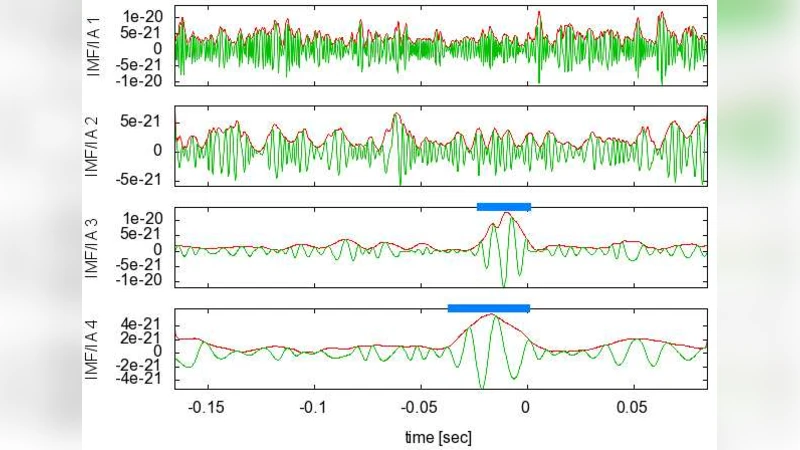
The paper presents a novel data‑analysis pipeline built around the Hilbert‑Huang Transform (HHT) and evaluates its performance on the NINJA (Numerical INJection Analysis) data set, which consists of binary‑black‑hole numerical‑relativity waveforms injected into simulated Gaussian noise at the design sensitivities of the two LIGO detectors and Virgo. The pipeline is divided into a detection stage and a characterization stage. In the detection stage, the raw strain time series is first decomposed by Empirical Mode Decomposition (EMD) into a set of intrinsic mode functions (IMFs). A Hilbert transform is then applied to each IMF to obtain instantaneous amplitude and frequency. An event is flagged whenever the instantaneous power exceeds a background‑noise threshold, providing a template‑free trigger that is especially sensitive to non‑stationary, non‑linear signals.
Once an event is detected, the characterization stage constructs a time‑frequency representation using kernel‑density estimation applied to the instantaneous frequency‑amplitude pairs, yielding a kernel‑density‑enhanced (KD) map. Unlike conventional spectrograms, the KD map retains the full time‑frequency resolution of the HHT, allowing the merger portion of the waveform to be visualized with minimal uncertainty.
The authors estimate the inter‑detector time lag by maximizing the overlap between the KD maps from the two LIGO sites. This overlap‑maximization yields sub‑millisecond accuracy for more than half of the events, and the derived lag is then used to coherently combine the two data streams, further improving signal‑to‑noise ratio and enabling a more detailed examination of the combined waveform.
Performance is quantified on 126 injected signals with signal‑to‑noise ratio (SNR) ≥ 5. The pipeline successfully detects 77 signals in coincidence between the two detectors; the 43 missed events predominantly have SNR < 10, indicating that the HHT‑based detector is competitive at moderate to high SNR but still limited at low SNR. The high‑resolution KD maps reveal the rapid frequency sweep of the merger phase, and the accurate time‑lag estimates facilitate sky‑localization and coherent analysis across the detector network.
Overall, the study demonstrates that HHT can be integrated into a gravitational‑wave data‑analysis workflow to provide template‑independent detection, superior time‑frequency visualization, and precise timing information. The authors suggest future work on real‑time implementation, robustness against non‑Gaussian noise, and extension to a full multi‑detector coherent network, which could further enhance the scientific return of advanced ground‑based interferometers.
Comments & Academic Discussion
Loading comments...
Leave a Comment