Science with the Virtual Observatory: the AstroGrid VO Desktop
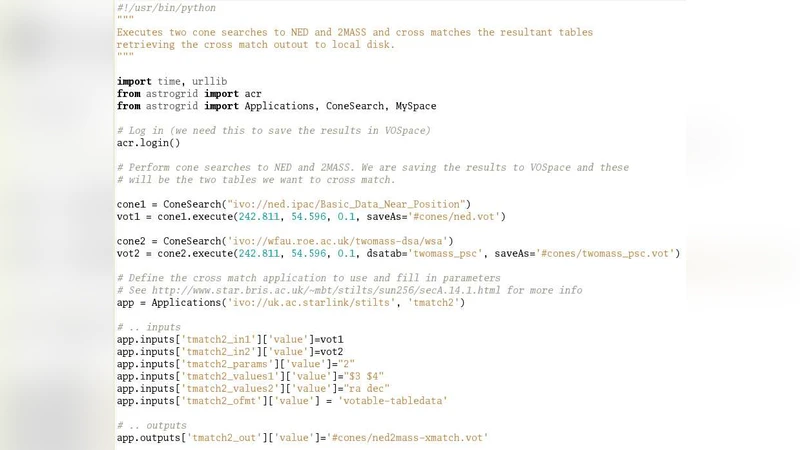
We introduce a general range of science drivers for using the Virtual Observatory (VO) and identify some common aspects to these as well as the advantages of VO data access. We then illustrate the use of existing VO tools to tackle multi wavelength science problems. We demonstrate the ease of multi mission data access using the VOExplorer resource browser, as provided by AstroGrid (http://www.astrogrid.org) and show how to pass the various results into any VO enabled tool such as TopCat for catalogue correlation. VOExplorer offers a powerful data-centric visualisation for browsing and filtering the entire VO registry using an iTunes type interface. This allows the user to bookmark their own personalised lists of resources and to run tasks on the selected resources as desired. We introduce an example of how more advanced querying can be performed to access existing X-ray cluster of galaxies catalogues and then select extended only X-ray sources as candidate clusters of galaxies in the 2XMMi catalogue. Finally we introduce scripted access to VO resources using python with AstroGrid and demonstrate how the user can pass on the results of such a search and correlate with e.g. optical datasets such as Sloan. Hence we illustrate the power of enabling large scale data mining of multi wavelength resources in an easily reproducible way using the VO.
💡 Research Summary
The paper presents a practical overview of how the Virtual Observatory (VO) can be employed to conduct multi‑wavelength astronomical research, focusing on the AstroGrid implementation and its VOExplorer tool. It begins by outlining a broad set of scientific drivers—such as galaxy‑cluster identification, time‑domain variability studies, and large‑scale spectroscopic cross‑matching—that require seamless access to heterogeneous data sets spanning X‑ray, optical, infrared, and radio regimes. The authors argue that the VO’s core strengths—standardised data access protocols (SIA, SSA, TAP), a globally federated registry of services, and rich metadata—directly address these drivers by removing the need for researchers to learn mission‑specific formats or download massive raw archives.
AstroGrid’s VOExplorer is introduced as a visual, “iTunes‑style” browser of the entire VO registry. Users can filter resources by keyword, service type, wavelength, or any metadata field, and then bookmark a personalised collection of services. The tool provides a built‑in query builder that supports ADQL, allowing both simple field‑based selections and complex spatial or morphological constraints. As a concrete example, the authors demonstrate how to query the 2XMMi X‑ray source catalogue for extended objects (e.g., extent > 6 arcsec) and then cross‑match these candidates with an existing X‑ray galaxy‑cluster catalogue. The result is exported as a VOTable, which can be dragged directly into TopCat, a VO‑enabled visualisation and analysis package. Within TopCat, the authors perform coordinate‑based joins, column calculations, and generate diagnostic plots that quickly reveal the physical properties of the candidate clusters.
Beyond interactive use, the paper showcases scripted access to VO services using the Python library pyvo, part of the AstroGrid suite. A sample script performs the same extended‑source extraction, retrieves the resulting VOTable, and then issues a cone‑search against the Sloan Digital Sky Survey (SDSS) DR12 photometric catalogue. The matched optical counterparts are written to a CSV file for downstream analysis. This workflow illustrates how repetitive or large‑scale investigations—such as scanning multiple extent thresholds, processing hundreds of fields, or running batch cross‑matches—can be fully automated, ensuring reproducibility and facilitating collaborative research.
The authors discuss several key insights. First, the VO dramatically lowers the barrier to multi‑mission data mining by abstracting away heterogeneous data models. Second, VOExplorer’s visual interface makes metadata exploration intuitive even for users without deep VO expertise, while still offering the full power of ADQL for advanced queries. Third, the combination of VO‑enabled desktop tools (TopCat, Aladin, SPLAT) with programmatic access (pyvo) creates a flexible ecosystem that supports both exploratory analysis and production‑level pipelines. Finally, the paper acknowledges current limitations: incomplete or inconsistent metadata in some services, occasional downtime of VO endpoints, and the learning curve associated with ADQL for complex spatial queries. The authors suggest that future work should focus on improving metadata quality, implementing automated service health monitoring, and integrating machine‑learning‑driven query optimisation.
In summary, the paper demonstrates that the Virtual Observatory, through tools like AstroGrid’s VOExplorer and Python scripting, enables efficient, reproducible, and scalable multi‑wavelength data mining. By providing a concrete, end‑to‑end example—from resource discovery to catalogue cross‑matching and result export—the authors illustrate how modern astronomers can leverage VO standards to answer large‑scale scientific questions without the traditional overhead of data acquisition and format conversion. This work underscores the VO’s role as a foundational infrastructure for the data‑intensive era of astronomy.
Comments & Academic Discussion
Loading comments...
Leave a Comment