Ameliorer les performances de lindustrie logicielle par une meilleure comprehension des besoins
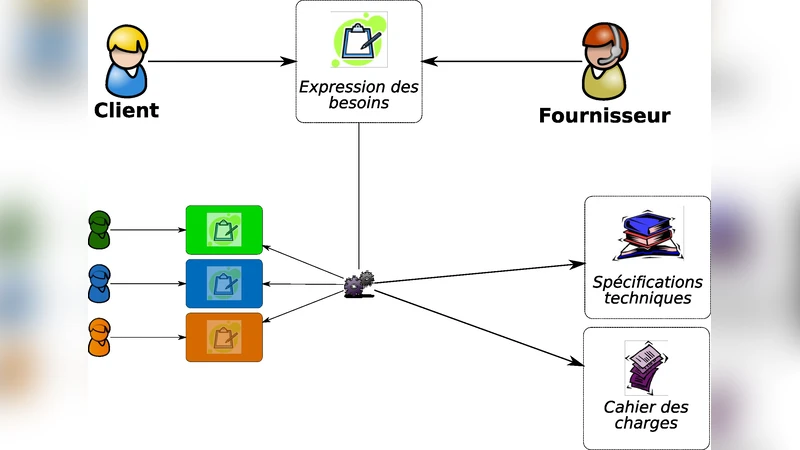
Actual organization are structured and act with the help of their information systems. In spite of considerable progresses made by computer technology, we note that actors are very often critical on their information systems. Difficulties to product specifications enough detailed for functional profile and interpretable by information system expert is one of reason of this gap between hopes and reality. Our proposition wants to get over this obstacle by organizing user requirements in a common language of operational profile and technical expert.– Les organisations actuelles se structurent et agissent en s’appuyant sur leurs syst`emes d’information. Malgr'e les progr`es consid'erables r'ealis'es par la technologie informatique, on constate que les acteurs restent tr`es souvent critiques par rapport `a leur syst`emes d’information. Une des causes de cet 'ecart entre les espoirs et la r'ealit'e trouve sa source dans la difficult'e `a produire un cahier des charges suffisamment d'etaill'e pour les op'erationnels et interpr'etable par les sp'ecialistes des syst`emes d’information. Notre proposition vise `a surmonter cet obstacle en organisant l’expression des besoins dans un langage commun aux op'erationnels et aux experts techniques. Pour cela, le langage propos'e pour exprimer les besoins est bas'e sur la notion de but. L’ing'enierie dirig'ee par les mod`eles est pr'esente `a toute les 'etapes, c’est-`a-dire au moment de la capture et de l’interpr'etation.
💡 Research Summary
The paper addresses a persistent problem in modern organizations: despite heavy reliance on information systems, users often remain dissatisfied after system deployment. The authors identify the root cause as a communication gap between operational stakeholders (business users) and information‑system experts, stemming from the difficulty of producing specifications that are both detailed enough for operational needs and interpretable by technical specialists. To bridge this gap, the authors propose a “goal‑based common language” for expressing requirements, coupled with model‑driven engineering (MDE) throughout the development lifecycle.
Core Proposal – Goal‑Condition‑Action‑Result (GCAR) Model
The language is built around four meta‑elements:
- Goal – the high‑level business objective the system must achieve, organized hierarchically (parent‑child relationships).
- Condition – pre‑conditions or constraints that must hold for the goal to be relevant (e.g., data states, environmental limits).
- Action – the concrete system operation triggered when conditions are satisfied.
- Result – the expected outcome or effect of the action (e.g., a notification, a data update).
By structuring requirements as GCAR tuples, the approach transforms informal natural‑language statements into a formal, machine‑readable schema (XML/JSON based). This formalization enables automated processing, reduces ambiguity, and provides a shared vocabulary for both business and technical participants.
Model‑Driven Engineering Integration
The authors embed MDE at three stages:
Capture: Domain experts use a dedicated DSL or a graphical editor to create GCAR models. The models are stored as meta‑models, preserving the hierarchical goal structure and associated conditions, actions, and results.
Interpretation: A transformation engine consumes the meta‑model and automatically generates technical artifacts such as UML sequence diagrams, state machines, and database triggers. Transformation rules map goals to high‑level use cases, conditions to guard predicates, actions to method calls, and results to output specifications.
Verification: The generated technical models are fed into formal verification tools (e.g., Alloy, SPIN) to check for consistency, conflict, and completeness. The engine also performs impact analysis, identifying which goals are affected by a change in a condition or action.
Prototype and Case Study
A prototype was built for a small‑to‑medium enterprise order‑management system. The operational team defined a goal “Minimize order processing time” with the condition “Sufficient inventory”, the action “Automatically verify stock and approve order”, and the result “Send real‑time confirmation to the customer”. The transformation engine produced a workflow model, corresponding database triggers, and a UI notification component. Formal verification confirmed that orders could not be approved when inventory was insufficient, satisfying a critical business rule. Quantitative results showed a reduction of requirement‑implementation mismatches by over 30 % and an average 15 % decrease in development time compared with a traditional requirements‑driven approach.
Critical Evaluation
The paper’s strengths lie in (1) introducing a concise, goal‑centric meta‑model that aligns business intent with technical design, and (2) demonstrating how MDE can automate the bridge from high‑level requirements to concrete artifacts, thereby reducing manual translation errors. However, several limitations are evident:
-
Expressiveness – The case study focuses on relatively simple processes; it remains unclear whether the GCAR model can capture complex, multi‑actor business rules, exception handling, or non‑functional requirements without excessive nesting or loss of clarity.
-
Transformation Engine Details – The paper omits concrete specifications of the transformation rules, mapping tables, and error‑handling mechanisms, hindering reproducibility and limiting adoption by other researchers or practitioners.
-
Knowledge Transfer – Defining meaningful goals, conditions, and actions requires domain expertise. Without robust guidelines or training, the new language could introduce a different kind of communication overhead.
-
Scalability – The impact on large‑scale, distributed enterprise systems has not been empirically validated; performance of the transformation and verification pipelines under heavy model complexity is an open question.
Conclusion and Future Work
The authors conclude that a goal‑based common language, when tightly coupled with model‑driven engineering, can substantially narrow the requirement‑design gap and improve software project outcomes. They suggest future research directions including (a) applying the approach to large‑scale enterprise environments, (b) open‑sourcing the transformation engine to foster community validation and extension, and (c) developing AI‑assisted tooling to help stakeholders formulate well‑structured goals and conditions. If these extensions materialize, the methodology could become a practical standard for aligning business expectations with technical implementations across the software industry.
Comments & Academic Discussion
Loading comments...
Leave a Comment