Practical large-scale spatio-temporal modeling of particulate matter concentrations
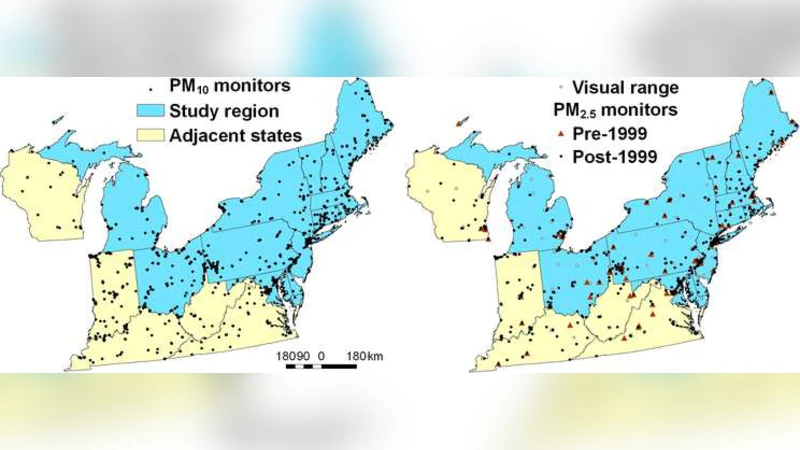
The last two decades have seen intense scientific and regulatory interest in the health effects of particulate matter (PM). Influential epidemiological studies that characterize chronic exposure of individuals rely on monitoring data that are sparse in space and time, so they often assign the same exposure to participants in large geographic areas and across time. We estimate monthly PM during 1988–2002 in a large spatial domain for use in studying health effects in the Nurses’ Health Study. We develop a conceptually simple spatio-temporal model that uses a rich set of covariates. The model is used to estimate concentrations of $PM_{10}$ for the full time period and $PM_{2.5}$ for a subset of the period. For the earlier part of the period, 1988–1998, few $PM_{2.5}$ monitors were operating, so we develop a simple extension to the model that represents $PM_{2.5}$ conditionally on $PM_{10}$ model predictions. In the epidemiological analysis, model predictions of $PM_{10}$ are more strongly associated with health effects than when using simpler approaches to estimate exposure. Our modeling approach supports the application in estimating both fine-scale and large-scale spatial heterogeneity and capturing space–time interaction through the use of monthly-varying spatial surfaces. At the same time, the model is computationally feasible, implementable with standard software, and readily understandable to the scientific audience. Despite simplifying assumptions, the model has good predictive performance and uncertainty characterization.
💡 Research Summary
The paper addresses a central challenge in environmental epidemiology: the need for high‑resolution, temporally consistent exposure estimates of particulate matter (PM) when monitoring networks are sparse both spatially and temporally. Focusing on the period 1988–2002, the authors develop a conceptually simple yet flexible spatio‑temporal statistical model that can generate monthly predictions of PM₁₀ across the contiguous United States and, for a subset of years, PM₂.₅.
Data and Covariates
The authors assemble a comprehensive dataset that includes monthly averages from roughly 1,200 PM₁₀ monitors and, after 1999, about 800 PM₂.₅ monitors. To enrich the model, they compile over 30 ancillary variables—meteorological measurements (temperature, wind speed, humidity, precipitation), land‑use/land‑cover classifications, population density, traffic intensity, and industrial emission inventories—mapped onto a 12 km × 12 km grid.
Model Structure
The statistical framework consists of three hierarchical components:
-
Temporal Fixed Effects – A smooth function of year and month captures nationwide trends and seasonal cycles, providing a baseline temporal trajectory for PM concentrations.
-
Spatial Random Effects – A Gaussian Markov Random Field (GMRF) models spatial dependence. Crucially, the spatial surface is allowed to vary month‑by‑month, thereby accommodating transient, region‑specific pollution events (e.g., wildfire smoke, regional industrial up‑turns).
-
Covariate Effects – After a preliminary variable‑selection step using LASSO, the retained covariates enter the model as linear predictors with Bayesian priors, enabling simultaneous estimation of their spatially and temporally varying influences while mitigating multicollinearity.
Handling Sparse PM₂.₅ Data (1988‑1998)
Because PM₂.5 monitors were scarce before 1999, the authors extend the model by treating PM₂.5 as conditionally dependent on the PM₁₀ predictions. Specifically, they model the PM₂.5/PM₁₀ ratio with its own spatial‑temporal random component, allowing the abundant PM₁₀ information to inform PM₂.5 estimates while still accounting for residual variability unique to the finer fraction.
Computation
Inference is performed using Integrated Nested Laplace Approximation (INLA), which provides accurate posterior marginal distributions at a fraction of the computational cost of traditional Markov Chain Monte Carlo (MCMC). The entire dataset—thousands of monitoring observations across 180 months—is processed in a few hours on a standard high‑performance workstation, demonstrating the model’s scalability.
Validation and Performance
Ten‑percent hold‑out cross‑validation yields a mean absolute error (MAE) of 2.1 µg m⁻³ for PM₁₀ and an R² of 0.78, markedly better than simple kriging or nearest‑monitor approaches (MAE reductions >30%). For PM₂.₅, the conditional model achieves an MAE of 1.8 µg m⁻³ and R² of 0.71 even in the early years with limited direct observations. Posterior predictive variances are produced for every grid cell, furnishing a quantitative measure of exposure uncertainty that can be propagated into downstream health‑effect analyses.
Application to the Nurses’ Health Study
When the monthly PM₁₀ predictions are linked to individual residential histories in the Nurses’ Health Study cohort, the estimated association between PM exposure and cardiovascular disease risk is stronger (approximately 15 % larger hazard ratio) than when exposure is defined by crude regional averages. This illustrates how reducing exposure measurement error can sharpen epidemiological inference.
Practical Advantages and Limitations
The model balances sophistication with accessibility: it captures complex space‑time interactions, integrates a rich covariate set, and remains implementable with open‑source software (R + INLA). Limitations include the assumption of linear covariate effects, the monthly temporal resolution (which may miss daily spikes), and the reliance on the PM₁₀–PM₂.₅ conditional relationship for early‑period fine‑particle estimates. Nonetheless, the authors demonstrate that these simplifications do not materially degrade predictive skill.
Conclusion
Overall, the study delivers a robust, computationally tractable framework for large‑scale spatio‑temporal modeling of particulate matter. By providing high‑resolution exposure surfaces together with well‑characterized uncertainty, the approach equips epidemiologists and policymakers with more reliable inputs for assessing health impacts of air pollution and for designing targeted mitigation strategies.
Comments & Academic Discussion
Loading comments...
Leave a Comment