Cell-Probe Lower Bounds for Prefix Sums
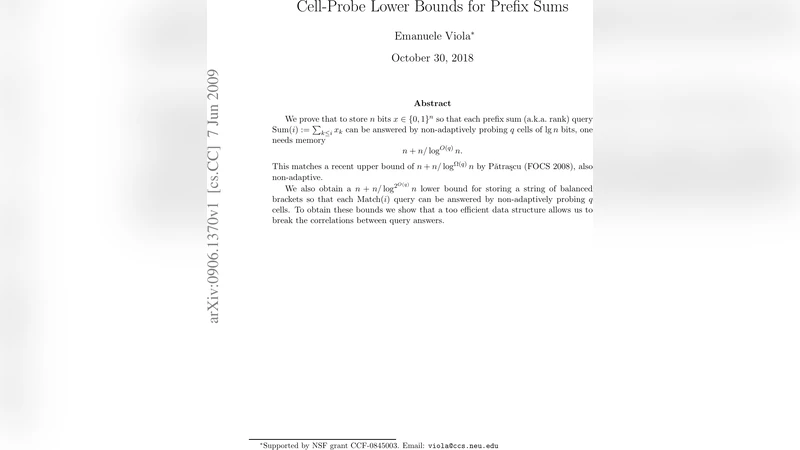
We prove that to store n bits x so that each prefix-sum query Sum(i) := sum_{k < i} x_k can be answered by non-adaptively probing q cells of log n bits, one needs memory > n + n/log^{O(q)} n. Our bound matches a recent upper bound of n + n/log^{Omega(q)} n by Patrascu (FOCS 2008), also non-adaptive. We also obtain a n + n/log^{2^{O(q)}} n lower bound for storing a string of balanced brackets so that each Match(i) query can be answered by non-adaptively probing q cells. To obtain these bounds we show that a too efficient data structure allows us to break the correlations between query answers.
💡 Research Summary
The paper studies static data‑structure lower bounds in the cell‑probe model, focusing on two classic query problems: prefix sums and balanced‑bracket matching. In the cell‑probe model a memory word (cell) stores Θ(log n) bits and the cost of a query is measured solely by the number of cells it reads. The authors restrict attention to non‑adaptive queries, i.e., for each query i a fixed set of q cell addresses is probed, independent of the cell contents. This restriction models parallel memory accesses and is common in theoretical work on succinct data structures.
The first main result concerns the prefix‑sum problem. Given an n‑bit array x, a query Sum(i) = Σ_{k<i} x_k must be answered by probing q cells. The authors prove that any data structure that answers all n queries non‑adaptively must use at least
M ≥ n + Ω( n / log^{c·q} n )
bits of space, where c is an absolute constant. In the notation of the abstract this is written as M > n + n / log^{O(q)} n. This lower bound matches the upper bound of Patrascu (FOCS 2008), which achieves space n + n / log^{Ω(q)} n with a non‑adaptive scheme. Hence the space‑time trade‑off for prefix sums in the non‑adaptive cell‑probe model is settled up to constant factors in the exponent.
The proof introduces a novel “information‑flow‑disruption” technique. For each query i let S_i be the set of q cells it reads and let X_i denote the bits stored in those cells. If the total space were only n + o(n), the families {S_i} would have to overlap heavily, causing the random variables X_i and X_j to share a large amount of information. Conversely, if the space is at least n + n / log^{O(q)} n, one can select a large subset I⊆
Comments & Academic Discussion
Loading comments...
Leave a Comment