M Star Astrosphere Size Fluctuations and Habitable Planet Descreening
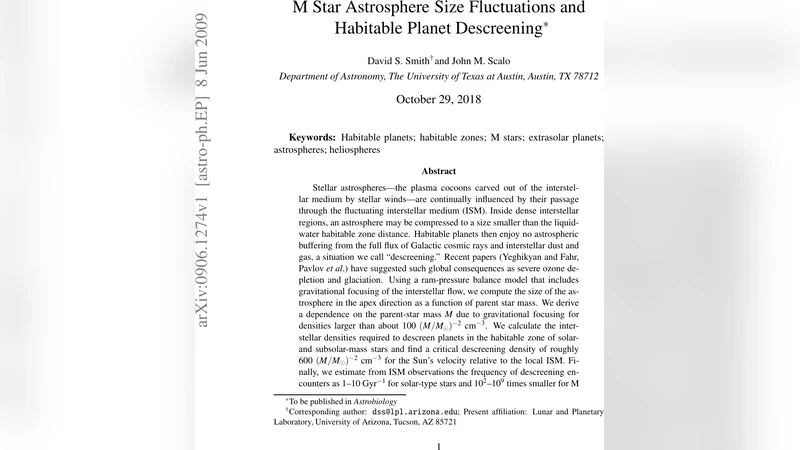
Stellar astrospheres–the plasma cocoons carved out of the interstellar medium by stellar winds–are continually influenced by their passage through the fluctuating interstellar medium (ISM). Inside dense interstellar regions, an astrosphere may be compressed to a size smaller than the liquid-water habitable zone distance. Habitable planets then enjoy no astrospheric buffering from the full flux of Galactic cosmic rays and interstellar dust and gas, a situation we call ``descreening.’’ Recent papers (Yeghikyan and Fahr, Pavlov et al.) have suggested such global consequences as severe ozone depletion and glaciation. Using a ram-pressure balance model that includes gravitational focusing of the interstellar flow, we compute the size of the astrosphere in the apex direction as a function of parent star mass. We derive a dependence on the parent-star mass M due to gravitational focusing for densities larger than about 100 (M/M_\odot)^{-2} cm^{-3}. We calculate the interstellar densities required to descreen planets in the habitable zone of solar- and subsolar-mass stars and find a critical descreening density of roughly 600 (M/M_\odot)^{-2} cm^{-3} for the Sun’s velocity relative to the local ISM. Finally, we estimate from ISM observations the frequency of descreening encounters as 1–10 Gyr^{-1} for solar-type stars and 10^2–10^9 times smaller for M stars. Given this disparity, we conclude that M star habitable-zone planets are virtually never exposed to the severe effects discussed by Yeghikyan and Fahr and Pavlov et al.
💡 Research Summary
The paper investigates how the size of a star’s astrosphere – the plasma bubble carved out of the interstellar medium (ISM) by the stellar wind – varies as the star moves through regions of differing ISM density, and what consequences arise when the astrosphere is compressed to a radius smaller than the orbital distance of a planet in the liquid‑water habitable zone (HZ). The authors term this situation “descreening,” because the planet loses the protective buffer of the astrosphere and is exposed directly to the full flux of Galactic cosmic rays, interstellar dust, and gas. Such exposure has been proposed in earlier work (Yeghikyan & Fahr; Pavlov et al.) to cause severe ozone depletion, glaciation, and other catastrophic climate effects.
To quantify the conditions for descreening, the authors adopt a ram‑pressure balance model. The outward pressure of the stellar wind, (P_w \approx \dot{M} v_w / (4\pi r_a^2)) (where (\dot{M}) is the mass‑loss rate, (v_w) the wind speed, and (r_a) the astrosphere radius), is set equal to the dynamic pressure of the oncoming ISM flow, (P_{\rm ISM}= \rho_{\rm ISM} v_{\rm rel}^2) (with (\rho_{\rm ISM}) the ISM mass density and (v_{\rm rel}) the relative star‑ISM speed). Solving for (r_a) yields the familiar inverse‑square‑root dependence on ISM density.
A key innovation of the study is the inclusion of gravitational focusing of the ISM flow by the star. As the star’s gravity pulls the incoming gas toward its apex, the local density and velocity increase, effectively lowering the ISM density required to compress the astrosphere. The focusing term scales with the stellar mass, (M), and the relative speed, leading to a critical ISM density for descreening that varies as (\rho_{\rm crit} \propto M^{-2}). For solar‑type parameters (relative speed ≈ 20 km s⁻¹) the authors derive a simple expression:
\