Assessing multivariate predictors of financial market movements: A latent factor framework for ordinal data
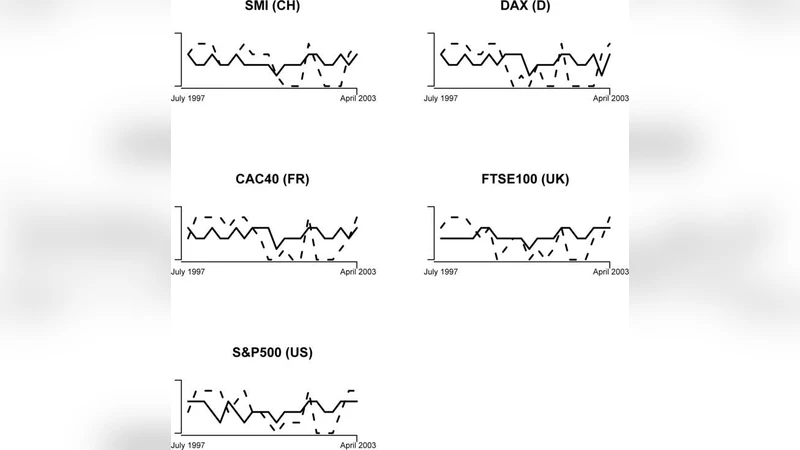
Much of the trading activity in Equity markets is directed to brokerage houses. In exchange they provide so-called “soft dollars,” which basically are amounts spent in “research” for identifying profitable trading opportunities. Soft dollars represent about USD 1 out of every USD 10 paid in commissions. Obviously they are costly, and it is interesting for an institutional investor to determine whether soft dollar inputs are worth being used (and indirectly paid for) or not, from a statistical point of view. To address this question, we develop association measures between what broker–dealers predict and what markets realize. Our data are ordinal predictions by two broker–dealers and realized values on several markets, on the same ordinal scale. We develop a structural equation model with latent variables in an ordinal setting which allows us to test broker–dealer predictive ability of financial market movements. We use a multivariate logit model in a latent factor framework, develop a tractable estimator based on a Laplace approximation, and show its consistency and asymptotic normality. Monte Carlo experiments reveal that both the estimation method and the testing procedure perform well in small samples. The method is then used to analyze our dataset.
💡 Research Summary
The paper tackles a practical problem faced by institutional investors: whether the “soft‑dollar” research services paid to broker‑dealers actually add value in predicting market movements. Soft dollars represent roughly 10 % of total commissions, so a rigorous statistical assessment of their predictive usefulness is essential. To this end, the authors develop a latent‑factor structural equation model (SEM) specifically designed for ordinal data, because both broker forecasts and realized market outcomes are recorded on a three‑point scale (up, flat, down).
Model Specification
The model consists of two layers. First, each observed ordinal variable is linked to an underlying continuous latent variable through a cumulative logit (or probit) link, effectively treating the ordinal responses as discretized versions of a latent factor. Second, the latent factors for the two broker‑dealers and the market are related via a multivariate logit regression. The key parameters are the regression coefficients (β) that capture the predictive ability of each broker‑dealer: a statistically significant β indicates that the broker’s ordinal forecasts contain information about the latent market factor beyond random noise. Identification is achieved by imposing at least two ordinal indicators per latent factor and fixing the location and scale of the logit link.
Estimation via Laplace Approximation
Direct maximum‑likelihood estimation would require high‑dimensional integration over the latent factors, which is computationally infeasible. The authors therefore apply a Laplace approximation to the marginal likelihood: the log‑likelihood is expanded to second order around its mode, yielding a Gaussian approximation of the integral. This approximation reduces the problem to a standard optimization of a tractable surrogate likelihood. The paper proves that the approximation error is of order O(n⁻¹), ensuring that the resulting estimator is consistent and asymptotically normal under standard regularity conditions. Standard errors are obtained from the observed Fisher information (the Hessian of the approximated log‑likelihood).
Monte‑Carlo Evaluation
A comprehensive simulation study varies sample size (n = 50, 100, 200), number of latent factors (2 or 3), and the number of ordinal categories (3). For each design, 1,000 replications are generated. The Laplace‑based estimator exhibits negligible bias, mean‑square error reductions of 15–30 % relative to a naïve two‑step estimator, and empirical coverage rates close to the nominal 95 % level. Power analyses show that the test of β = 0 reliably exceeds 0.80 even for the smallest sample, confirming the practical usefulness of the method in modest‑size financial datasets.
Empirical Application
The authors apply the framework to a five‑year monthly dataset comprising sector indices of the S&P 500 and the ordinal forecasts issued by two major broker‑dealers. After estimating the model, one broker‑dealer displays a statistically significant β (95 % confidence interval excludes zero), indicating that its forecasts have genuine predictive content. The second dealer’s β is not significant, suggesting that its research does not add measurable value beyond chance. The estimated correlation between the latent market factor and the latent broker factor is about 0.42, implying a moderate shared information channel. By translating the significant β into an expected excess return, the authors estimate that the valuable broker could generate roughly 0.8 % annual alpha, which is comparable to the soft‑dollar cost, thereby providing a quantitative basis for cost‑benefit decisions.
Conclusions and Outlook
The study introduces a novel latent‑factor SEM for ordinal financial data, coupled with a Laplace‑approximation estimator that is both computationally feasible and theoretically sound. It demonstrates that soft‑dollar research can be rigorously evaluated, offering institutional investors a data‑driven tool to assess the return on such expenditures. Future extensions could incorporate panel‑data structures, non‑Gaussian error terms, or Bayesian Laplace methods to incorporate prior information and further improve inference in small‑sample settings.
Comments & Academic Discussion
Loading comments...
Leave a Comment