Graphical Presentations of Symmetric Monoidal Closed Theories
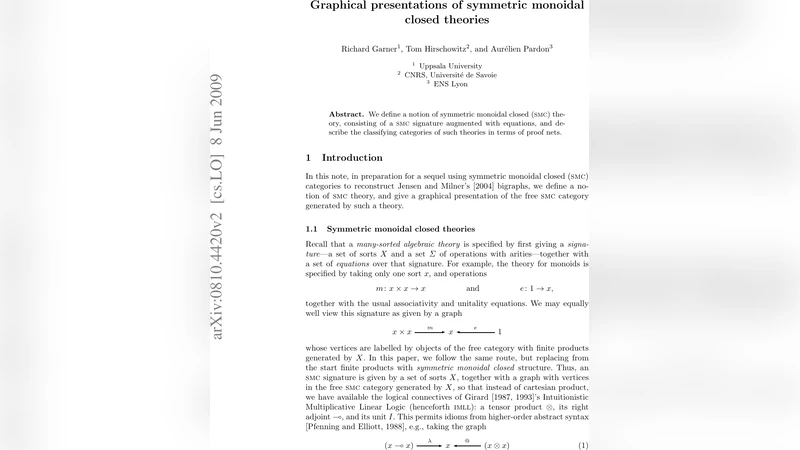
We define a notion of symmetric monoidal closed (SMC) theory, consisting of a SMC signature augmented with equations, and describe the classifying categories of such theories in terms of proof nets.
💡 Research Summary
The paper introduces a formal framework for symmetric monoidal closed (SMC) theories by pairing a syntactic SMC signature with a set of equations, and then characterizes the classifying categories of these theories using proof nets—a graphical representation originally developed for linear logic. The authors begin by defining an SMC signature as a collection of basic objects (types) and generating morphisms, including tensor, internal hom, and unit. From this signature they construct the free SMC category, whose objects are generated by tensoring and taking internal homs of the basic types, and whose morphisms are built from the generating morphisms using composition, tensor, and currying.
To capture the additional equalities that a concrete theory imposes, the authors augment the signature with equations between morphisms. Rather than handling these equations purely algebraically, they translate both the free category and the equations into a graphical language: proof nets. In a proof net, nodes correspond to generating morphisms (tensor, hom, unit, etc.) and edges represent the flow of types. The crucial insight is that the structural laws of a symmetric monoidal closed category—associativity, symmetry, unit laws, and the adjunction between tensor and internal hom—can be expressed as local graph rewrite rules.
The paper then develops a rewrite system for proof nets that incorporates the given equations as additional rewrite rules. The authors prove that this system is terminating and confluent, guaranteeing that every net reduces to a unique normal form. This normal form serves as a canonical representative of the equivalence class of morphisms dictated by the equations. Consequently, the classifying category of an SMC theory can be described concretely: its objects are the same as those of the free SMC category, and its morphisms are equivalence classes of proof nets modulo the rewrite system.
A significant portion of the work is devoted to showing that this graphical description is indeed a classifying category in the categorical sense: any model of the SMC theory in a symmetric monoidal closed category C corresponds uniquely to a strong monoidal functor from the constructed category to C, and conversely every such functor yields a model. This establishes a universal property analogous to the usual presentation of algebraic theories, but now with a visual, combinatorial substrate.
The authors illustrate the utility of their approach with three case studies. First, they reinterpret linear logic proof nets as instances of SMC proof nets, highlighting how the additional equations of linear logic (e.g., cut‑elimination) fit naturally into their framework. Second, they model quantum circuits by treating qubits as basic objects and quantum gates as generating morphisms, showing that the graphical calculus of quantum computing aligns with their proof‑net semantics. Third, they apply the theory to the type system of a functional programming language with linear types, demonstrating that type‑checking and program equivalence can be reduced to net reduction.
In the conclusion, the paper points out several avenues for future research: extending the graphical calculus to higher‑dimensional categories (e.g., braided or pivotal structures), developing automated tools for net reduction and equivalence checking, and exploring connections with categorical semantics of rewriting systems. Overall, the work provides a robust, visually intuitive method for presenting and reasoning about symmetric monoidal closed theories, bridging the gap between abstract categorical presentations and concrete, manipulable graphical representations.
Comments & Academic Discussion
Loading comments...
Leave a Comment