A converse to the Whitehead Theorem
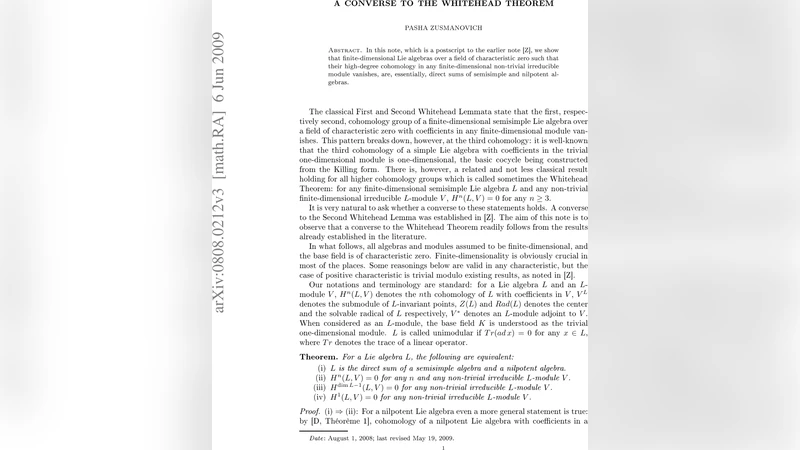
We show that finite-dimensional Lie algebras over a field of characteristic zero such that their high-degree cohomology in any finite-dimensional non-trivial irreducible module vanishes, are, essentially, direct sums of semisimple and nilpotent algebras.
💡 Research Summary
The paper investigates the converse of the classical Whitehead theorem for finite‑dimensional Lie algebras over a field of characteristic zero. The original Whitehead theorem (and its higher‑degree extensions) asserts that if a Lie algebra 𝔤 is semisimple then the cohomology groups Hⁿ(𝔤, V) vanish for all n ≥ 1 and for every finite‑dimensional 𝔤‑module V with no non‑zero invariants. The author asks whether the vanishing of cohomology in high degrees, assumed for all non‑trivial irreducible finite‑dimensional modules, forces the Lie algebra to have a very restricted structure.
The main hypothesis is that there exists an integer N such that for every non‑trivial irreducible finite‑dimensional 𝔤‑module V and every n ≥ N one has Hⁿ(𝔤, V)=0. Under this hypothesis the author proves that 𝔤 must be a direct sum of a semisimple Lie algebra and a nilpotent Lie algebra; more precisely, 𝔤≅𝔰⊕𝔫 where 𝔰 is semisimple and 𝔫 is nilpotent, and the two summands commute (the action of 𝔰 on 𝔫 is trivial). This result is described as a “converse to the Whitehead theorem”.
The proof proceeds through several standard tools in Lie algebra cohomology. First, the Levi decomposition 𝔤=𝔰⋉𝔯 is used, where 𝔰 is a Levi (semisimple) subalgebra and 𝔯 is the radical (the maximal solvable ideal). The author analyses the radical in two cases.
If the radical 𝔯 is not nilpotent, then it contains a non‑zero abelian ideal or a non‑trivial semisimple quotient. By constructing a suitable irreducible module V that is non‑trivial on this part, the Hochschild–Serre spectral sequence for the extension 0→𝔯→𝔤→𝔰→0 yields a non‑vanishing E₂‑term Hᵖ(𝔰, Hᵠ(𝔯, V)) for some p,q≥1. Consequently Hⁿ(𝔤, V) cannot be zero for all large n, contradicting the hypothesis. Hence the radical must be nilpotent.
For a nilpotent radical 𝔫, the well‑known result of Dixmier (or of Nöther–Baranov) states that Hᵠ(𝔫, W)=0 for all q≥1 and any non‑trivial finite‑dimensional 𝔫‑module W. Applying the Hochschild–Serre spectral sequence again, the only potentially non‑zero terms are Hᵖ(𝔰, W^{𝔫}) where W^{𝔫} denotes the 𝔫‑invariants. If V is irreducible and non‑trivial for 𝔤, then V^{𝔫}=0, so all E₂‑terms vanish and the hypothesis is satisfied.
The remaining issue is the interaction between 𝔰 and 𝔫. If 𝔰 acts non‑trivially on 𝔫, then 𝔫 can be regarded as a non‑trivial 𝔰‑module. Choosing V to be an irreducible 𝔰‑module that appears in the cohomology H¹(𝔰, 𝔫) (which is non‑zero whenever the action is non‑trivial) produces a non‑vanishing term in the spectral sequence, again violating the vanishing condition. Therefore the action must be trivial, and the semisimple and nilpotent parts commute, giving a direct sum decomposition.
The paper also discusses several illustrative examples. For instance, a solvable but non‑nilpotent Lie algebra such as the Borel subalgebra of sl₂ fails the hypothesis because its cohomology with suitable modules does not vanish in high degrees. Conversely, any direct sum of a semisimple algebra and a nilpotent algebra satisfies the hypothesis, confirming the necessity of the condition.
Finally, the author notes that the characteristic‑zero assumption is essential; in positive characteristic the cohomology behavior changes dramatically and the converse does not hold in general.
In summary, the article establishes that the complete vanishing of high‑degree cohomology for all non‑trivial irreducible finite‑dimensional modules characterizes precisely those Lie algebras that are direct sums of semisimple and nilpotent components. This provides a clean structural converse to the classical Whitehead theorem and highlights the powerful constraints imposed by cohomological vanishing conditions.
Comments & Academic Discussion
Loading comments...
Leave a Comment