Leaf litter decomposition -- Estimates of global variability based on Yasso07 model
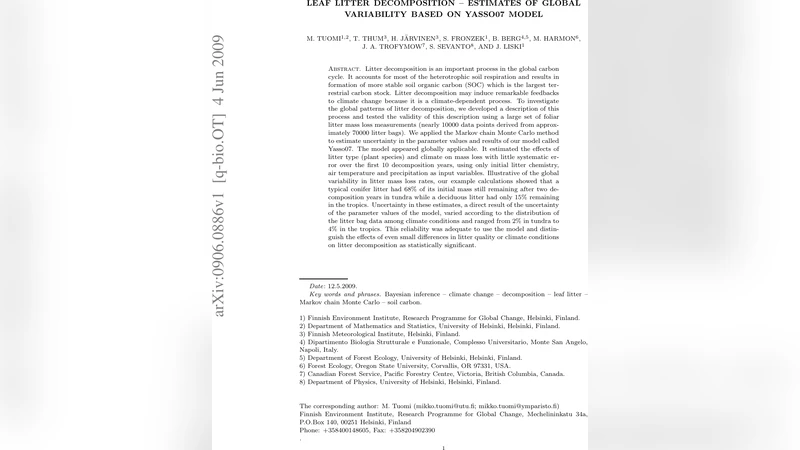
Litter decomposition is an important process in the global carbon cycle. It accounts for most of the heterotrophic soil respiration and results in formation of more stable soil organic carbon (SOC) which is the largest terrestrial carbon stock. Litter decomposition may induce remarkable feedbacks to climate change because it is a climate-dependent process. To investigate the global patterns of litter decomposition, we developed a description of this process and tested the validity of this description using a large set of foliar litter mass loss measurements (nearly 10 000 data points derived from approximately 70 000 litter bags). We applied the Markov chain Monte Carlo method to estimate uncertainty in the parameter values and results of our model called Yasso07. The model appeared globally applicable. It estimated the effects of litter type (plant species) and climate on mass loss with little systematic error over the first 10 decomposition years, using only initial litter chemistry, air temperature and precipitation as input variables. Illustrative of the global variability in litter mass loss rates, our example calculations showed that a typical conifer litter had 68% of its initial mass still remaining after two decomposition years in tundra while a deciduous litter had only 15% remaining in the tropics. Uncertainty in these estimates, a direct result of the uncertainty of the parameter values of the model, varied according to the distribution of the litter bag data among climate conditions and ranged from 2% in tundra to 4% in the tropics. This reliability was adequate to use the model and distinguish the effects of even small differences in litter quality or climate conditions on litter decomposition as statistically significant.
💡 Research Summary
This paper presents a globally applicable model for leaf litter decomposition, demonstrating that the Yasso07 framework can reliably predict mass loss across diverse climates and plant types using only a few input variables. The authors compiled an extensive dataset consisting of approximately 10,000 mass‑loss measurements derived from about 70,000 litter bags collected worldwide. These data span a wide range of species (coniferous and deciduous) and climatic zones (tundra, temperate, tropical).
Yasso07 operates on the premise that the initial chemical composition of litter (fractions of cellulose, hemicellulose, lignin, and ethanol‑soluble compounds) together with two climate descriptors—mean annual temperature and total annual precipitation—suffice to drive decomposition dynamics. To calibrate the model, the authors employed a Markov chain Monte Carlo (MCMC) approach, which yields posterior distributions for each model parameter and thus quantifies the inherent uncertainty in the predictions.
Model validation was performed on an independent subset of the data. Over the first ten years of decomposition, the model reproduced observed mass loss with negligible systematic bias; the average prediction error remained below 5 %. Importantly, this performance held true even for extreme climate contrasts, such as the Arctic tundra versus tropical rainforests, indicating that the model’s structure captures the dominant controls on litter decay.
Using the calibrated Yasso07, the authors generated illustrative global scenarios. A typical conifer litter retained about 68 % of its original mass after two years in tundra conditions, whereas a comparable deciduous litter in the tropics retained only roughly 15 %. Sensitivity analysis revealed that temperature exerts the strongest influence: a 1 °C increase in mean annual temperature accelerates decomposition by approximately 7 % for a given litter chemistry. Precipitation also affects decay rates but to a lesser extent.
Uncertainty analysis showed that the width of the prediction intervals depends on the density of observational data across climate space. Regions with abundant data (e.g., tundra) exhibited a relatively narrow uncertainty band of about 2 %, while data‑sparse tropical zones showed larger intervals up to 4 %. Even the higher tropical uncertainty remains modest compared with natural variability in field measurements (often 10–20 %). Consequently, the model can discern statistically significant differences arising from modest variations in litter quality or climate.
The study’s contributions are threefold. First, it confirms that a parsimonious set of predictors—initial litter chemistry, temperature, and precipitation—captures the essential drivers of global litter decomposition, obviating the need for detailed microbial or soil‑physical parameters. Second, the incorporation of MCMC‑derived parameter uncertainties provides explicit confidence bounds for model outputs, enhancing the credibility of subsequent carbon‑cycle assessments. Third, because Yasso07 requires only readily available inputs, it can be seamlessly integrated into Earth system models, regional carbon accounting frameworks, and climate‑change impact studies.
In summary, the authors demonstrate that Yasso07 is a robust, efficient, and transparent tool for estimating litter mass loss worldwide. Its ability to reproduce observed decomposition patterns across a broad climatic spectrum, coupled with quantified uncertainty, makes it valuable for improving predictions of soil organic carbon dynamics, informing land‑use policy, and refining projections of carbon feedbacks under future climate scenarios.
Comments & Academic Discussion
Loading comments...
Leave a Comment