A Spectral Sequence for the K-theory of Tiling Spaces
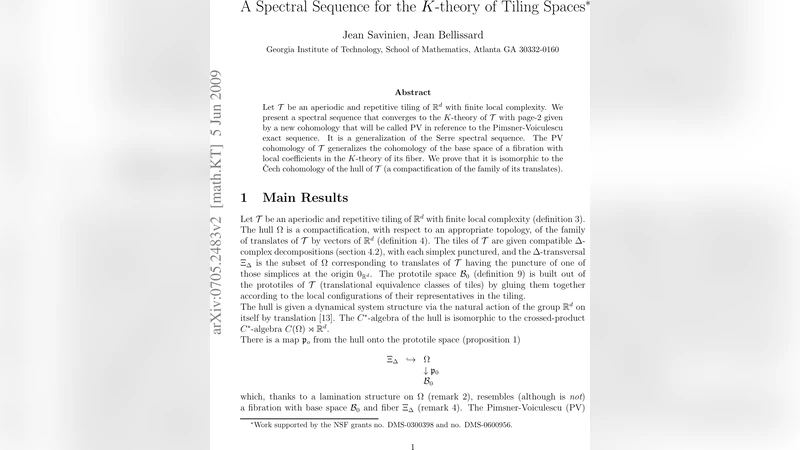
Let $\Tt$ be an aperiodic and repetitive tiling of $\RM^d$ with finite local complexity. We present a spectral sequence that converges to the $K$-theory of $\Tt$ with $E_2$-page given by a new cohomology that will be called PV in reference to the Pimsner-Voiculescu exact sequence. It is a generalization of the Serre spectral sequence. The PV cohomology of $\Tt$ generalizes the cohomology of the base space of a fibration with local coefficients in the $K$-theory of its fiber. We prove that it is isomorphic to the \v{C}ech cohomology of the hull of $\Tt$ (a compactification of the family of its translates).
💡 Research Summary
The paper addresses the problem of computing the K‑theory of tiling spaces associated with aperiodic, repetitive tilings of Euclidean space that have finite local complexity (FLC). Such tilings give rise to a compact hull (\Omega_{\mathcal{T}}) – the closure of the translation orbit of the tiling – which carries a natural (\mathbb{R}^d) action. The authors construct a spectral sequence converging to the K‑theory of the crossed‑product C(^)‑algebra (C^(\mathcal{G}{\mathcal{T}})) of the associated transformation groupoid (\mathcal{G}{\mathcal{T}}). The novelty lies in the identification of the (E_2)‑page with a new cohomology theory, which they call PV cohomology, in homage to the Pimsner‑Voiculescu exact sequence.
The construction proceeds as follows. First, the tiling is encoded by a cellular pattern complex (\mathcal{P}) whose cells correspond to prototiles together with their admissible local configurations. To each cell (\sigma) of dimension (p) one attaches the K‑group (K_q(C(\mathbb{T}^d))) (the K‑theory of the torus, which appears as the fiber of the local transversal). The collection of all such groups forms a bigraded chain complex \
Comments & Academic Discussion
Loading comments...
Leave a Comment