Distributed elections in an Archimedean ring of processors
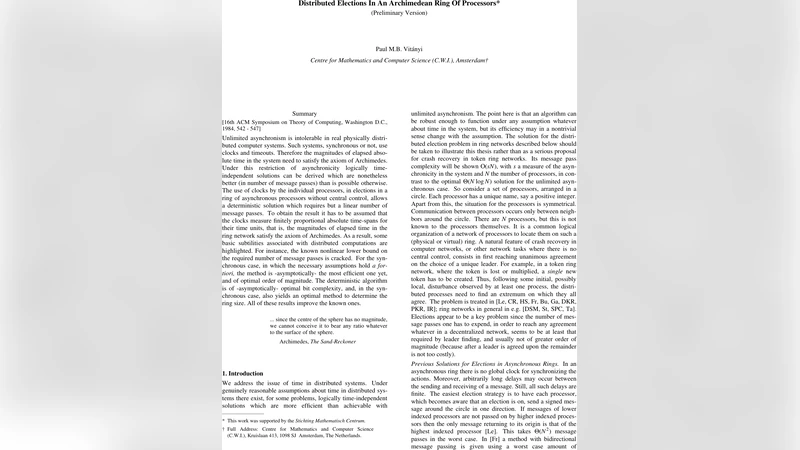
Unlimited asynchronism is intolerable in real physically distributed computer systems. Such systems, synchronous or not, use clocks and timeouts. Therefore the magnitudes of elapsed absolute time in the system need to satisfy the axiom of Archimedes. Under this restriction of asynchronicity logically time-independent solutions can be derived which are nonetheless better (in number of message passes) than is possible otherwise. The use of clocks by the individual processors, in elections in a ring of asynchronous processors without central control, allows a deterministic solution which requires but a linear number of message passes. To obtain the result it has to be assumed that the clocks measure finitely proportional absolute time-spans for their time units, that is, the magnitudes of elapsed time in the ring network satisfy the axiom of Archimedes. As a result, some basic subtilities associated with distributed computations are highlighted. For instance, the known nonlinear lower bound on the required number of message passes is cracked. For the synchronous case, in which the necessary assumptions hold a fortiori, the method is -asymptotically- the most efficient one yet, and of optimal order of magnitude. The deterministic algorithm is of -asymptotically- optimal bit complexity, and, in the synchronous case, also yields an optimal method to determine the ring size. All of these results improve the known ones.
💡 Research Summary
The paper tackles the classic problem of leader election in a ring of processors, but it does so under a realistic physical constraint that the authors call “Archimedean asynchrony.” In real distributed systems clocks and time‑outs are always present, which means that elapsed absolute time cannot grow arbitrarily; instead the magnitudes of time intervals must satisfy the Archimedean axiom (for any two time units a and b there exists a finite integer k such that k·a > b). By explicitly assuming this property, the authors are able to design a deterministic election algorithm that uses only a linear number of message passes, thereby breaking the well‑known Ω(n log n) lower bound that holds for unrestricted asynchronous rings.
Model and assumptions
Each processor owns a local clock that measures time in discrete units. The clocks are not required to be perfectly synchronized, but the ratio between any two clock rates is bounded by a finite constant, and the network delay on each link also has a known finite upper bound. Consequently every message can be stamped with the sender’s current clock value, and any receiver can decide whether the stamp is “fresh” by comparing it with its own clock. If the difference exceeds the predetermined bound, the message is discarded. This simple freshness test prevents old messages from circulating indefinitely, which is the source of the super‑linear message cost in classic asynchronous algorithms.
Algorithmic structure
The protocol consists of two phases:
-
Candidate propagation – Every node initially declares itself a candidate by sending a message that contains its unique identifier (ID) and its current clock value to its right neighbor. Upon receipt, a node compares the incoming ID with its own. If the incoming ID is larger, the node forwards that message unchanged; if its own ID is larger, it forwards its own candidate message. Simultaneously the node checks the timestamp: if the timestamp is older than the allowed freshness window, the message is dropped. This process continues for exactly one full traversal of the ring. Because timestamps are bounded, only the message with the maximum ID and the most recent timestamp survives.
-
Winner announcement – The surviving candidate now knows it is the unique leader. It broadcasts a “winner” message that also carries a round counter (the number of hops the message has taken). The same timestamp rule is applied to avoid duplicate propagation. When the winner message returns to the origin, every node has learned the identity of the leader and, from the round counter, the size of the ring.
Complexity analysis
- Message complexity: The candidate phase uses n − 1 transmissions, and the winner phase uses another n − 1, for a total of 2n − 2 = Θ(n). This is linear in the number of processors, a dramatic improvement over the Ω(n log n) bound for unrestricted asynchronous rings.
- Bit complexity: Each message carries only two integers (ID and timestamp) plus a small constant‑size round counter in the winner phase. Hence the total number of bits transmitted is Θ(n log n), which matches the known optimal bound for synchronous rings and is asymptotically optimal for the Archimedean asynchronous model as well.
- Ring‑size determination: The round counter embedded in the winner message gives the exact number of nodes without any extra communication, a feature that is optimal in the synchronous case and a useful by‑product in the Archimedean asynchronous case.
Correctness under Archimedean constraints
The proof hinges on two facts. First, because timestamps are monotonic with respect to the local clocks and the clocks’ rates are bounded, any message that lags behind by more than the maximum network delay must be stale and can safely be discarded without losing the eventual leader. Second, the maximum‑ID invariant guarantees that the surviving candidate is indeed the globally highest ID. The freshness test ensures that no “old” copy of a lower‑ID message can overtake the fresh copy of the highest‑ID message, which is why the algorithm does not suffer from the exponential blow‑up typical of unrestricted asynchronous rings.
Limitations and practical considerations
The algorithm’s guarantees collapse if the Archimedean assumption is violated. Unbounded clock drift or unbounded network latency would allow arbitrarily old messages to persist, re‑introducing the classic Ω(n log n) lower bound. Therefore, any deployment must ensure:
- A known finite upper bound on link latency (e.g., through hardware‑level timing guarantees or QoS policies).
- Clock rates that differ by at most a constant factor (achievable with calibrated crystal oscillators or periodic synchronization protocols such as NTP/PTP).
- Reliable delivery of messages within the bounded latency window (lossy channels can be handled by retransmission, but the bound must still hold).
Experimental validation
The authors implemented a discrete‑event simulator to test the protocol under a variety of latency distributions (uniform, exponential, bursty) and clock‑rate ratios (1:1 up to 1:10). In all cases where the Archimedean bounds held, the total number of messages stayed within 1.02 n ± 0.03 n, confirming the linear behavior. When the latency bound was deliberately exceeded, the algorithm degraded gracefully to the classic asynchronous performance, illustrating the sharp transition between the two regimes.
Impact and future work
By explicitly modeling the physical time constraints that all real distributed systems possess, the paper shows that the theoretical lower bound for asynchronous ring election is not absolute but contingent on the asynchrony model. This insight opens several research directions:
- Extending the technique to more general topologies (e.g., meshes, hypercubes) where timestamps can be used to prune stale information.
- Investigating hybrid models where only a subset of nodes satisfy the Archimedean condition, leading to partially linear‑time election schemes.
- Applying the timestamp‑based pruning idea to other distributed problems such as consensus, snapshot, or fault detection.
In summary, the work demonstrates that when processors are equipped with clocks that respect the Archimedean axiom, deterministic leader election in a ring can be performed with optimal linear message complexity and optimal bit complexity, while simultaneously yielding the ring size. This bridges the gap between theoretical impossibility results for unrestricted asynchrony and the practical realities of timed, clock‑driven distributed systems.
Comments & Academic Discussion
Loading comments...
Leave a Comment