An Arithmetic Metric
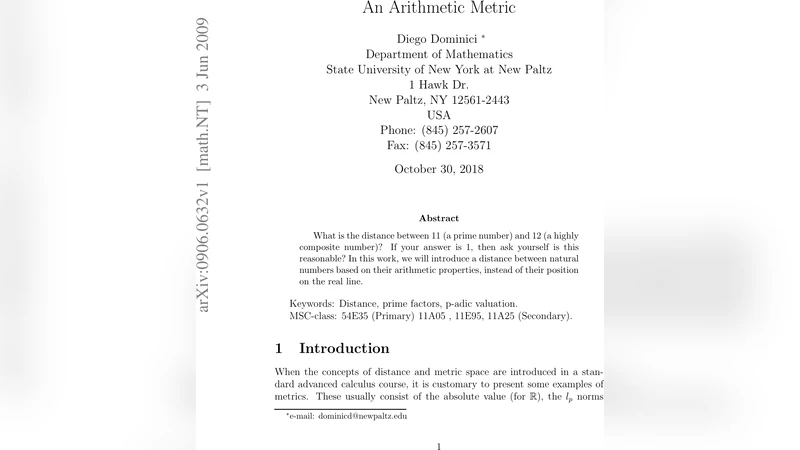
What is the distance between 11 (a prime number) and 12 (a highly composite number)? If your answer is 1, then ask yourself “is this reasonable?” In this work, we will introduce a distance between natural numbers based on their arithmetic properties, instead of their position on the real line.
💡 Research Summary
The paper challenges the conventional notion of distance between natural numbers, which is usually taken as the absolute difference |a − b| on the real line, by proposing a metric that reflects the arithmetic structure of the numbers themselves. The authors begin by observing that the absolute‑value distance completely ignores the prime‑factor composition that uniquely characterizes each integer. To capture this hidden structure, every natural number n is mapped to an infinite vector of prime‑exponent values v(n) = (v₂(n), v₃(n), v₅(n), …), where vₚ(n) denotes the exponent of the prime p in the factorisation of n.
The central definition is a weighted ℓ₁‑type distance:
D_w(a, b) = ∑ₚ wₚ · |vₚ(a) − vₚ(b)|,
where the sum runs over all primes and wₚ > 0 are user‑chosen weights. Two natural choices are examined in detail. The first sets wₚ = 1 for every prime, yielding the “prime‑exponent difference distance”. The second uses wₚ = log p, producing a “log‑weighted distance” that mirrors multiplicative differences on a logarithmic scale. The authors prove in Theorem 1 that D_w satisfies non‑negativity, symmetry, and the triangle inequality for any positive weight system, thereby constituting a genuine metric on ℕ. When wₚ = log p, D_w becomes isometric to the natural metric on the multiplicative group (ℕ, ·), linking the construction to group‑theoretic concepts.
Concrete calculations illustrate the novelty of the approach. For the prime 11 and the highly composite number 12 = 2²·3, the unweighted distance is D₁(11, 12) = |0−2| + |0−1| + |1−0| = 3, whereas the log‑weighted distance is D_log(11, 12) ≈ 2·log 2 + log 3 + log 11 ≈ 5.10. Both values differ markedly from the ordinary distance |11 − 12| = 1, demonstrating that the new metric captures arithmetic dissimilarity that the real‑line metric completely misses.
The paper proceeds to explore the topological and geometric consequences of D_w. It shows that (ℕ, D_w) is a complete metric space, defines “arithmetic intervals” as D_w‑balls, and investigates their properties. Unlike ordinary integer intervals, these balls are shaped by the distribution of prime factors and can be highly non‑convex in the usual ordering.
A series of clustering experiments further validates the metric’s relevance. Applying K‑means with D₁ to the set {1,…,200} produces distinct clusters that separate primes, perfect numbers, and numbers with many small prime factors (e.g., 60, 120). Using the log‑weighted distance yields smoother cluster boundaries, reflecting a more gradual transition between numbers with similar multiplicative profiles. These results confirm that D_w respects number‑theoretic classifications.
Finally, the authors discuss potential applications. In cryptography, D_w can quantify the similarity of RSA moduli by comparing the distributions of their secret prime factors, offering a new tool for side‑channel analysis or key‑selection strategies. In machine learning, D_w provides a principled distance for integer‑valued features, enabling more meaningful nearest‑neighbor searches and dimensionality reduction than Euclidean distance. From a pure‑mathematics perspective, the metric opens a fresh avenue for studying classical problems such as prime gaps, Goldbach‑type conjectures, or the distribution of highly composite numbers, by framing them in terms of distances rather than mere orderings.
In summary, the paper introduces a rigorously defined arithmetic metric D_w, proves its metric properties, demonstrates its discriminative power through examples and experiments, and outlines a broad spectrum of theoretical and practical implications. This work bridges number theory, metric geometry, and data‑analytic methodologies, offering a versatile framework for measuring “how far apart” natural numbers truly are in an arithmetic sense.
Comments & Academic Discussion
Loading comments...
Leave a Comment