When is the diagonal functor Frobenius?
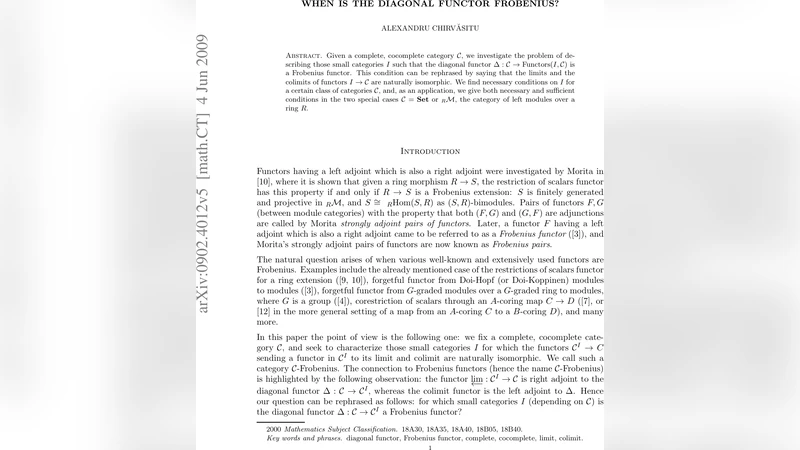
Given a complete, cocomplete category $\mathcal C$, we investigate the problem of describing those small categories $I$ such that the diagonal functor $\Delta:\mathcal C\to {\rm Functors}(I,\mathcal C)$ is a Frobenius functor. This condition can be rephrased by saying that the limits and the colimits of functors $I\to\mathcal C$ are naturally isomorphic. We find necessary conditions on $I$ for a certain class of categories $\mathcal C$, and, as an application, we give both necessary and sufficient conditions in the two special cases $\mathcal C={\bf Set}$ or $_R\mathcal M$, the category of left modules over a ring $R$.
💡 Research Summary
The paper investigates when the diagonal functor Δ : 𝓒 → Fun(I, 𝓒) is Frobenius, i.e. when it possesses both a left and a right adjoint simultaneously. In a complete and cocomplete category 𝓒, the left adjoint of Δ is the limit functor and the right adjoint is the colimit functor; therefore Δ is Frobenius precisely when limits and colimits of any diagram indexed by a small category I are naturally isomorphic. The authors first derive a general necessary condition on I: it must be an equivalence‑connected groupoid. In other words, every morphism in I must be invertible and any two objects must be linked by an isomorphism. If I fails to be a groupoid, one can construct diagrams whose limits (products, equalizers, etc.) differ essentially from their colimits (coproducts, coequalizers), breaking the Frobenius property.
Having identified the structural constraint on I, the paper turns to concrete categories 𝓒. For the category of sets, the authors prove that the condition is also sufficient provided I is a finite groupoid. Finiteness is essential because infinite products and infinite coproducts are never naturally isomorphic in Set. Moreover, the invertibility of all morphisms guarantees that each diagram reduces to a family of identical sets, making limit and colimit coincide.
The second main case is the module category _R𝓜 of left modules over a ring R. Here the situation is more delicate: besides I being a finite groupoid, the ring R must be semisimple (or, more generally, satisfy that direct sums and direct products of modules coincide for the relevant families). Under these hypotheses, every I‑diagram of modules decomposes into a finite direct sum of isomorphic copies, and the limit (product) and colimit (coproduct) are naturally isomorphic. If R is not semisimple, counter‑examples show that the Frobenius property fails even when I meets the groupoid condition.
The authors illustrate the gap between necessity and sufficiency with a series of examples and counter‑examples. They exhibit infinite groupoids where Δ is not Frobenius in Set, and finite groupoids with non‑invertible arrows where the property collapses. They also discuss cases where I is a finite groupoid but R lacks semisimplicity, leading to failure in the module setting.
In conclusion, the paper establishes that Δ is Frobenius exactly when I is a finite equivalence‑connected groupoid and the ambient category 𝓒 has enough algebraic regularity to identify products with coproducts (e.g., Set, or _R𝓜 with R semisimple). This result clarifies the interplay between the indexing category’s categorical symmetry (invertibility of morphisms) and the internal algebraic properties of 𝓒, providing a clear criterion for when limits and colimits of I‑diagrams coincide naturally. The work opens avenues for extending the analysis to higher‑dimensional categories, enriched settings, or other algebraic contexts where similar Frobenius phenomena may arise.
Comments & Academic Discussion
Loading comments...
Leave a Comment