Role-Based Access Controls
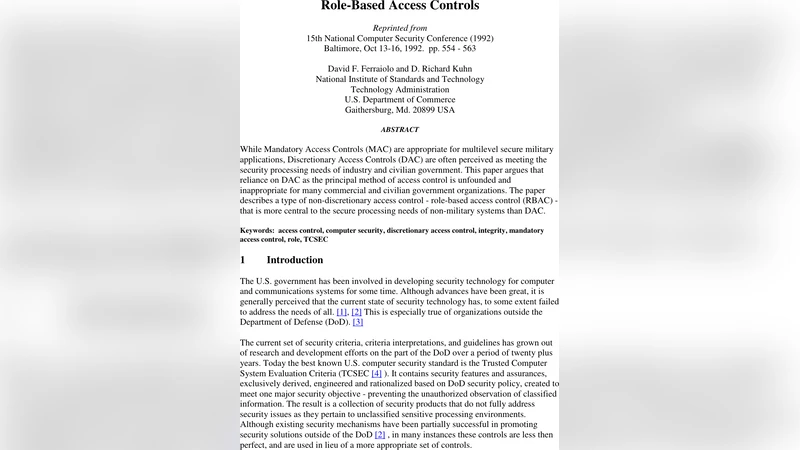
While Mandatory Access Controls (MAC) are appropriate for multilevel secure military applications, Discretionary Access Controls (DAC) are often perceived as meeting the security processing needs of industry and civilian government. This paper argues that reliance on DAC as the principal method of access control is unfounded and inappropriate for many commercial and civilian government organizations. The paper describes a type of non-discretionary access control - role-based access control (RBAC) - that is more central to the secure processing needs of non-military systems than DAC.
💡 Research Summary
The paper opens by contrasting three major access‑control paradigms: Mandatory Access Control (MAC), Discretionary Access Control (DAC), and Role‑Based Access Control (RBAC). MAC, with its label‑based, top‑down enforcement, is acknowledged as the gold standard for multilevel‑secure military systems but is deemed too costly and inflexible for commercial environments. DAC, by contrast, is the de‑facto model in most industry and civilian‑government settings because it lets object owners grant and revoke permissions at will. The authors argue, however, that this very discretion creates systemic weaknesses: permission creep, inconsistent policy application, and a high likelihood of human error when thousands of users and resources must be managed manually. Empirical examples illustrate how DAC‑centric organizations frequently suffer from orphaned privileges after staff turnover and from difficulty demonstrating compliance during audits.
Against this backdrop, the paper introduces RBAC as a non‑discretionary alternative that aligns more closely with the operational realities of modern enterprises. RBAC abstracts business functions into “roles” and assigns to each role a minimal set of permissions required to perform that function. Users are then mapped to one or more roles, and any change in a user’s job description is reflected simply by altering role assignments rather than editing individual permissions. The authors emphasize two structural advantages. First, role hierarchies allow senior roles to inherit the permissions of subordinate roles, dramatically reducing the number of explicit permission entries (the so‑called “role explosion” problem). Second, RBAC supports formal Separation‑of‑Duty (SoD) constraints. The paper distinguishes concurrency constraints (preventing a single user from holding two conflicting roles simultaneously) and inheritance constraints (blocking certain role‑to‑role inheritance relationships). These constraints are codified in the access‑control policy and enforced automatically, thereby mitigating insider‑threat risks and facilitating regulatory compliance.
Implementation is presented as a three‑phase process. Phase 1 (role definition) relies on thorough business‑process analysis, interviews, and review of existing access logs to identify roles and their associated permission sets. Phase 2 (role assignment) maps users to roles using a combination of automated matching based on job titles and manual overrides for exceptional cases. Phase 3 (constraint enforcement) integrates SoD rules into the enforcement engine, with built‑in rollback and alert mechanisms for violations. This modular approach means that policy updates require changes only to role definitions or constraints, not to the underlying permission matrix, resulting in lower maintenance overhead.
The authors also discuss auditability. Because every access request can be traced back to a role rather than an individual discretionary grant, auditors can quickly answer “who accessed what, through which role, and when?” This traceability satisfies many compliance frameworks (e.g., SOX, HIPAA) and accelerates incident response. A case study of a large financial institution that migrated from DAC to RBAC is provided: after deployment, permission‑related errors dropped by 85 %, audit preparation time fell by 60 %, and the organization achieved a measurable reduction in regulatory findings.
Finally, the paper acknowledges RBAC’s challenges. Defining an optimal role set can be labor‑intensive, and dynamic environments may require frequent role re‑evaluation. To address these issues, the authors propose future research into machine‑learning‑driven role recommendation systems and simulation tools that can predict the impact of policy changes before they are enacted. In conclusion, the paper asserts that reliance on DAC is unjustified for many non‑military contexts and that RBAC, with its structured, non‑discretionary nature and built‑in support for separation of duties, offers a more secure and manageable foundation for contemporary access‑control needs.
Comments & Academic Discussion
Loading comments...
Leave a Comment