Convergence in strongly monotone systems with an increasing first integral
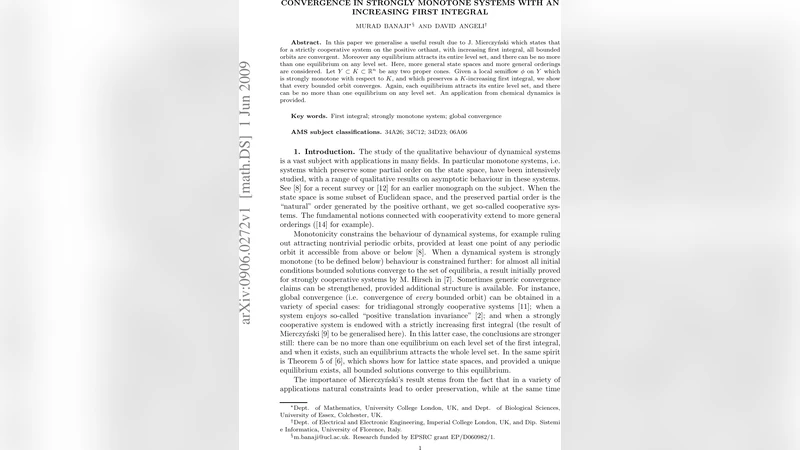
In this paper we generalise a useful result due to J. Mierczynski which states that for a strictly cooperative system on the positive orthant, with increasing first integral, all bounded orbits are convergent. Moreover any equilibrium attracts its entire level set, and there can be no more than one equilibrium on any level set. Here, more general state spaces and more general orderings are considered. Let Y subset K subset R^n be any two proper cones. Given a local semiflow phi on Y which is strongly monotone with respect to K, and which preserves a K-increasing first integral, we show that every bounded orbit converges. Again, each equilibrium attracts its entire level set, and there can be no more than one equilibrium on any level set. An application from chemical dynamics is provided.
💡 Research Summary
The paper extends a classic convergence result originally proved by J. Mierczyński for strictly cooperative systems on the positive orthant that possess an increasing first integral. Mierczyński’s theorem states that, under those conditions, every bounded trajectory converges to an equilibrium, each equilibrium attracts its entire level set, and no level set can contain more than one equilibrium. The present work generalizes this theorem to a much broader setting by replacing the positive orthant with arbitrary proper cones and by allowing more general orderings.
The authors consider two closed, convex, pointed cones (Y) and (K) in (\mathbb{R}^n) with (Y\subset K). The state space of the dynamical system is the cone (Y), while the cone (K) defines a partial order (\prec_K). A local semiflow (\phi:\mathbb{R}_+\times Y\to Y) is assumed to be strongly monotone with respect to (K): if (x\prec_K y) then for every (t>0) one has (\phi_t(x)\prec_K \phi_t(y)) and the inequality is strict. In addition, there exists a (K)-increasing first integral (H:Y\to\mathbb{R}) that is constant along trajectories ((H(\phi_t(x))=H(x)) for all (t\ge0)) and satisfies (x\prec_K y\Rightarrow H(x)<H(y)).
Under these hypotheses three main theorems are proved:
-
Global convergence of bounded orbits. For any initial condition whose forward orbit remains bounded, the limit (\lim_{t\to\infty}\phi_t(x)) exists and is an equilibrium of the semiflow. The proof relies on the compactness of the (\omega)-limit set, its (K)-connectedness, and the strong monotonicity which forces the (\omega)-limit set to be a singleton.
-
Attraction of whole level sets. If (e) is an equilibrium and (c=H(e)), then the level set (L_c={x\in Y\mid H(x)=c}) is invariant and every point in (L_c) converges to (e). Thus each equilibrium attracts the entire fiber of the first integral that contains it.
-
Uniqueness of equilibria on a level set. No level set can contain two distinct equilibria. If two equilibria shared the same value of (H), strong monotonicity would create a strict order between them, contradicting the fact that both are limit points of the same invariant set.
The paper’s methodology combines order-theoretic arguments (comparison principles, monotone convergence) with topological properties of cones (interior, boundary, compactness). A crucial technical device is the use of the cone‑induced order to guarantee that trajectories cannot “cross” each other, which is what enables the reduction of the dynamics to a one‑dimensional monotone flow on each level set.
To illustrate the abstract theory, the authors present an application from chemical reaction network theory. In many mass‑action systems the total mass (or total number of atoms) is a linear first integral, and the reaction rates are monotone with respect to the natural cone of non‑negative concentrations. The system’s vector field is then strongly monotone with respect to this cone, satisfying all the hypotheses of the main theorems. Consequently, any bounded concentration trajectory converges to a steady state, each steady state attracts all concentration vectors with the same total mass, and a given total‑mass hyperplane can contain at most one steady state. This result relaxes the usual detailed‑balance or complex‑balance assumptions that are often required for convergence proofs in chemical kinetics.
Beyond the chemical example, the authors discuss several extensions. They note that the cone (K) need not be symmetric; even non‑standard cones can be used provided they define a proper partial order. They also comment on the possibility of vector‑valued first integrals, where each component is (K)-increasing, leading to intersections of level sets that still enjoy the same convergence properties. Finally, they suggest that the framework could be adapted to infinite‑dimensional systems (e.g., reaction‑diffusion PDEs) or to hybrid systems with switching dynamics, as long as a suitable strong monotonicity can be established.
In summary, the paper provides a powerful and flexible generalization of Mierczyński’s convergence theorem. By abstracting the notions of monotonicity and first integrals to arbitrary proper cones, it opens the door to applying monotone‑dynamical‑systems techniques to a wide variety of models in biology, chemistry, and engineering where the state space is naturally ordered but not confined to the positive orthant. The results guarantee global convergence, level‑set attraction, and equilibrium uniqueness under minimal and easily verifiable conditions, thereby offering a valuable tool for both theoreticians and practitioners.
Comments & Academic Discussion
Loading comments...
Leave a Comment