Some Numerical Results on the Rank of Generic Three-Way Arrays over R
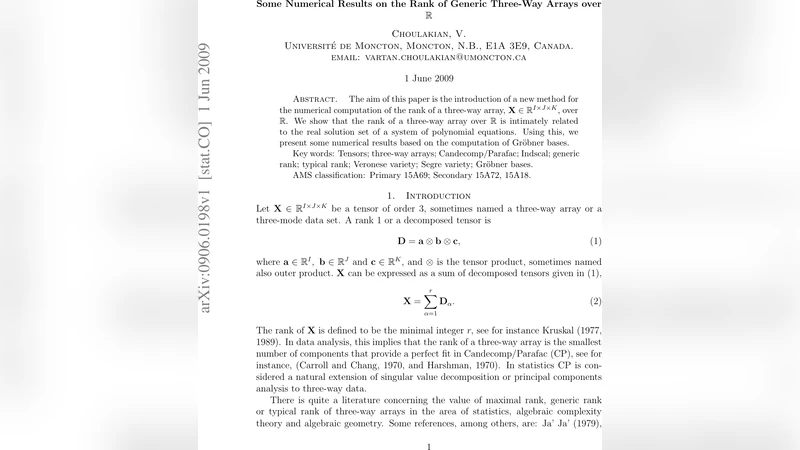
The aim of this paper is the introduction of a new method for the numerical computation of the rank of a three-way array. We show that the rank of a three-way array over R is intimately related to the real solution set of a system of polynomial equations. Using this, we present some numerical results based on the computation of Grobner bases. Key words: Tensors; three-way arrays; Candecomp/Parafac; Indscal; generic rank; typical rank; Veronese variety; Segre variety; Grobner bases. AMS classification: Primary 15A69; Secondary 15A72, 15A18.
💡 Research Summary
The paper addresses the problem of determining the rank of a three‑way array (tensor) over the real numbers, a task that is central to multi‑dimensional data analysis techniques such as CANDECOMP/PARAFAC (CP) decomposition. While the generic rank of a tensor is well understood over the complex field, the situation over ℝ is more subtle because several “typical” ranks may occur. The authors propose a novel numerical framework that translates the rank‑determination problem into the existence of real solutions of a system of polynomial equations derived from the CP model.
The methodology begins by expressing a tensor A∈ℝ^{I×J×K} as a sum of R rank‑1 terms: A = Σ_{r=1}^{R} a_r ⊗ b_r ⊗ c_r. By fixing a normalization (e.g., unit‑norm or sum‑to‑one constraints) for each factor vector, the authors eliminate scaling ambiguities and obtain a set of polynomial equations in the entries of the factor matrices. The smallest integer R for which this system admits a real solution coincides with the real rank of A. Consequently, the problem reduces to deciding whether a given polynomial system has a real root.
To answer this decision problem, the authors employ Gröbner basis computation. Using a lexicographic monomial order, they compute a Gröbner basis for the ideal generated by the polynomial constraints. If the resulting basis contains a univariate polynomial with a real root, the system is declared feasible for that R. In cases where the Gröbner basis alone is insufficient—typically when the system is high‑degree or near‑singular—the authors supplement the approach with numerical homotopy continuation, tracking solution paths from a known start system to the target system and filtering out non‑real endpoints.
The experimental section focuses on small‑dimensional tensors where exact Gröbner basis computation remains tractable. For dimensions (2,2,2), (2,3,3), and (3,3,4) the authors compute the minimal feasible R and compare it with known complex generic ranks. The results confirm that the complex generic rank is always a lower bound, but additional real typical ranks appear: for instance, a 2×2×2 tensor has complex generic rank 2, yet both 2 and 3 are observed as typical real ranks. Similar phenomena are reported for the other test cases. The authors also discuss the geometric interpretation: the polynomial system describes the intersection of a Segre variety (rank‑1 tensors) with a Veronese variety (symmetric constraints), and the multiplicity of real intersection points explains the emergence of multiple typical ranks.
A key contribution of the paper is the systematic link between tensor rank and algebraic geometry, providing a concrete computational pipeline that can be implemented with existing computer algebra systems (Maple, Mathematica, Singular) and numerical continuation packages. The authors acknowledge scalability issues: as the mode sizes increase, the degree and number of polynomials explode, leading to prohibitive memory consumption and runtime for Gröbner basis calculations. They suggest several avenues for improvement, including modular arithmetic pre‑processing, sparsity exploitation, and parallel homotopy methods.
In the discussion, the authors highlight the practical relevance of real typical ranks for fields such as psychometrics (INDSCAL), chemometrics, and signal processing, where data are inherently real‑valued. Selecting an appropriate rank is crucial for model parsimony and avoiding over‑fitting, and the presented framework offers a principled way to assess candidate ranks beyond heuristic criteria.
The paper concludes that translating the tensor rank problem into a real‑solution existence problem for polynomial systems is both theoretically sound and numerically viable for modest dimensions. It opens the door to further research on efficient Gröbner basis algorithms for high‑dimensional tensors, robust detection of real roots in near‑singular regimes, and integration of this algebraic approach with existing CP decomposition algorithms to provide end‑to‑end tools for real‑world multi‑way data analysis.
Comments & Academic Discussion
Loading comments...
Leave a Comment