Dynamos of giant planets
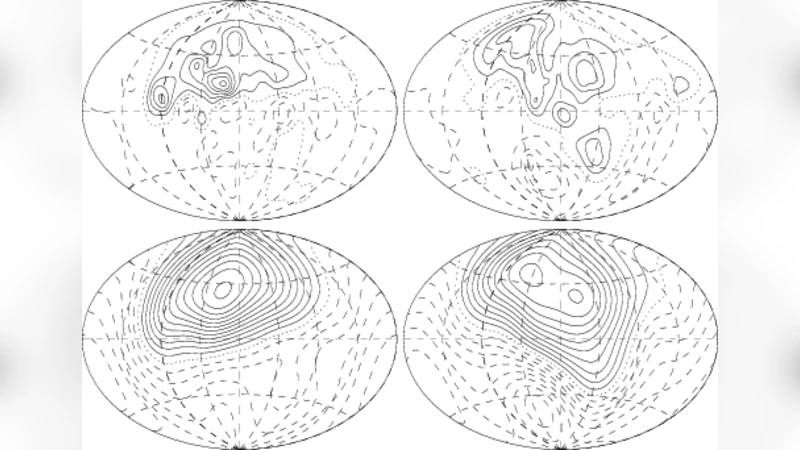
Possibilities and difficulties of applying the theory of magnetic field generation by convection flows in rotating spherical fluid shells to the Giant Planets are outlined. Recent progress in the understanding of the distribution of electrical conductivity in the Giant Planets suggests that the dynamo process occurs predominantly in regions of semiconductivity. In contrast to the geodynamo the magnetic field generation in the Giant Planets is thus characterized by strong radial conductivity variations. The importance of the constraint on the Ohmic dissipation provided by the planetary luminosity is emphasized. Planetary dynamos are likely to be of an oscillatory type, although these oscillations may not be evident from the exterior of the planets.
💡 Research Summary
The paper examines how the classical theory of magnetic field generation by convection in rotating spherical fluid shells—originally developed for the Earth’s geodynamo—must be modified to describe the dynamos of the giant planets. Recent high‑pressure experiments and ab‑initio calculations have shown that the electrical conductivity inside Jupiter, Saturn, Uranus and Neptune is far from uniform. Instead of a metallic core surrounded by a relatively homogeneous conducting mantle, these planets possess a deep region where hydrogen transitions from an insulating molecular phase to a metallic phase, with an extended intermediate semiconducting layer. Conductivity therefore varies by several orders of magnitude over a radial distance of a few thousand kilometres.
The authors argue that this strong radial conductivity gradient fundamentally changes the location and nature of the dynamo‑active region. Rather than being confined to a deep metallic core, the electric currents that sustain the magnetic field are concentrated in the semiconducting shell where the conductivity is moderate (≈10⁻⁴–10⁻² S m⁻¹ for Jupiter). In this shell the Coriolis force, buoyancy‑driven convection, and magnetic induction interact in a regime that is distinct from the Earth’s.
A second, equally critical constraint is the planetary luminosity. Ohmic dissipation—the conversion of magnetic energy into heat by electric currents—must not exceed the total internal heat flux that the planet radiates into space. If the dynamo were to generate currents that produce more heat than the planet’s observed luminosity (≈10²⁶ W for Jupiter and Saturn), the thermal balance would be violated. Consequently, any realistic dynamo model must incorporate the luminosity‑limited Ohmic loss as a hard upper bound on allowable current densities.
To explore these issues, the authors performed three‑dimensional magnetohydrodynamic simulations that simultaneously include (i) a radially varying conductivity profile derived from recent laboratory and theoretical work, (ii) rapid rotation typical of giant planets, and (iii) vigorous convection driven by internal heat. The simulations reveal that when the conductivity gradient is steep, the convective flow organizes into non‑axisymmetric columnar structures that shear the magnetic field and produce a thin, intense current sheet at the conductivity transition. This configuration naturally leads to an oscillatory dynamo: the magnetic field reverses polarity on timescales ranging from a few thousand to several million years, depending on the exact conductivity profile and rotation rate. From an external viewpoint, the field appears relatively steady because the oscillation period is long compared to human observational windows, which explains why Jupiter’s field looks dipolar and stable, while Uranus and Neptune exhibit highly tilted, non‑dipolar fields that may be snapshots of an ongoing oscillation.
The paper also highlights that the thin current sheet amplifies electromagnetic torques, enhancing the efficiency of magnetic field generation despite the modest conductivity of the semiconducting layer. This mechanism contrasts sharply with the Earth’s dynamo, where the magnetic field is primarily sustained by a uniformly conducting liquid‑iron outer core.
In summary, the authors conclude that giant‑planet dynamos are governed by two dominant factors: (1) strong radial variations in electrical conductivity that relocate the dynamo action to a semiconducting shell, and (2) the requirement that Ohmic dissipation remain below the planetary luminosity. These constraints produce dynamos that are likely oscillatory, possibly non‑axisymmetric, and whose surface signatures may not reveal the underlying temporal variability. The study calls for future work that couples high‑resolution conductivity models with long‑term magnetic observations, both for the Solar System giants and for exoplanets, to test and refine this revised dynamo paradigm.
Comments & Academic Discussion
Loading comments...
Leave a Comment