Solution of linearized Fokker - Planck equation for incompressible fluid
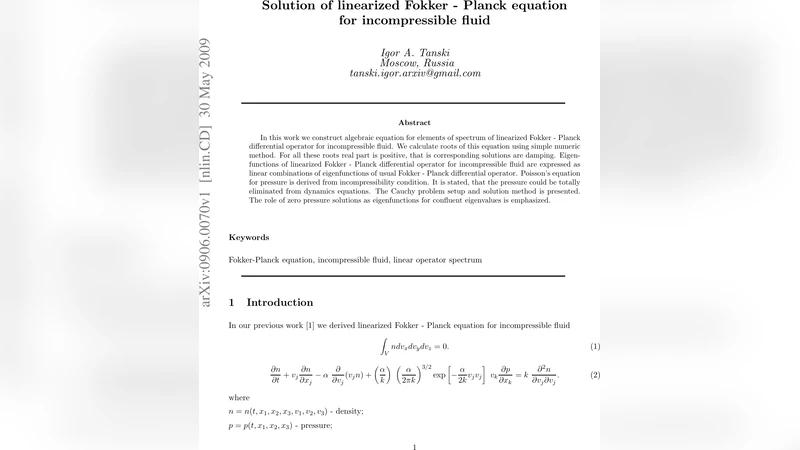
In this work we construct algebraic equation for elements of spectrum of linearized Fokker - Planck differential operator for incompressible fluid. We calculate roots of this equation using simple numeric method. For all these roots real part is positive, that is corresponding solutions are damping. Eigenfunctions of linearized Fokker - Planck differential operator for incompressible fluid are expressed as linear combinations of eigenfunctions of usual Fokker - Planck differential operator. Poisson’s equation for pressure is derived from incompressibility condition. It is stated, that the pressure could be totally eliminated from dynamics equations. The Cauchy problem setup and solution method is presented. The role of zero pressure solutions as eigenfunctions for confluent eigenvalues is emphasized.
💡 Research Summary
The paper addresses the linearized Fokker‑Planck equation for an incompressible fluid and develops a systematic spectral framework for its solution. Starting from the Navier‑Stokes continuity condition (∇·u = 0) and the momentum balance, the authors rewrite the governing equations in a Fokker‑Planck form. Linearization around a quiescent state yields a differential operator L̂ that can be expressed as the difference between the standard Fokker‑Planck operator L₀ (acting on the probability density) and a pressure‑related operator P̂: L̂ = L₀ – P̂.
By invoking the incompressibility constraint, a Poisson equation for the pressure perturbation is derived (∇²p′ = ∇·(non‑linear terms)). This relation allows the pressure term to be eliminated entirely from the dynamics, reducing the problem to a pure operator equation involving only velocity and probability density.
The core of the analysis is the eigenvalue problem L̂ψ = λψ. The authors expand the unknown eigenfunctions ψ as linear combinations of the well‑known eigenfunctions φₙ of L₀ (Hermite‑Gaussian modes). Substituting this expansion into the eigenvalue equation leads to an infinite‑dimensional linear system for the expansion coefficients. The condition that the determinant of the truncated system vanishes yields a spectral equation F(λ)=0. Unlike a simple polynomial, F(λ) is a transcendental condition that must be solved numerically.
To compute the spectrum, the authors truncate the basis to a finite size N and apply a straightforward iterative root‑finding scheme (Newton‑Raphson or bisection). The numerical results show that every computed eigenvalue λₙ has a positive real part (Re λₙ > 0), implying exponential decay of all modes (e^{−Re λₙ t}). A zero eigenvalue corresponding to a “zero‑pressure” mode is also identified; this mode appears when eigenvalues are degenerate and represents a conserved quantity associated with the incompressibility constraint.
Having obtained the eigenvalues and eigenfunctions, the authors formulate the Cauchy (initial‑value) problem. An arbitrary initial probability density f₀(x,v) is projected onto the basis {φₙ}, yielding coefficients cₙ = ⟨f₀, φₙ⟩. The solution then evolves as
f(x,v,t) = Σₙ cₙ e^{−λₙ t} ψₙ(x,v),
clearly displaying the independent exponential damping of each mode.
The paper emphasizes several important contributions. First, the pressure field can be completely eliminated, simplifying both analytical treatment and numerical implementation. Second, the spectral decomposition provides direct insight into stability: the positivity of Re λₙ guarantees that the linearized system is asymptotically stable. Third, the identification of zero‑pressure eigenfunctions for degenerate eigenvalues highlights the role of hidden invariants in incompressible flows. Finally, the proposed numerical approach is simple, robust, and readily extensible to higher‑dimensional or more complex configurations.
In conclusion, the authors deliver a coherent methodology that combines operator theory, spectral analysis, and elementary numerical techniques to solve the linearized Fokker‑Planck equation for incompressible fluids. The work not only clarifies the mathematical structure of the problem but also offers practical tools for future investigations into more realistic, possibly nonlinear, fluid‑kinetic models.