The paper starts from the observation on the complexity of the manipulation of fuzzy processes that increases very rapidly with the extents of the processes representation. Therefore, a productive approach is to divide the problem into smaller parts, treated separately and then the results combined. Some algebraic results obtained by the authors are presented.
Deep Dive into On Some Manipulations with Fuzzy Processes.
The paper starts from the observation on the complexity of the manipulation of fuzzy processes that increases very rapidly with the extents of the processes representation. Therefore, a productive approach is to divide the problem into smaller parts, treated separately and then the results combined. Some algebraic results obtained by the authors are presented.
We remind the notion of fuzzy process that we introduced in [LD01], a formalism for the notion of fuzzy contract between a device and its environment. Such a contract specifies the device-environment interface in terms of executions, which can be sequences of events, time functions, etc; yet we will consider them justly as elements of an arbitrary set E.
Let E be the set of all executions and
be two fuzzy subsets of E. In what follows, we note with:
and we respectively call:
• X -the set of accessible executions;
• Y -the set of acceptable executions;
• B -the set of rejections. Additionally, we note ,
, where X ∆ and Y Γ are defined as above, is called a (vague) fuzzy process over E.
The set of all fuzzy processes over a pair of crisp subsets X and Y of E, as above, is called the space of the fuzzy process of (X, Y), and the set of all fuzzy process over E is called the space of the fuzzy process of E. ■
In [Luc03] we studied in detail the refination ( ), we defined and studied the operations with fuzzy processes: the sum (⊕), the product (⊗), the intersection ( ), the reunion ( ), and the reflection (-).
As we could notice, the complexity of manipulation of fuzzy processes increases very rapidly with the representation of their extent. Therefore, a productive approach consists in dividing the problem into smaller parts, treated separately and then combining the results.
We start by presenting some algebraic results we have obtained:
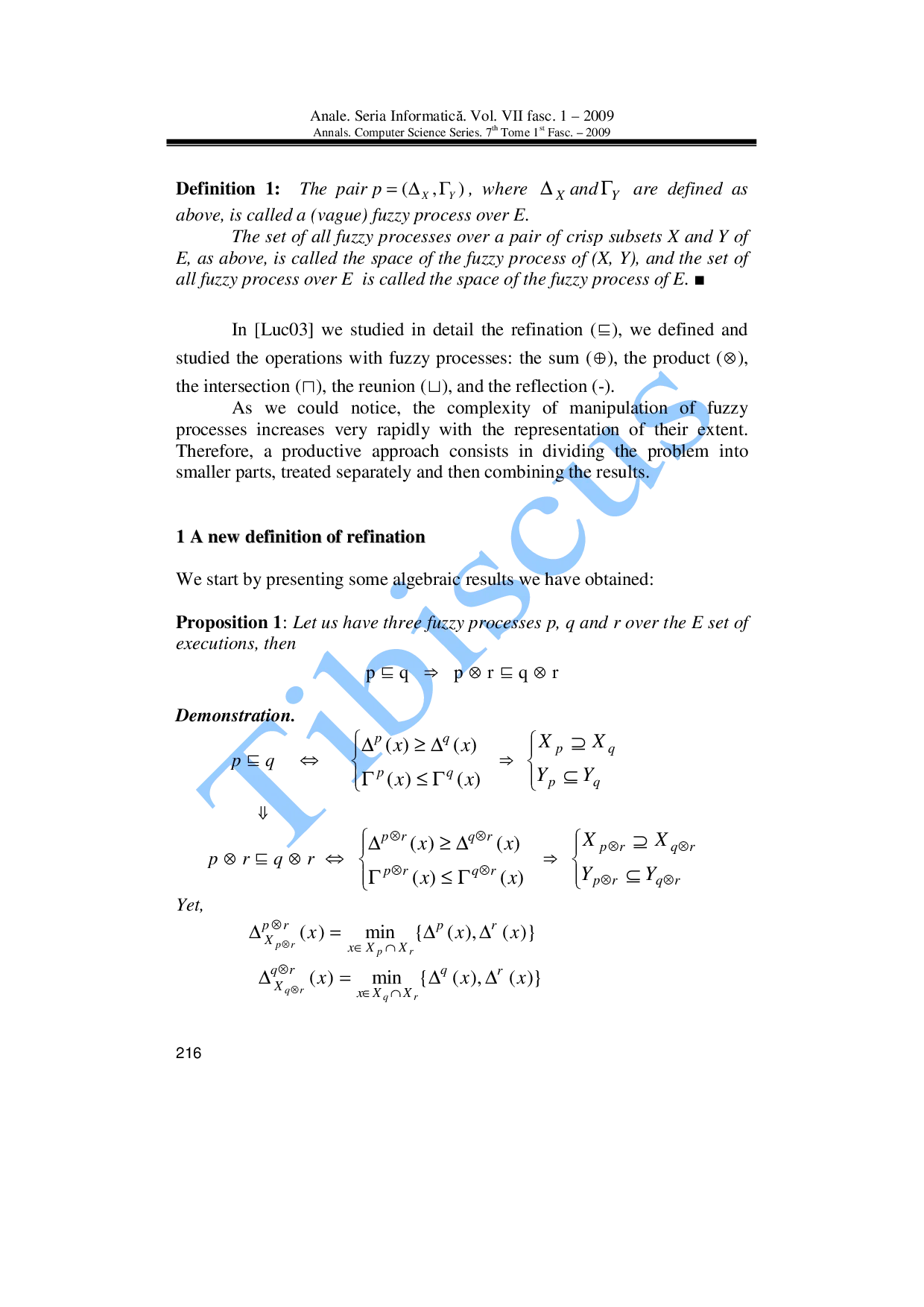
Proposition 1: Let us have three fuzzy processes p, q and r over the E set of executions, then p q ⇒ p ⊗ r q ⊗ r Demonstration.
■ Corollary 1: Let the fuzzy processes p and q be over the E set of executions, then p q ⇒ p p ⊗ q Demonstration: Considering from the proposition 1 we obtain:
Corollary 2: Let the fuzzy processes p 1 , p 2 , q 1 , q 2 and q be over the E set of executions:
Demonstration. i) From proposition 1 we obtain that:
(from the commutativity of ⊗) From the transitivity of the refination relation:
ii) immediately results from the idempondency of ⊗, by the substitution of q 1, respectively q 2 with q and applying the relation i):
Proposition 1, together with the transitivity of the refination and the commutativity of the product, enables the modular and hierarchical verification. The problem is to determine if p q, where p is a specification and q an implementation. The idea is to determine a chain of intermediate specifications t 0 , t 1 ,…,t n so that t 0 =p şi t n =q.
The intermediate specifications (including p and q) may be broken into components:
Then, we verify for each j, that:
From the monotony of the product ⊗ comparing with , it follows:
and from the transitivity we establish that for p q.
If we also consider the property of idempotency the consecutive specifications can be partially covered: the refination between p and q can be checked by breaking p in more parts:
and, then, by comparing each part with q. The parts of p can be considered the properties that must be individually verified. If for each index i, p i q, then p q.
It is obvious that the technique of modular and hierarchical verification, with a finite number of levels of specifications and with a finite number of components at each level is justified by corollary 2.
An alternative definition of the refination is to say that an “implementation” q relatively is correct to a “specification” p, if q operates properly in the environment of p. The question is whether this alternative definition is equivalent to the definition 8 (definition 8) of paper [LL09].
The following proposition answers positively to this question and therefore it connects the notions of absolute and relative correctness (see [LL09]). Theorem 1. Let us have two fuzzy processes p and q over the set of executions E,
The above theorem allows us to verify whether an implementation satisfies the specification, by placing the implementation in the environment of the specification and then verifying the condition of the absolute correctness of their product. Our result is identical to that obtained in the classical approaches (i.e, [Ver94]).
We can give an alternative definition for refination in terms of testing: q is “better than or as good” as p if q passes all the tests that p can pass. Passing a test r can be seen as an absence of rejections when the device is connected to r.
The following theorem shows that this definition of refination is equivalent to the definition 8 from [LD01], and therefore it provides a new connection between the notions of absolute and relative correctness from the space of the fuzzy process.
Theorem 2: Let us have two fuzzy processes p and q over the set of executions E,
Demonstration. From theorem 1 and proposition 1 we have that:
So, it is sufficient to show that: p q ∀r (r p ⇒r q ) The first implication follows from the transitivity of the refineries: p q ∧r p ⇒r q Reciprocally, let us have r = -p, then -r = p and from the reflexivity of the refination ⇒r q. F
…(Full text truncated)…
This content is AI-processed based on ArXiv data.