A "working mathematicians" definition of semi-abelian categories
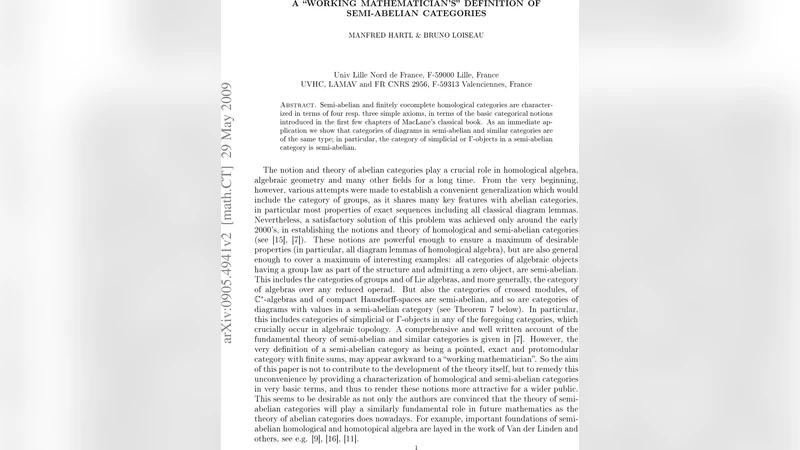
Semi-abelian and finitely cocomplete homological categories are characterized in terms of four resp. three simple axioms, in terms of the basic categorical notions introduced in the first few chapters of MacLane’s classical book. As an immediate application we show that categories of diagrams in semi-abelian and similar categories are of the same type; in particular, the category of simplicial or \Gamma-objects in a semi-abelian category is semi-abelian.
💡 Research Summary
The paper presents a streamlined, “working mathematician’s” definition of semi‑abelian categories and of finitely cocomplete homological (or simply homological) categories, using only the elementary categorical notions that appear in the first chapters of Mac Lane’s classic textbook. The authors show that a homological category can be captured by three elementary axioms: (1) every monomorphism is regular, (2) every epimorphism is regular, and (3) short exact sequences satisfy the “three‑arrow lemma”, a condition that replaces the traditional kernel‑cokernel formulation. Adding a fourth axiom—regular epimorphisms always admit a cokernel—yields the definition of a semi‑abelian category. Each axiom is proved to be independent, and together they guarantee the usual homological properties such as stability of regular epimorphisms under pullback, the existence of a well‑behaved notion of exactness, and the ability to form internal actions and central extensions.
A central technical contribution is the proof that these axioms are preserved under formation of functor (diagram) categories. For any small indexing category I and any semi‑abelian category C, the functor category Fun(I, C) inherits pointwise limits and colimits, and pointwise regular monomorphisms and epimorphisms remain regular. Moreover, a pointwise regular epimorphism still has a cokernel computed pointwise, so Fun(I, C) satisfies the same four axioms and is therefore semi‑abelian. This result immediately implies that the categories of simplicial objects Δᵒᵖ→C and of Γ‑objects Γ→C are semi‑abelian whenever C is.
The authors illustrate the theory with a range of classical examples: groups, Lie algebras, commutative rings, and various algebraic structures that have been known to form semi‑abelian categories. They verify that each of these satisfies the four axioms, confirming that the new definition is fully compatible with the established literature. By avoiding the more sophisticated machinery traditionally employed (e.g., protomodular conditions, internal actions, or the Smith is Huq condition), the paper offers a definition that is both conceptually simple and readily checkable in concrete settings.
In summary, the paper achieves three main goals. First, it reduces the definition of semi‑abelian and homological categories to a minimal set of elementary axioms, making the concepts more accessible to mathematicians who need to apply them without delving into deep categorical theory. Second, it demonstrates that these definitions are stable under diagrammatic constructions, thereby extending the semi‑abelian framework to simplicial, Γ‑, and more general diagram categories. Third, it validates the approach by showing that all standard examples fit neatly into the new axiomatic scheme. The work thus provides a practical foundation for further developments in categorical algebra, homological algebra, and related areas of theoretical computer science where semi‑abelian structures play a role.
Comments & Academic Discussion
Loading comments...
Leave a Comment