Final coalgebras in accessible categories
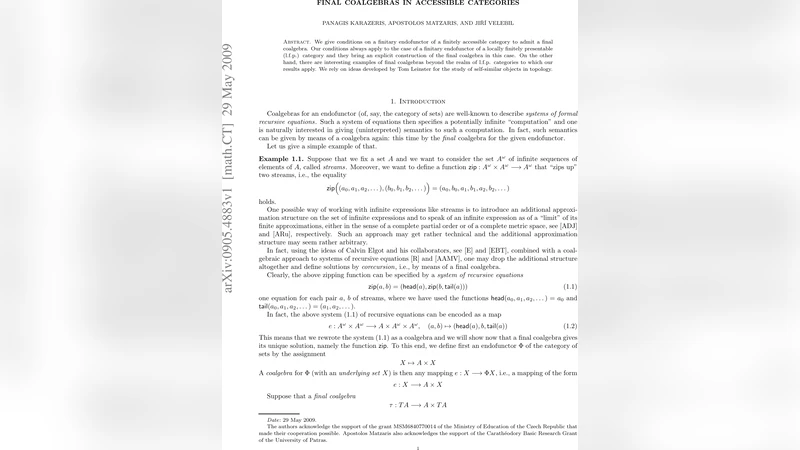
We give conditions on a finitary endofunctor of a finitely accessible category to admit a final coalgebra. Our conditions always apply to the case of a finitary endofunctor of a locally finitely presentable (l.f.p.) category and they bring an explicit construction of the final coalgebra in this case. On the other hand, there are interesting examples of final coalgebras beyond the realm of l.f.p. categories to which our results apply. We rely on ideas developed by Tom Leinster for the study of self-similar objects in topology.
💡 Research Summary
The paper investigates the existence of final coalgebras for finitary endofunctors on finitely accessible categories, extending classical results that were limited to locally finitely presentable (l.f.p.) categories. After recalling the definition of a finitely accessible category—one generated under λ‑directed colimits by a set of finitely presentable objects—the authors focus on endofunctors F that are finitary, i.e., they preserve λ‑directed colimits for some regular cardinal λ larger than the presentability rank of the generating objects.
The central technical contribution is an adaptation of Tom Leinster’s self‑similarity framework. The authors introduce an “accessible chain” built from the initial F‑algebra by repeatedly applying a dual transition that moves “backwards” along F. Each step of the chain is a λ‑directed colimit of earlier stages, and because F preserves such colimits, the chain stabilises in a precise categorical sense. The limit of this dual chain—an inverse limit taken in the ambient category—turns out to be a final F‑coalgebra.
The main theorem states that if a finitely accessible category C admits sufficiently large λ‑directed colimits and a finitary endofunctor F preserves those colimits, then the dual chain construction yields a final coalgebra for F. The proof shows that the limit object inherits a unique coalgebra structure and that any other F‑coalgebra admits a unique morphism into it, establishing finality.
A crucial corollary is that the theorem automatically applies to any locally finitely presentable category. In an l.f.p. setting every object is a λ‑directed colimit of finitely presentable ones, so the required λ‑directed colimits exist and are preserved by any finitary functor. Consequently, the paper not only recovers known existence results for final coalgebras in l.f.p. categories but also supplies an explicit, constructive method: start from the initial algebra, generate the accessible chain, and take its inverse limit.
Beyond the l.f.p. realm, the authors present several illustrative examples where the ambient category is not locally finitely presentable yet the conditions hold. Notable cases include the countable powerset functor on Set, certain graph‑expansion functors, and functors generating infinite trees. In each instance the functor is finitary and preserves the relevant directed colimits, so the construction yields a final coalgebra that was previously unknown.
The paper concludes with a discussion of potential applications. Final coalgebras model canonical “steady‑state” behaviours in systems theory, serve as fixed points for recursive domain equations, and capture self‑similar structures such as fractals. The accessible‑chain method provides an algorithmic blueprint for computing such fixed points, suggesting uses in the semantics of programming languages, the analysis of infinite-state machines, and the design of data‑flow networks. The authors outline future work on extending the framework to higher‑dimensional categorical settings and on improving the computational aspects of the construction.
In summary, the work delivers a robust, category‑theoretic criterion for the existence of final coalgebras of finitary endofunctors on finitely accessible categories, unifies and generalises earlier results for l.f.p. categories, and opens the door to new applications in mathematics and computer science.
Comments & Academic Discussion
Loading comments...
Leave a Comment