On Kurosh problem in varieties of algebras
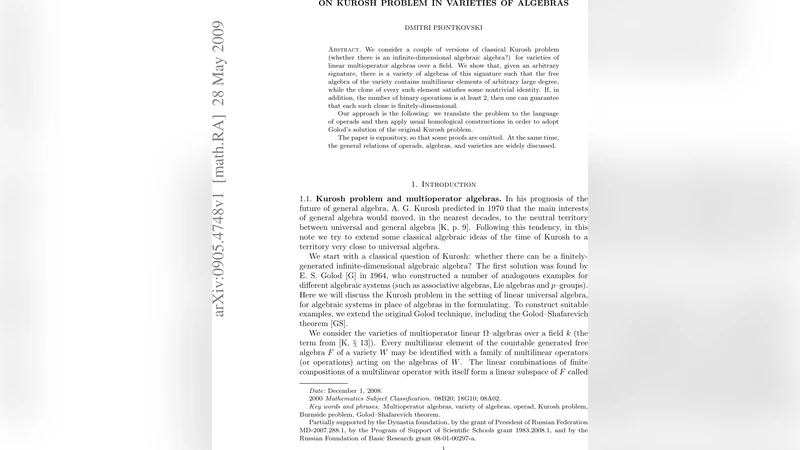
We consider a couple of versions of classical Kurosh problem (whether there is an infinite-dimensional algebraic algebra?) for varieties of linear multioperator algebras over a field. We show that, given an arbitrary signature, there is a variety of algebras of this signature such that the free algebra of the variety contains multilinear elements of arbitrary large degree, while the clone of every such element satisfies some nontrivial identity. If, in addition, the number of binary operations is at least 2, then one can guarantee that each such clone is finitely-dimensional. Our approach is the following: we translate the problem to the language of operads and then apply usual homological constructions, in order to adopt Golod’s solution of the original Kurosh problem. The paper is expository, so that some proofs are omited. At the same time, the general relations of operads, algebras, and varieties are widely discussed.
💡 Research Summary
The paper revisits the classical Kurosh problem – whether an infinite‑dimensional algebra all of whose elements satisfy a polynomial identity (i.e., an algebraic algebra) can exist – and lifts it to the setting of linear multi‑operator algebras over a field. The authors work with an arbitrary signature Σ, possibly containing many n‑ary operations, and ask whether one can construct a variety V of Σ‑algebras whose free algebra F_V contains multilinear elements of arbitrarily large degree, while each such element generates a clone that satisfies a non‑trivial identity. Moreover, when the signature contains at least two binary operations, the clones can be forced to be finite‑dimensional.
The central methodological move is to translate the problem into the language of operads. An operad encodes the composition rules of the operations in Σ, and the free algebra of a variety can be identified with a free module over the corresponding free operad. This identification makes it possible to apply homological tools that were originally used by Golod in his solution of the original Kurosh problem for associative algebras.
The authors first construct, for any given Σ, the free operad O(Σ) and describe its presentation by generators (the operations of Σ) and relations. They then consider the graded module M = O(Σ)·X, where X is a set of formal generators placed in degree one. Using Golod–Shafarevich type estimates for the Hilbert series of M, they show that the series diverges, which implies that M contains non‑zero multilinear elements in every degree. Consequently, the free algebra F_V of the associated variety V contains multilinear elements of arbitrarily large degree.
For each multilinear element m ∈ F_V, the clone C(m) is the sub‑operad generated by the operations that appear in the expression of m. By carefully adding extra operadic relations to O(Σ), the authors guarantee that C(m) satisfies at least one non‑trivial operadic identity. In other words, although the whole variety V is “large” (it admits elements of unbounded degree), every individual clone is constrained by an identity, preventing it from being a free operad itself.
When the signature contains at least two binary operations, the authors introduce additional quadratic relations that force any clone generated by a multilinear element to be finite‑dimensional. The proof relies on a refined homological argument: the presence of two independent binary operations yields a richer Koszul dual structure, which in turn bounds the growth of the corresponding sub‑operad. Thus each clone C(m) becomes a finite‑dimensional algebraic object, even though the ambient free algebra remains infinite‑dimensional.
The paper is organized as follows. After a historical overview of the Kurosh problem and Golod’s solution, Section 2 recalls basic notions of varieties, clones, and operads, emphasizing the correspondence between free algebras and free operad modules. Section 3 presents the construction of the operad O(Σ) and derives the Golod‑type inequality for its Hilbert series. Section 4 proves the main theorem: existence of a variety with the required properties, and the finiteness of clones under the binary‑operation hypothesis. Section 5 supplies concrete examples, such as a signature with two binary and one ternary operation, and works out the explicit identities satisfied by the clones. The final section discusses open questions, including precise dimension estimates for clones, extensions to non‑linear or non‑associative settings, and potential applications to universal algebra, computer‑science semantics, and deformation theory.
In summary, by recasting the Kurosh problem in operadic terms and applying Golod’s homological machinery, the authors exhibit a broad class of varieties of multi‑operator algebras that simultaneously display infinite‑dimensional free objects and highly constrained, often finite‑dimensional, substructures. This work not only provides a new solution to a classical problem but also showcases the power of operad theory as a unifying framework for tackling deep questions in algebra.
Comments & Academic Discussion
Loading comments...
Leave a Comment