We present an upper limit of galactic diffuse gamma-ray flux, measured with the GAMMA experiment at energy about 175 TeV. The results were obtained using selection of muon poor extensive air showers at mountain level (700 g/cm^2, Mt. Aragats, Armenia) for 5 GeV muon energy threshold. An upper limit for the differential flux at energy E=175+/-25 TeV is equal to (5.8-7.0)x10^-12 [erg m^2 s sr]^-1 for 95% confidence level.
Deep Dive into Galactic diffuse gamma-ray flux at the energy about 175 TeV.
We present an upper limit of galactic diffuse gamma-ray flux, measured with the GAMMA experiment at energy about 175 TeV. The results were obtained using selection of muon poor extensive air showers at mountain level (700 g/cm^2, Mt. Aragats, Armenia) for 5 GeV muon energy threshold. An upper limit for the differential flux at energy E=175+/-25 TeV is equal to (5.8-7.0)x10^-12 [erg m^2 s sr]^-1 for 95% confidence level.
Ultra-high energy (E > 100 TeV) galactic gammaradiation is an important source of information about the origin of cosmic rays and their propagation. According to conventional model of cosmic rays the expected flux of ultra-high energy γ-rays in the energy range of 0.1 -1 PeV has presumably to have hadronic origin from sources distributed within radii ∼ 1 -0.01 Mpc [1] respectively.
In the very-high (TeV) energy region γ-ray flux was measured by ground-based systems and single Cherenkov telescopes (Whipple [2], CANGAROO [3], MAGIC [4], H.E.S.S. [5], MILAGRO [6]). The measurements in the ultra-high energy region (E > 100 TeV) are still poor and made only by extensive air showers (EAS) arrays at Chacaltaya [7], MSU [8], Tien-Shan [9], CASA-MIA [11], EAS-TOP [12], KASCADE [13] and Grapes-III [10].
This paper is devoted to measurements of the diffuse gamma-rays with GAMMA EAS array [14], [15] at Aragats mountain observatory, where correlation of observable shower parameters with primary energy is about 0.98. The primary nuclei (predominantly H) and γ-showers were discriminated using no-muon signal from underground muon scintillation carpet.
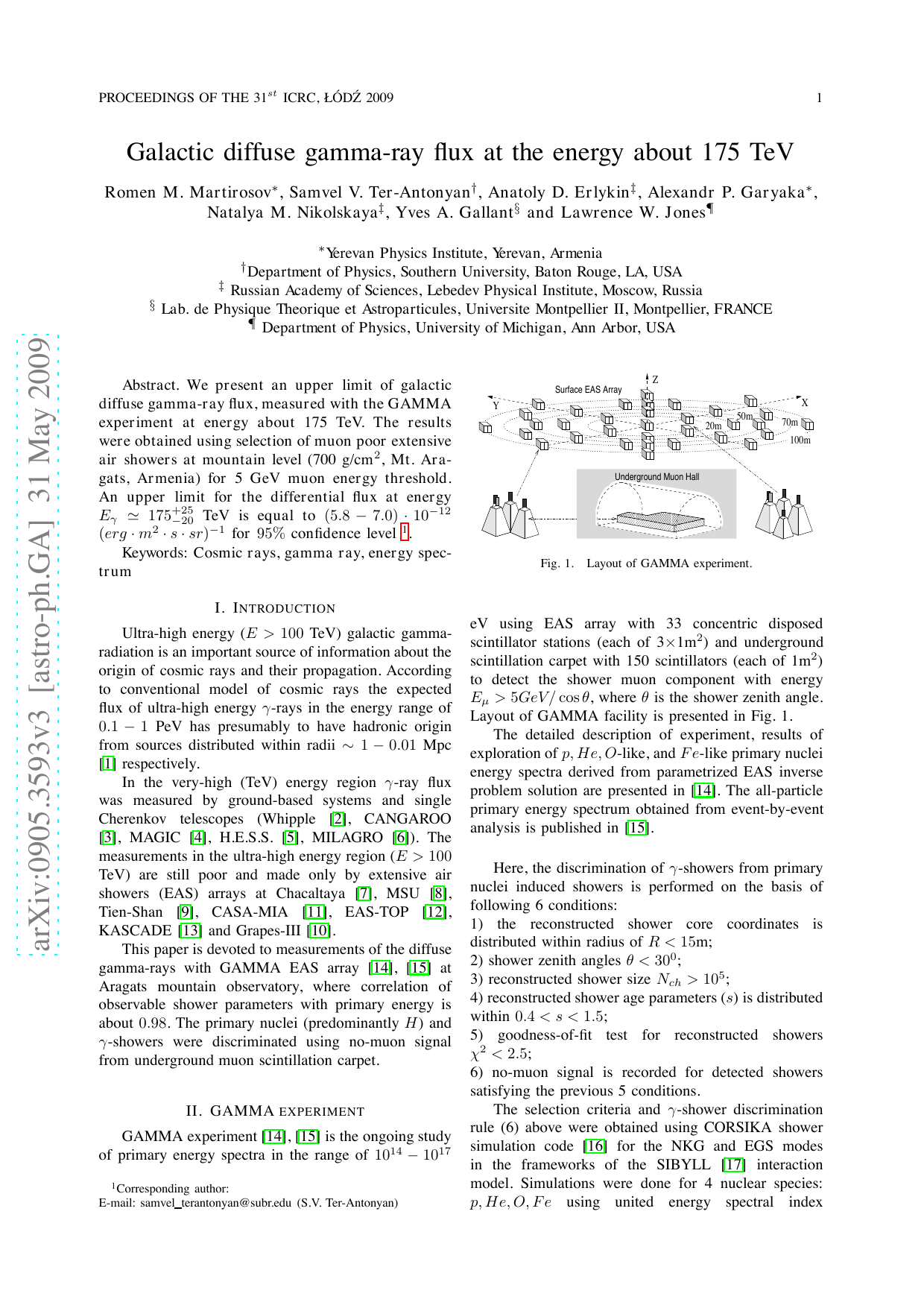
GAMMA experiment [14], [15] is the ongoing study of primary energy spectra in the range of 10 eV using EAS array with 33 concentric disposed scintillator stations (each of 3×1m 2 ) and underground scintillation carpet with 150 scintillators (each of 1m 2 ) to detect the shower muon component with energy E µ > 5GeV / cos θ, where θ is the shower zenith angle. Layout of GAMMA facility is presented in Fig. 1.
The detailed description of experiment, results of exploration of p, He, O-like, and F e-like primary nuclei energy spectra derived from parametrized EAS inverse problem solution are presented in [14]. The all-particle primary energy spectrum obtained from event-by-event analysis is published in [15].
Here, the discrimination of γ-showers from primary nuclei induced showers is performed on the basis of following 6 conditions: 1) the reconstructed shower core coordinates is distributed within radius of R < 15m; 2) shower zenith angles θ < 30 0 ; 3) reconstructed shower size N ch > 10 5 ; 4) reconstructed shower age parameters (s) is distributed within 0.4 < s < 1.5; 5) goodness-of-fit test for reconstructed showers χ 2 < 2.5; 6) no-muon signal is recorded for detected showers satisfying the previous 5 conditions.
The selection criteria and γ-shower discrimination rule (6) above were obtained using CORSIKA shower simulation code [16] for the NKG and EGS modes in the frameworks of the SIBYLL [17] interaction model. Simulations were done for 4 nuclear species: p, He, O, F e using united energy spectral index
, where α A and N 0,A parameters depend on primary particle (A). γ = -2.7 [14]. Simulated samples were equal 7.5 × 10 5 , 10 5 , 7 × 10 4 and 5 × 10 4 for p, He, O, F e nuclei and NKG mode of CORSIKA. The samples for the EGS mode of CORSIKA were equal to 2.5 × 10 4 for primary γ-quanta, 7.5 × 10 4 for primary protons and 3 × 5000 for He, 0 and F e primary nuclei. The simulation strategy and reconstruction method for shower size (N ch ), age parameter (s), core coordinates (x 0 , y 0 ) and shower zenith angle (θ) were the same as in [14].
The shower trigger efficiency and shower size reconstruction errors (∆ N ch and σ N ch ) are presented in Figs. 2,3 respectively. The observed differences of reconstructed shower size biases ∆ N ch for different primary particles (Fig. 3, lower panel) stems from differences of corresponding lateral distribution functions of shower particles.
The distribution of detected shower age parameters (GAMMA data) in comparison with expected distributions for primary p, He, O, F e nuclei are presented in Fig. 4 (left panel). The primary elemental composition and energy spectra were taken from solution of parametrized EAS inverse problem [14] in the frameworks of the SIBYLL interaction model (Fig. 5, shaded area [14]) and were extrapolated up to the 100 TeV energy region. The reliability of this extrapolations stems from data [18].
The right panel of Fig. 4 shows distribution of shower age parameters for selected no-muon signal events (shades GAMMA data area) in comparison with corresponding expected distributions from the simulated γ-showers and background proton showers. It is well seen, that the EAS age parameter is also a data carrier about primary particle (γ-showers are younger). However, we did not include yet the age parameter in the γ-showers selection criteria. Results in Fig. 4 we use only as indication of an agreement between simulated and corresponding detected distributions.
The detected muon number spectra in the normalization of probability density function for different shower size thresholds (N ch > 10 5 , 2 × 10 5 and 4 × 10 5 ) are presented in Fig. 6 (hollow symbols) in comparison with the corresponding expected spectra from different primary particles (γ, p, He, O, F e) and ) Fig. 5. Primary energy spectra and all-par
…(Full text truncated)…
This content is AI-processed based on ArXiv data.