Alexander B. Medvinsky \emph{et al} [A. B. Medvinsky, I. A. Tikhonova, R. R. Aliev, B.-L. Li, Z.-S. Lin, and H. Malchow, Phys. Rev. E \textbf{64}, 021915 (2001)] and Marcus R. Garvie \emph{et al} [M. R. Garvie and C. Trenchea, SIAM J. Control. Optim. \textbf{46}, 775-791 (2007)] shown that the minimal spatially extended reaction-diffusion model of phytoplankton-zooplankton can exhibit both regular, chaotic behavior, and spatiotemporal patterns in a patchy environment. Based on that, the spatial plankton model is furtherly investigated by means of computer simulations and theoretical analysis in the present paper when its parameters would be expected in the case of mixed Turing-Hopf bifurcation region. Our results show that the spiral waves exist in that region and the spatiotemporal chaos emerge, which arise from the far-field breakup of the spiral waves over large ranges of diffusion coefficients of phytoplankton and zooplankton. Moreover, the spatiotemporal chaos arising from the far-field breakup of spiral waves does not gradually involve the whole space within that region. Our results are confirmed by means of computation spectra and nonlinear bifurcation of wave trains. Finally, we give some explanations about the spatially structured patterns from the community level.
Deep Dive into Emergence of spatiotemporal chaos driven by far-field breakup of spiral waves in the plankton ecological systems.
Alexander B. Medvinsky \emph{et al} [A. B. Medvinsky, I. A. Tikhonova, R. R. Aliev, B.-L. Li, Z.-S. Lin, and H. Malchow, Phys. Rev. E \textbf{64}, 021915 (2001)] and Marcus R. Garvie \emph{et al} [M. R. Garvie and C. Trenchea, SIAM J. Control. Optim. \textbf{46}, 775-791 (2007)] shown that the minimal spatially extended reaction-diffusion model of phytoplankton-zooplankton can exhibit both regular, chaotic behavior, and spatiotemporal patterns in a patchy environment. Based on that, the spatial plankton model is furtherly investigated by means of computer simulations and theoretical analysis in the present paper when its parameters would be expected in the case of mixed Turing-Hopf bifurcation region. Our results show that the spiral waves exist in that region and the spatiotemporal chaos emerge, which arise from the far-field breakup of the spiral waves over large ranges of diffusion coefficients of phytoplankton and zooplankton. Moreover, the spatiotemporal chaos arising from the far
There is a growing interest in the spatial pattern dynamics of ecological systems [1,2,3,4,5,6,7,8,9,10,11,12,13]. However, many mechanisms of the spatiotemporal variability of natural plankton populations are not known yet. Pronounced physical patterns like thermoclines, upwelling, fronts and eddies often set the frame for the biological process. Measurements of the underwater light field are made with state-of-the-art instruments and used to calculate concentrations of phytoplankton biomass (as chlorophyll) as well as other forms of organic matter. Very high diffusion of the marine environment would prevent the formation of any stable patch spatial distribution with much longer life-time than the typical time of biodynamics. Meanwhile, in addition to very changeable transient spatial patterns, there also exist other spatial patterns in marine environment, much more stable spatial structure associated with ocean fronts, spatiotemporal chaos [10,11,14], cyclonic rings, and so called meddies [15]. In fact, it is significant to create the biological basis for understanding spatial patterns of plankton [16]. For instance, the impact of space on the persistence of enriched ecological systems was proved in laboratory experiments [17]. Recently, it has been shown both in laboratory experiments [18] and theoretically [14,19,20,21] that the existence of a spatial structure makes a predator-prey system less prone to extinc-tion. This is due to the temporal variations of the density of different sub-populations can become asynchronous and the events of local extinction can be compensated due to re-colonization from other sites in the space [22]. During a long period of time, all the spiral waves have been widely observed in diverse physical, chemical, and biological systems [23,24,25,26]. However, a quite limited number of documents [11,12,27,28,29] concern the spiral wave pattern and its breakup in the ecological systems.
The investigation of transition from regular patterns to spatiotemporally chaotic dynamics in spatially extended systems remains a challenge in nonlinear science [14,23,30,31]. In a nonlinear ecology system, the two most commonly seen patterns are spiral waves and turbulence (spatio-temporal chaos) for the level of the community [32]. It has been recently shown that spontaneous spatiatemoporal pattern formation is an instrinsic property of a predator-prey system [11,14,33,34,35,36] and spatiotemporal structures play an important role in ecological systems. For example, spatially induced speciation prevents the extinction of the predator-prey models [11,12,37]. So far, plankton patchiness has been observed on a wide range of spatial temporal scales [38,39]. There exist various, often heuristic explanations of the spatial patterns phenomenon for these systems. It should be noted that, although conclusive evidence of ecological chaos is still to be found, there is a growing number of indications of chaos in real ecosystems [40,41,42,43]. section and a major transition in evolution. In present paper, the scenario in the spatially extended plankton ecological system is observed by means of the numerical simulation. The system has been demonstrated to exhibit regular or chaostic, depending on the initial conditions and the parameter values [10,29]. We find that the far-field breakup of the spiral wave leads to complex spatiotemporal chaos (or a turbulentlike state) in the spatially extended plankton model (1). Our results show that regular spiral wave pattern shifts into spatiotemporal chaos pattern by modulating the diffusion coefficients of the species.
In this paper we study the spatially extended nutrientphytoplankton-zooplankton-fish reaction-diffusion system. Following Scheffer’s minimal approach [44], which was originally formulated as a system of ordinary diffential equation (ODEs) and later developed models [10,11,29,45,46], as a further investigation, we study a two-variable phytoplankton and zooplankton model on the level of the community to describe pattern formation with the diffusion. The dimensionless model is written as
where the parameters are r, a, b, m, n, d p , d h , and f which refer to work in Refs. [10,11]. The explanation of model (1) relates to the nutrient-phytoplanktonzooplankton-fish ecological system [see Refs. [10,29,44] for details]. The local dynamics are given by
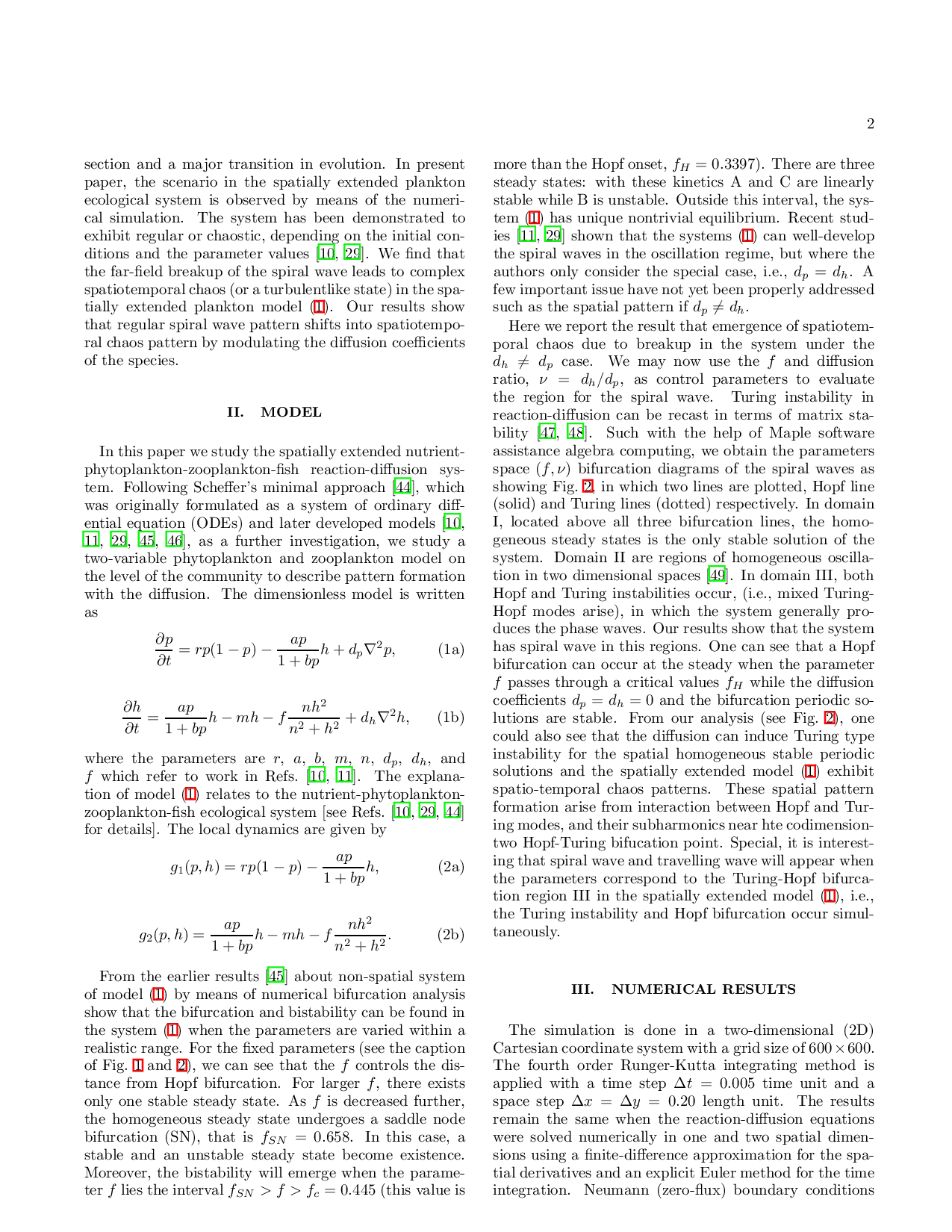
From the earlier results [45] about non-spatial system of model (1) by means of numerical bifurcation analysis show that the bifurcation and bistability can be found in the system (1) when the parameters are varied within a realistic range. For the fixed parameters (see the caption of Fig. 1 and 2), we can see that the f controls the distance from Hopf bifurcation. For larger f , there exists only one stable steady state. As f is decreased further, the homogeneous steady state undergoes a saddle node bifurcation (SN), that is f SN = 0.658. In this case, a stable and an unstable steady state become existence.
…(Full text truncated)…
This content is AI-processed based on ArXiv data.