About raising and handling exceptions
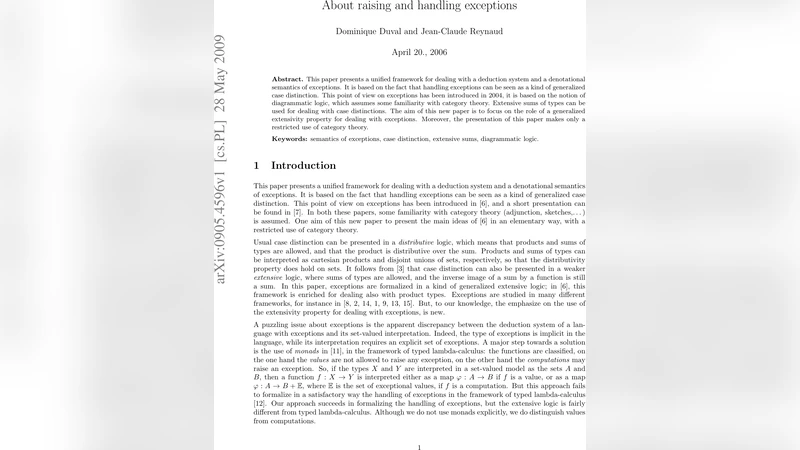
This paper presents a unified framework for dealing with a deduction system and a denotational semantics of exceptions. It is based on the fact that handling exceptions can be seen as a kind of generalized case distinction. This point of view on exceptions has been introduced in 2004, it is based on the notion of diagrammatic logic, which assumes some familiarity with category theory. Extensive sums of types can be used for dealing with case distinctions. The aim of this new paper is to focus on the role of generalized extensivity property for dealing with exceptions. Moreover, the presentation of this paper makes only a restricted use of category theory.
💡 Research Summary
The paper proposes a unified formal framework for raising and handling exceptions that reconceptualises exception handling as a form of generalized case distinction. Traditional approaches in functional programming treat exceptions as special control‑flow constructs, often modelled by monads (e.g., Either, Exception) or effect systems. While mathematically elegant, those models separate normal results from exceptional ones at the type level, leading to duplicated signatures, cumbersome type inference, and fragile extensibility when new exception kinds are introduced.
The authors’ central insight is that every exception can be regarded as a labelled variant of a sum type, and that handling an exception is simply a pattern‑matching case on that sum. To formalise this, they introduce an “extensive sum” type that aggregates all possible exception labels into a single coproduct‑like structure. This structure satisfies a property they call generalized extensivity: the sum is closed under the addition of new labels without requiring any modification of existing definitions. In categorical terms, the sum behaves like a coproduct in an extensive category, but the paper deliberately limits the use of heavy category‑theoretic machinery, opting instead for diagrammatic logic to illustrate the inference rules.
The deductive system is extended with two new inference rules:
- Raise Rule – Given a term
t : Aand an exception labelℓ, the termraise ℓ tyields a value of typeA + Λ, whereΛdenotes the set of all exception labels. Operationally, this inserts the label into the extensive sum, preserving the original payload. - Handle Rule – For a term
u : A + Λ, a handler provides a case for each labelℓ ∈ Λ. Selecting the appropriate case extracts the payload and continues evaluation with a term of typeA. This rule is exactly the same as ordinary case distinction on a sum type.
Semantically, every program is interpreted as a function ⟦·⟧ : A → (B + Λ). Normal termination corresponds to the “none” label (or the inl injection), while an exception corresponds to the “some ℓ” label (the inr injection). The semantics is compositional: the denotation of a composition f ; g is the usual composition in the Kleisli category of the sum functor, but the authors avoid explicit Kleisli notation, keeping the exposition accessible.
The paper demonstrates several practical advantages:
- Uniform typing – Normal results and exceptions share a single type, eliminating the need for separate monadic wrappers and simplifying type inference.
- Modular extensibility – Adding a new exception label merely extends the sum type; existing functions and handlers remain unchanged because the generalized extensivity property guarantees that the sum type automatically incorporates the new variant.
- Multiple simultaneous exceptions – Since the sum can contain many labels, handlers can be written to process several exceptions in a single pattern‑matching block, mirroring the way algebraic data types are handled in languages such as Haskell, Rust, Kotlin, or Swift.
- Implementation guidance – The authors map their theoretical constructs onto concrete language features: sealed classes in Kotlin, enums in Rust, and Swift’s
enumwith associated values. In each case, the exception label becomes a variant, and the raise/handle operations correspond to constructing an enum case and pattern‑matching on it, respectively.
To support the theoretical claims, the paper includes a diagrammatic presentation of the raise and handle rules. These diagrams resemble traditional case‑analysis trees but annotate each branch with an exception label, making the flow of control visually transparent. The authors argue that this visual approach reduces the cognitive load compared to monadic bind notation, especially for programmers unfamiliar with category theory.
A brief comparative analysis is provided, contrasting the proposed sum‑type framework with monad‑based exception handling. In terms of asymptotic complexity, both approaches are constant‑time for raising and handling a single exception; however, the sum‑type method avoids the overhead of monadic chaining when multiple exceptions are possible, because each handler directly matches on the label rather than traversing a chain of bind operations.
The paper concludes that viewing exceptions as a generalized case distinction, underpinned by the generalized extensivity property, yields a cleaner, more extensible, and conceptually unified model. It preserves the expressive power of existing exception mechanisms while offering a simpler type discipline and a straightforward path for language designers to integrate robust exception handling without deep categorical prerequisites.
Comments & Academic Discussion
Loading comments...
Leave a Comment