Minimum Distance and Convergence Analysis of Hamming-Accumulate-Acccumulate Codes
In this letter we consider the ensemble of codes formed by the serial concatenation of a Hamming code and two accumulate codes. We show that this ensemble is asymptotically good, in the sense that most codes in the ensemble have minimum distance grow…
Authors: Alex, re Graell i Amat, Raphael Le Bidan
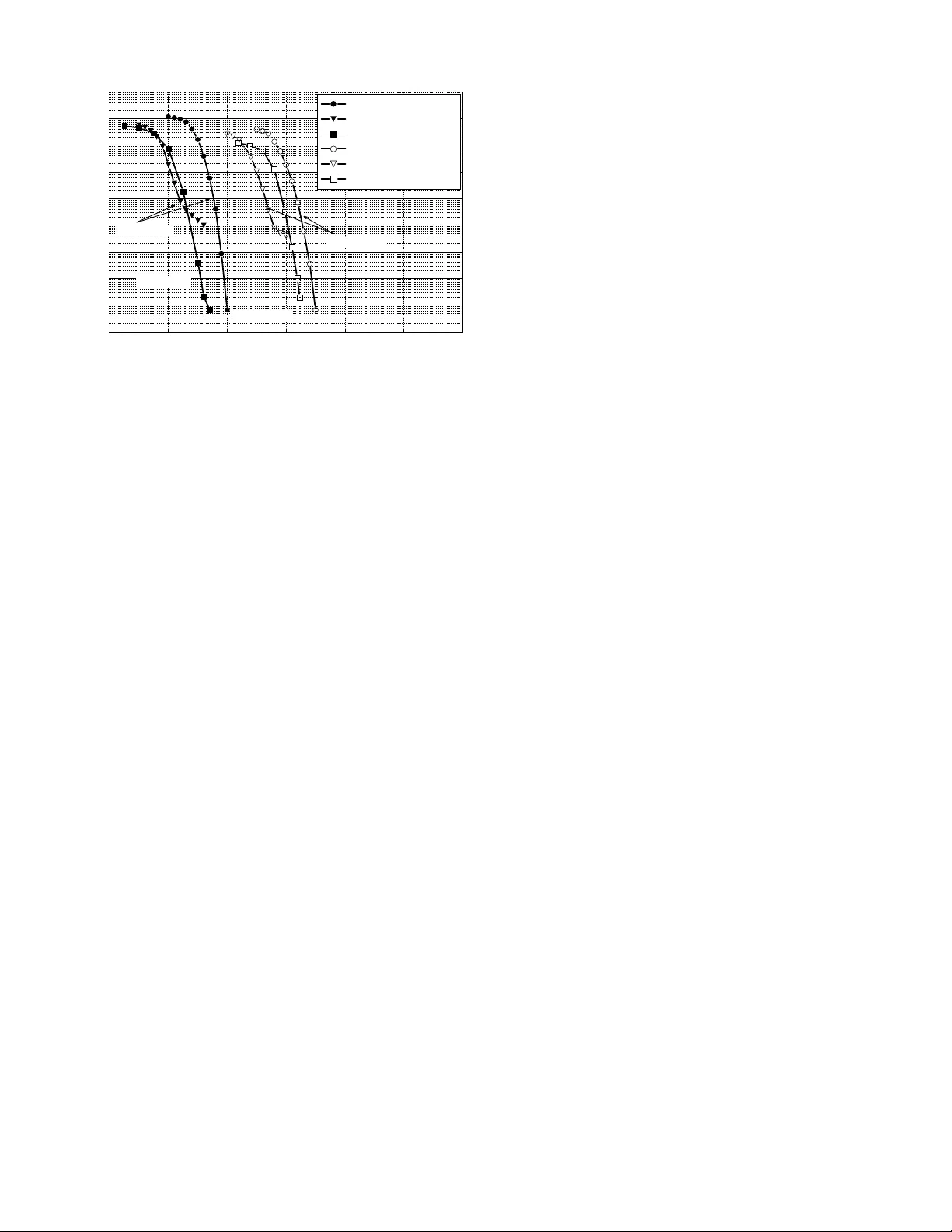
1 Minimum Distance and Con v er gence Analysis of Hamming-Accumulate -Acccumulate Cod es Alexandre Graell i Ama t a nd Rapha ¨ el Le Bidan Abstract —In this letter we consider th e ensemble of codes fo rmed by the se rial concatenation of a Hamming code and two accumulate codes. W e show that this ensemble is asymptotically good, in the sense t hat most codes in th e ensemble hav e minimum distance gro wing li nearly with the block length. Thus, the resulting codes achieve hi gh minimum distances with h igh probability , about h alf or more of the minimum distance of a typical random li near code of the same rate an d l ength in our examples. The p roposed codes also show reaso nably good iterativ e conv ergence thresholds, which makes them attractiv e fo r applications requiring high code rates and low error rates, such as opti cal communications and magnetic recording . I . I N T RO D U C T I O N Applications su ch as magnetic record ing or fiber-optic co m- munication s r equire erro r-correcting cod es with a very high code rate ( R > 0 . 8 ) and simp le dec oding algor ithms amenable to h igh-thro ughpu t de coding arch itectures. Follo wing the in- vention of turbo codes [1] and the rediscovery o f Gallager’ s low-density p arity-check (LDPC) codes [2], several high- rate lo w-comp lexity capacity- approac hing codes hav e been propo sed in the literature. Exa mples o f such codes include turbo prod uct codes (TPC) [3] , the serial c oncatenation of a Hamm ing code with an accumulate cod e [4] or structured LDPC c odes ( see e.g. [5 , chap . 17]) . While such cod es usually offer very good p erform ance in the waterfall region, they are not asymptotically good in the sense that, unlike ra ndom codes, th eir minim um distance d min does not g row lin early with block length, and thus may not be lar ge enough to achieve the r equired error r ates ( e.g. o f the order of 10 − 15 or lower for o ptical com munication s). Recently , it was shown tha t repeat multiple-accumu late (RMA) codes with two or more a ccumulate stages are asymptotically g ood [ 6, 7]. I t was furth er shown in [6] that high-r ate code ensemb les obtain ed b y punctu ring a low-rate repeat-accu mulate-accu mulate (RAA) code yield linear dis- tance growth close to the Gilbert-V arshamov Bound (GVB). Unfortu nately , as we shall see in Section IV, iterati ve decoding of punc tured RMA does not conver ge fo r very high rates, making them imprac tical. In or der to overco me this limitatio n, we consider in this work a class of hig h-rate d ouble serially concatenate d cod es based on an outer, possibly extend ed Hamming code, with two acc umulate co des. W e first stud y A. Graell i Amat i s with the Depart ment of E lect ronics, Institut TELECOM- TELECOM Bretagne , CS 83818 - 29238 Brest Cedex 3, France (e-mail: ale xandre.grae ll@telecom-bre tagne.eu). R. Le Bidan is with the Signal and Communicat ions Department, Institut TELE COM-TELECOM Bretagn e, CS 83818 - 29238 Brest Cede x 3, France (e-mail: raphael.lebi dan@tel ecom- bretagn e.eu). A. Graell i Amat is supported by a Marie Curie Intra-European Fello wship within the 6th European Community Framew ork Programme. Fig. 1. Serial concatena tion of an ( n, k ) block code C 0 and two a ccumulat ors C 1 and C 2 . the ensemble-average finite-len gth weigh t en umerator for this code ensemble. Then, by generalizing the analytical tools introdu ced in [6, 7] to handle the case of an ar bitrary outer linear block code, we study the asymptotic growth r ate of the weight enumerator . W e show , thr ough selected examples, that th e ty pical m inimum d istance of Hammin g-accum ulate- accumulate (HAA) codes grows linearly with block length, and provide a numerical estimate of the growth rate. Finally , we use extrinsic information transfer (EXIT) charts to estimate the iterativ e convergence thresholds. It is shown th at the p roposed codes have reasonably goo d co n vergence th resholds desp ite the do uble serial concaten ation. Compared to TPCs m uch larger minimu m distances can be achiev ed at the expense of a mo derate loss in code conv ergence. Thus, HAA c odes ar e a valid altern ati ve when very high code r ates and very low err or rates a re soug ht for . I I . E N C O D E R S T RU C T U R E A N D FI N I T E - L E N G T H E N S E M B L E E N U M E R A T O R S W e consider th e code en semble C form ed by the serial concatenatio n of an ( n, k ) outer block co de C BC and two r ate- 1, memory -one, accu mulate co des C 1 and C 2 with gener ator polyno mials g ( D ) = 1 / (1 + D ) , connected throu gh two interleavers π 1 and π 2 . W e assume that the interleaver size N is a multiple L of the length n of the outer block code. The overall code rate is R = K/ N , where K = k L is the input blo ck len gth and N = nL is the o utput blo ck len gth. W e deno te by C 0 the ( N , K ) o uter bloc k co de ob tained by concatenatin g together L successive codew o rds of C BC . T rellis termination is used to transfor m the accu mulate cod es C 1 and C 2 into two equiv a lent ( N l , K l ) block codes, l = 1 , 2 . Th e correspo nding en coder is depicted in Fig. 1. In this letter, we consider Hamming and extended Hammin g (eHamming ) codes fo r C BC since they can ach ie ve min imum distances 3 and 4 with the high est code rate for a given dimension, with reasonable decod ing complexity . A uniform distribution is assumed o n the choice of the two p ermutation s π 1 and π 2 . In the fo llowing, the code ensemble C with a n outer code of pa rameters ( n, k ) will be ref erred to as th e ( n, k ) AA ensemble. Let A C w, h denote the input- output weight enum erator (IO WE) of a blo ck code C , i. e. the n umber of co dew ords with input weig ht w and o utput w eight h in C . Similarly , let 2 A C h = P w A C w, h denote the weig ht enumerator (WE) of the code, i.e. the n umber of codewords of outp ut weight h . Th en, using the uniform interleaver co ncept [8, 9], th e ensemb le- av erage WE of the c ode en semble C c an be com puted as: A C h = N X h 0 =0 N X h 1 =0 A C 0 h 0 A C 1 h 0 ,h 1 A C 2 h 1 ,h N h 0 N h 1 (1) The IO WE of an a ccumulate c ode with block leng th N can be written in closed form as [10 ]: A AC C w, h = N − h ⌊ w/ 2 ⌋ h − 1 ⌈ w/ 2 ⌉ − 1 (2) In po lynomial form , the WE o f C 0 and C BC are linked by the following relatio nship [8]: A C 0 ( H ) = N X h =0 A C 0 h H h = [ A C BC ( H )] L (3) Here, we d eriv e an other alter nativ e expression of the WE of C 0 which is more con ven ient for asymptotic analysis. Consider a co dew ord c of o utput weight h 0 in C 0 and de note b y m i the number o f codewords of weight i in C BC that p articipate in c . Then, the WE o f the outer b lock code, A C 0 h 0 , can be expressed as A C 0 h 0 = X m 0 ,m 1 ,...,m n L m 0 , m 1 , . . . , m n × × ( A C BC 0 ) m 0 · · · ( A C BC n ) m n (4) under the co nstraints P n i =0 im i = h 0 and P n i =0 m i = L , and where L m 0 ,m 1 ,...,m n = L ! m 0 ! m 1 ! ...m n ! is the multino mial coefficient. The ensemble- av erage WE can be used to bou nd the mini- mum distance d min of the code ensemb le C . In par ticular , the following Proposition h olds [11 ]: Pr opo sition 1: The probab ility that a code randomly chosen from an ensemb le of linear codes C with average WE A C h has d min < d is upper b ounded by Pr( d min < d ) ≤ d − 1 X h =1 A C h (5) In Fig. 2 we display this probabilistic bound for four ( n, k ) AA c ode ensembles b y p lotting the largest weight d in the r ight-hand side (RHS) of (5) yielding P d − 1 h =1 A C h < 1 / 2 , as a fun ction o f the cod e len gth N . He nce we expect at least half of the codes in C to have a m inimum distance d min at least equal to the value predicted by the curves. The considered outer codes are the (3 1 , 26) and (63 , 57 ) Hamming codes, a s well as th e (32 , 26) an d (64 , 57) eHamming c odes. A typical rando m lin ear co de of length N and ra te R has minimum distanc e N δ GV [12], where δ GV is the n ormalized Gilbert-V arshamov distance define d as the root δ ≤ 1 / 2 of the eq uation H 2 ( δ ) = 1 − R , and H 2 ( x ) is the binar y en tropy function (with binary logarithm). F or comparison purposes, we have also plotted in Fig. 2 the minim um distance predicted by the GVB for rates R = 26 / 3 2 , R = 26 / 3 1 an d R = 5 7 / 63 (the GVB for R = 57 / 6 4 is o mitted f or clarity). All cod es appear to have a minim um d istance that grows lin early with the 0 800 1600 2400 3200 4000 4800 5600 6400 7200 8000 8800 Block Length (N) 0 40 80 120 160 200 d m i n (32,26)AA (31,26)AA (64,57)AA (63,57)AA GVB GVB, R=26/32 GVB, R=26/31 GVB, R=63/57 Fig. 2. Probabil istic bound on the minimum distance d min versus block length N for seve ral ( n, k ) AA code ensembles. block length. Furthermo re, th e achiev a ble minimum distance s are very high. For in stance, the bou nd for the (31 , 26) AA ensemble pred icts a ty pical minimu m distance d min ≈ 117 for b lock length N = 8184 . For comp arison, the pro duct code (12 8 , 120 ) × (64 , 57) of similar code length an d rate has d min = 16 only . I I I . A S Y M P T OT I C E N S E M B L E W E I G H T E N U M E R A T O R A N A L Y S I S In this Section we analyze the asymptotic behavior o f th e WE to show th at the minimum distance of the con sidered ( n, k ) AA c ode grows linearly with code length . T o this en d, we study the behavior of the spectral shape function o f the code e nsemble C , defined as [2] r ( δ ) = lim N →∞ sup 1 N ln A C ⌊ δN ⌋ (6) where δ = h/ N = h/ ( nL ) is the normalized output weight. Fro m (6 ) the WE can b e expressed as A C h ∼ e N r ( δ ) . Therefo re, if there exists some abscissa δ min > 0 such that sup x ≤ δ r ( x ) < 0 ∀ δ < δ min , and r ( δ ) > 0 for some δ > δ min , th en it can be shown (u sing Prop osition 1 for example) th at, with high p robability , th e minimum distance of most cod es in the en semble grows linearly with the block length N , with growth r ate δ min [7, 13]. On the oth er hand, if r ( δ ) is equal to zero rath er tha n strictly n egati ve in the interval (0 , δ min ) , it ca nnot be co ncluded dire ctly wheth er the minimum distance grows linearly or not with N since the RHS in (5) m ay be boun ded away from zero . As shown recently in [7], the spectr al sh ape of RMA co de en sembles exhibits such a behavior . Ho wever , b ased on WE a nalysis and appr opriate bound ing techniques, the authors of [7] were able to prove that for such co de ensembles, the typical m inimum distance indeed gr ows linear ly with N , with growth rate δ min . A. Spectral shape of the pr o posed code ensemble Consider the ( N l , K l ) block co de C l , l = 0 , 1 , 2 . W e define the a symptotic (lo garithmic) be havior of the WE for C l as the function a C l ( β l ) = lim N l →∞ sup 1 N l ln A C l ⌊ β l N l ⌋ (7) 3 where β l = h l / N l is th e normalized ou tput we ight. Sim ilarly , we define the asymptotic behavior of th e I O WE fo r C l as the function a C l ( α l , β l ) = lim N l →∞ sup 1 N l ln A C l ⌊ α l K l ⌋ , ⌊ β l N l ⌋ (8) where α l = w l /K l is the normalized input weight. Then, using (1) and ( 7-8) in (6) and recalling Stirling’ s ap proximatio n f or binomial coefficients n k n →∞ − → e n H e ( k/n ) where H e ( · ) is the binary entro py function with natu ral logarithms, the spec tral shape fu nction of the code en semble C can b e written as r ( δ ) = lim N →∞ sup 1 N ln N X h 0 =0 N X h 1 =0 exp { N a C 0 ( β 0 ) + N a C 1 ( β 0 , β 1 ) + N a C 2 ( β 1 , β ) − N H e ( β 0 ) − N H e ( β 1 ) } ≃ max 0 ≤ β 0 ,β 1 ≤ 1 a C 0 ( β 0 ) + a C 1 ( β 0 , β 1 ) + a C 2 ( β 1 , β ) − H e ( β 0 ) − H e ( β 1 ) (9) where β 0 = h 0 / N and β 1 = h 1 / N . The last lin e follows from the well-k nown max- log appr oximation ln(e a + e b ) ≃ max( a, b ) (see e.g. [1 4]). The asym ptotic behavior of the IOWE of the a ccumulate code C l , l = 1 , 2 , is easily obtained by in voking again Stirling’ s approx imation in (2 ), yielding [ 10], a C l ( α l , β l ) = (1 − β l ) H e α l 2(1 − β l ) + β l H e α l 2 β l (10) The next Proposition addr esses the problem of co mputing the asymp totic weight e numerato r a C 0 ( β 0 ) for the outer block code C 0 . Pr opo sition 2: Let C 0 be the ( N , K ) blo ck code o btained by concaten ating together L succ essi ve cod e words of an ( n, k ) block code C BC . Let p i be th e relativ e prop ortion of codewords of C BC of weig ht i in a codeword of C 0 , i. e. p i = m i /L . De fine P = ( p 0 , p 1 , . . . , p n ) and H ( P ) = − P n i =0 p i ln p i , with the convention 0 ln 0 = 0 . Then, the asymptotic IOWE of C 0 is given by the solution o f the following conv ex optim ization prob lem a C 0 ( β 0 ) = max P 1 n H ( P ) + n X i =0 p i ln A C BC i ! (11) under th e co nstraints P n i =0 ip i = nβ 0 and P n i =0 p i = 1 . Pr oof: The p roof follows th e appro ach pr oposed in [14] to o btain the spectral shape o f g eneralized LDPC codes employing sm all Ha mming co des at the check nodes. Since our p roblem is simpler, however , we arrive at a more tractable optimization prob lem ( only the knowledge of the WE o f C BC is req uired) and we av o id the conjectur es m ade in [14 ]. Recalling first that N 0 = N = nL , we can express a C 0 ( β 0 ) in (7) as a functio n of L , a C 0 ( β 0 ) = lim L →∞ sup 1 nL ln A C 0 h 0 (12) with β 0 = h 0 / N 0 = h 0 /nL . Now , define the type P = ( p 0 , p 1 , . . . , p n ) of a codew ord c in C 0 , c = c 1 c 2 . . . c L , with c j ∈ C BC , as the relativ e prop ortion o f occur rences of codewords of C BC of weigh t i , i = 0 , 1 , . . . , n , in c [ 15]. The set o f all length - L sequen ces each contain ing m i occurre nces of cod e words of C BC with weig ht i is called the typ e class of P , den oted T ( P ) . I t follows th at | T ( P ) | = L m 0 ,m 1 ,...,m n . From [ 15, Thm. 11.1 .3] we h a ve that | T ( P ) | L →∞ − → e L H ( p ) (13) Finally , using (13) in (4) and (12) we ob tain: a C 0 ( β 0 ) = lim L →∞ sup 1 nL ln X p 0 ,...,p n e L H ( p ) ( A C BC 0 ) p 0 L · · · ( A C BC n ) p n L (14) from which (11 ) follows. The asymptotic WE ( 11) admits a clo sed-form expression for a few simple cod es such as the ( nK , K ) block r epetition code o f rate R = 1 /n . Example 1: A symptotic WE of the ( nK, K ) r epetition code Let C 0 be the ( nK , K ) block cod e formed by co ncatenating together K code words of an ( n, 1) repetition co de C BC . W e have A C BC 0 = A C BC n = 1 and A C BC i = 0 for i = 1 , . . . , n − 1 . Define p 0 = m 0 /K and p n = m n /K . Using (1 1) we obtain: a C 0 ( β 0 ) = max P 1 n H ( P ) + n X i =0 p i ln A C BC i ! = max p 0 ,p n 1 n ( − p 0 ln p 0 − p n ln p n ) (15) under the two constraints np n = nβ 0 and p 0 + p n = 1 . Therefo re, a C 0 ( β 0 ) = 1 n ( − (1 − β 0 ) ln(1 − β 0 ) − β 0 ln β 0 ) = 1 n H e ( β 0 ) (16) which is a well-known result ( see e.g. [6, 10]) . For more general block cod es with known WE, a C 0 ( β 0 ) can be evaluated n umerically using standard convex o ptimization software. B. Asymptotic g r owth rate of the min imum distanc e The numer ical evaluation of (9) fo r th e (31 , 26 ) AA, (32 , 26) AA, (63 , 57 ) AA and (64 , 57) AA codes ensemb les is shown in Fig. 3. W e have also p lotted the spec tral shape r ( δ ) = H e ( δ ) − (1 − R ) ln(2) for the cor respondin g random linear code e nsembles. The behavior of the spectr al shape o f the ( n, k ) AA ensembles is similar to the o ne obtained in [ 7] for RMA cod es. It is strictly positive in the range ( δ min , 1 − δ min ) for some 0 < δ min < 1 / 2 , an d zer o elsewhere. Since a closed form expression of the WE of the o uter block cod e C 0 is no t av ailable , in co ntrast to RMA codes [7] we cann ot provide a formal proof that the co nsidered code ensembles are asympto t- ically good. Howe ver, extensive n umerical experiments using (5) show that Pr( d min < ⌊ δ min N ⌋ ) − → 0 as N gets large, which suggests that the results o f [7] hold tru e for more ge neral outer co des than just rep etition c odes. In T ab le I we re port the estimated v alues of δ min for se veral ( n, k ) AA e nsembles based on h igh-rate Hamm ing and extended Hamming codes. For 4 0.005 0.01 0.015 0.02 0.025 0.03 0.035 0.04 −0.01 0 0.01 0.02 0.03 0.04 0.05 δ r( δ ) (64,57)AA (63,57)AA (32,26)AA (31,26)AA Fig. 3. Spectral shape of selected ( n, k ) AA code ensembles. The spectral shape of the corresponding random linear codes of same rate is also shown in dashed lines. T ABLE I A S Y M P T O T I C N O R M A L I Z E D M I N I M U M D I S T A N C E δ min A N D I T E R A T I V E C O N V E R G E N C E T H R E S H O L D F O R S E L E C T E D ( n, k ) A A C O D E E N S E M B L E S . Code δ min δ GV Threshold Constrained capa city (32 , 26) AA 0.0197 0.0286 3.34 dB 2.14 dB (31 , 26) AA 0.0140 0.0236 3.48 dB 2.39 dB (64 , 57) AA 0.0091 0.0145 4.10 dB 3.03 dB (63 , 57) AA 0.0067 0.0122 4.20 dB 3.26 dB (128 , 120) AA 0.0042 0. 0073 4.70 dB 3.93 dB (127 , 120) AA 0.0032 0. 0063 4.79 dB 4.11 dB compariso n purpo ses, th e n ormalized min imum distance δ GV of random linear code s is also gi ven. The estimated asymptotic growth rates δ min are in goo d agre ement with the slope of the cu rves obtain ed b y th e fin ite-length analy sis in Section II. Hence we conc lude that HAA codes have minimum distance growing linearly with block length a s δ min N . I V . C O N V E R G E N C E A NA L Y S I S In this section, we in vestigate th e iter ati ve co n vergence behavior of ( n, k ) AA co de ensemb les by means of an EXI T chart analysis [16 ]. Th e iterativ e co n vergence thr esholds for the co nsidered ( n, k ) AA cod es ensemb les are g i ven in T ab le I. BPSK transmission over an A WGN chann el is assumed. Con vergence is achieved with in 0.7 dB–1. 2 dB from the correspo nding Shann on lim it. Further more, th e th resholds get closer to capacity for h igher rates. For in stance, th e predicted thresholds fo r the (3 1 , 26) AA and the (6 3 , 57) AA cod e en- sembles are 3 . 4 8 dB and 4 . 2 0 dB, respe cti vely , i.e. 1 . 09 dB and 0 . 94 dB away from the constrained capacity . W e also note that Hamming outer cod es m ay be pre ferable to extend ed Hamming outer cod es in pr actice since the former provide better threshold s at higher code rate an d with smaller deco ding complexity (numb er of states reduced b y half in th e code trellis), at th e expense of a slightly smaller a symptotic growth rate of the minimum distance. Comparison of the pr oposed codes with Hamm ing- accumulate cod es, denoted hereaf ter as ( n, k ) A codes, show that the latter ha ve better con vergence thresho lds. For example, the (31 , 26) A and (6 3 , 57) A co des conver ge at 2.81 dB a nd 3.58 dB, respectively . Th us doub le con catenation incu rs a loss of 0 . 6 dB with respect to single concatena tion. On the o ther T ABLE II N O R M A L I Z E D M I N I M U M D I S TAN C E δ min F O R S E L E C T E D R A N D O M LY - P U N C T U R E D R 3 A A CO D E S W I T H TA R G E T R AT E R . R δ min δ GV 26 / 32 0.0282 0.0286 26 / 31 0.0233 0.0236 57 / 64 0.0143 0.0145 57 / 63 0.0120 0.0122 120 / 128 0.0072 0.0073 120 / 127 0.0062 0.0063 hand, Hammin g-accum ulate co des (an d m ore gen erally BCH- accumulate co des [17 , 18 ]) are asympto tically bad. It was shown in [6] th at th e ensemble of randomly - punctur ed RAA codes is asymp totically good and achieves linear minimu m distance g rowth close to the GVB, even for very h igh rates. As an example, we have reported in T able II the norm alized minim um distance δ min for punctu red RAA codes with rep etition factor 3 (h ereafter den oted as R 3 AA) and same rate than th e ( n, k ) AA codes considered in T able I. T he r esults show th at pu nctured R 3 AA codes significantly outperf orm HAA codes in terms of normalized minimum distance. On the o ther hand, as no ted in [ 6, 11], the con vergence thr esholds of RAA under iterati ve decoding are generally away from capacity . T he situation gets e ven worse in the presen ce of pu ncturing. Our experim ents hav e shown the existence of a maxim um rate R max above which the EXI T chart for ra ndomly- punctur ed RAA codes shows an early cross b etween the two EXIT curves, ev en at very high (ultimately infinite) E b / N 0 , m eaning that iterative decod ing cannot conv erge. This lim iting r ate is around R max ≈ 0 . 695 for punc tured R 3 AA codes. T herefor e iterative deco ding of random ly-pun ctured R 3 AA cod es do no t conv erge at the cod e rates co nsidered in T ables I and II . Simu lations confir med this prediction . Note that lowering th e repetition factor d oes not help. For example, we f ound that R max ≈ 0 . 42 for R 6 AA. In [1 9] a family of asympto tically good rate-comp atible protog raph-b ased LDPC code s was introduc ed which supports any co de rate o f th e form R = ( n + 1 ) / ( n + 2) f or n = 0 , 1 , 2 , . . . These codes, nicknam ed AR 4 J A, combine rate flexibility with excellent c on vergence thresholds, within 0 . 45 d B or less fro m the con strained capac ity at all rates. For instance, AR 4 J A codes co n verge a t 0 . 37 dB from capacity at rate R = 5 / 6 [19]. This is 0 . 75 dB better than (31 , 26) AA codes. On the oth er hand, the minimu m distance growth rate for AR 4 J A co des is only δ min = 0 . 015 for the lowest code rate R = 1 / 2 [ 19], wh ereas HAA co des ach iev e almost the same growth r ate ( δ min = 0 . 014 ) but at much higher cod e rate R = 26 / 31 ≈ 5 / 6 . Thus, HAA cod es are expected to ac hiev e significantly highe r min imum distance than AR 4 J A codes of same rate and code length. V . S I M U L A T I O N R E S U LT S W e compar ed th e pe rforman ce of the p roposed ( n, k ) AA codes with that of TPCs, structured LDPC codes and ( n, k ) A codes, assumin g BPSK modulation an d transmission over an A WGN channel. In all simulations, rando m interleavers and a maxim um of 30 decoding iterations were considered for ( n, k ) AA codes and ( n, k ) A codes. T u rbo decoding o f the ( n, k ) AA codes was realized as described in [9]. An optimu m trellis-based MAP decod er was used to deco de the Ham ming 5 2 3 4 5 6 7 8 E b /N 0 (dB) 10 0 10 -1 10 -2 10 -3 10 -4 10 -5 10 -6 10 -7 10 -8 10 -9 B E R (31,26)AA (31,26)A (128,120)x(64,57) TPC (127,120)AA (127,120)A (10429,9852) LDPC N=8192 bits N=10414 bits N=8184 bits N=10429 bits Fig. 4. Bit e rror probabilit y performance for (31 , 26) AA and (1 27 , 120) AA ensembles on an A WGN channel with BPSK modulation. codes. T u rbo deco ding of th e TPC was realized using the Chase-Pyndiah deco ding algorithm [3 ] with 16 test p atterns and a maxim um of 1 6 iterations (no significant impr ovement was observed beyond). One iteratio n comprises here a row- decodin g step followed by a colu mn-deco ding step. No te that the Cha se-Pyndiah decoder may also be app lied to deco de the outer block cod e in the ( n, k ) A an d ( n, k ) AA con catenated schemes, resulting in lower complexity with p erforma nce very close to MAP decod ing [18]. In Fig. 4 the bit error r ate (BER) p erforman ce of the (31 , 26) AA code is compared with the pe rforman ce o f the (128 , 12 0) × (6 4 , 57) TPC a nd (31 , 2 6) A co de, respectively . The three codes have similar r ate. The block length is N = 8184 fo r the (31 , 26 ) AA and (31 , 26) A co des and N = 8192 for th e TPC. The simu lated curve for the (31 , 26) AA code is in agreemen t with th e c on vergence th reshold predicted by the EXIT charts. A lo ss of ∼ 0 . 6 dB and of ∼ 0 . 5 dB are observed with respec t to th e (31 , 2 6) A co de and the TPC, r espectively . Howe ver the (31 , 26) AA code is expected to yield significantly lower error floor th anks to a much hig her d min . For instan ce, the minimum distance of th e TPC is 16 while the majo rity of the codes in the (31 , 26) AA e nsemble are expected to hav e minimum d istance ∼ 1 14 with high prob ability . The perfor mance of the (127 , 12 0) AA co de is also given in Fig. 4. It is com pared with the per formanc e o f the (12 7 , 120) A code and also with a (10429 , 9852) , rate- R = 0 . 945 , graph- theoretic LDPC code descr ibed in [5, Fig 17.43] . The latter was selected bec ause of its code rate R ≈ 120 / 1 27 and its good performance unde r iterative d ecoding fo r a structured LDPC cod e (its T anner graph is free of length - 4 cycles). According ly , the block length w as set to N = 1041 4 bits for both the (127 , 120) AA and the (127 , 120) A co des. The (127 , 12 0) A code perform s th e b est in the waterfall region . Howe ver, it shows th e h ighest err or floor due to a p oor minimum distance (the floor would be lo wered about 2 decad es by using a caref ully optim ized in terleav er). T he (127 , 120) AA code shows a loss of ∼ 0 . 5 d B and ∼ 0 . 25 dB in the waterfall region with respect to the (127 , 120) A cod e and the structured LDPC code, r espectively . Th e minimum d istance of the structured LD PC co de is no t kn own pr ecisely but is guaran teed to be at least 7 [5 , p. 934 ]. On the othe r hand , at least half of the cod es in the (1 27 , 12 0) AA cod e ensemble have minimum distanc e 33 . The latter are theref ore expected to per form better at very low error ra tes. V I . C O N C L U S I O N S W e studied the serial concaten ation of a Hamming c ode with two accumu late codes and showed th at the resulting cod e ensemble is asympto tically good in the sense that m ost c odes in the en semble h av e m inimum distance growing line arly with block size. W e described a compu tational metho d to estimate the asymptotic growth rate of the minimum distance. Although only H amming cod es were consider ed here f or the pu rpose of design ing high -rate codes, the pro posed method natu rally extends to other outer linear block co de. Finally , an EXIT chart analysis showed that Hamming- accumulate- accumulate codes exhibit reasonably good iterati ve con vergence th resholds in spite of the double serial con catenation. A C K N OW L E D G M E N T S The au thors would like to thank Chiara Ravazzi, from Politecnico d i T o rino, for help ful d iscussions. Th ey also thank Karine Amis, f rom TE LECOM Bretag ne, for pr oviding us the simulation results for the turbo p roduct cod es in Sectio n V. R E F E R E N C E S [1] C. Berrou, A. Gla vieux, and P . Thitimaj shima, “Near Shannon limit error- correcti ng coding and decoding: Tu rbo-codes, ” in Proc . IEEE Int. Conf . Commun. (ICC) , (Genev a, Switzerland ), pp. 1064–1070, May 1993. [2] R. G. Gallager , Low-De nsity P arity-Chec k Co des . Cambridge , MA: MIT Press, 1963. [3] R. M. Pyndi ah, “Near -optimum decodin g of product co des: Blo ck turbo codes, ” IEEE T rans. Comm. , vol. 46, pp. 1003–1010, Feb . 1998. [4] D. Divsal ar and S. Dolinar , “Concat enation of hamming codes and ac- cumulato r codes with hi gh-order modu lations for high-spee d decod ing, ” J et Propulsi on Lab. IPN Pr ogr ess Report , vol. 42-156, Feb . 2004. [5] S. Lin and D. J. Costello, Err or Co ntr ol Coding . Prentice Hal l, 2nd ed., 2004. [6] J. Kliewe r , K. S. Zigangiro v , and D. J. Costello, Jr ., “New results on the minimum distance of repeat multiple accumulat e cod es, ” in Pr oc. 45th Annual Allerton Conf. on Commun., Contr ol, and Computing , (Montice llo, IL), Sept. 2007. [7] F . Fagnani and C. Rav azzi, “Spectra and m inimum distance s of repeat multiple accumulate codes, ” in Proc . Informatio n Theory and Applica- tion W orkshop IT A’08 , (San Diego, CA, USA), Jan. 2008. [8] S. Bene detto, D. Di vsalar , G. Monto rsi, and F . Pollara, “Seri al concate - nation of interlea ved codes: Performance analysis, design, and iterati ve decodin g, ” IEEE T rans. Inf. Theory , vol. 44, pp. 909–926, May 1998. [9] S. Be nedetto , D. Di vsalar , G. Montorsi, and F . Pollara, “ Analysis, design, and itera ti ve decoding of double serially concatena ted codes with interl eav ers, ” IEEE J. Sel. Areas in Commun. , vol. 16, pp. 231–244, Feb . 1998. [10] D. Divsa lar , H. Jin, and R. J. McEliece, “Coding theorems for ’turbo- lik e’ code s, ” in Proc . 3 6th Annu al All erton Conf. on Commun., Contr ol, and Computing , (Monticello , IL ), pp. 201–210, Sept. 1998. [11] H. D . Pfister and P . H. Sie gel, “The seria l conc atenat ion of rate-1 codes through uniform ra ndom in terlea vers, ” IEEE T rans. Inf . Theory , vol. 49, pp. 1425–1438, June 2003. [12] A. Barg and J. G. D. Forney , “Random codes: Minimum distance and error exponent s, ” IEEE T rans. Inf. Theory , vol. 48, pp. 2568–2573, Sept. 2002. [13] S. L . Fogal, R. J. McEliece, a nd J. Thorpe, “Enumerators for protograph ensembles of L DPC codes, ” in Proc. IEEE Int. Symp. Inform. Theory ISIT’05 , (Adela ¨ ıde, Australia), pp. 2150–2156, J uly 2005. 6 [14] S. Abu-Surra, W . E. Ryan, and D. Divsal ar , “Ensemble weight enu- merators for protog raph-based ge neraliz ed LDPC co des, ” i n Pr oc. IEEE Global T elecommun. Conf. , (W ashington DC, USA), pp. 1492–1497, Nov . 2007. [15] T . M. Cover an d J. A. Thomas, Elements of Information Theory . Hoboke n, Ne w Jerse y: Wile y Interscience , John W iley & Sons, Inc., 2nd ed., 2006. [16] M. T ¨ uchler , “Con vergenc e predic tion for iterat i ve decoding of three - fold concat enated systems, ” in P r oc. IEEE Global T elecommun. Conf. , (T aipei, T aiwan), pp. 1358–1362, Nov . 2002. [17] P . A. Martin, M. Isaka, and M. P . C. Fossorier , “Serial concatena tion of linear block codes and a rate-1 con volution al code, ” in Proc . 4th Int. S ymp. on T urbo Codes & Related T opics , ( Munich, German y), Apr . 2006. [18] A. Graell i Amat and R. Le Bidan, “Rate-c ompatible serially concate- nated codes with outer extend ed BCH codes, ” in Pro c. IEEE Global T elecommun. Conf. , (W ashington DC, USA), pp. 1476–1481, Nov . 2007. [19] D. Divsalar , C. Jones, S. Dolinar , and J. Thorpe, “Protog raph based LDPC cod es with minimum distance linearly gro wing with block siz e, ” in Pr oc. IEEE Global T elecommun . Conf . , (St Louis, MO, USA), pp. 1152–1156, Nov . 2005.
Original Paper
Loading high-quality paper...
Comments & Academic Discussion
Loading comments...
Leave a Comment