Two-fluid Instability of Dust and Gas in the Dust Layer of a Protoplanetary Disk
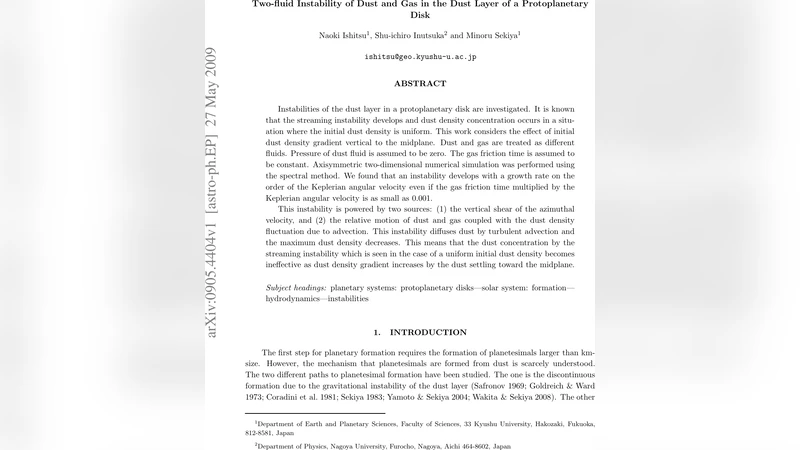
Instabilities of the dust layer in a protoplanetary disk are investigated. It is known that the streaming instability develops and dust density concentration occurs in a situation where the initial dust density is uniform. This work considers the effect of initial dust density gradient vertical to the midplane. Dust and gas are treated as different fluids. Pressure of dust fluid is assumed to be zero. The gas friction time is assumed to be constant. Axisymmetric two-dimensional numerical simulation was performed using the spectral method. We found that an instability develops with a growth rate on the order of the Keplerian angular velocity even if the gas friction time multiplied by the Keplerian angular velocity is as small as 0.001. This instability is powered by two sources: (1) the vertical shear of the azimuthal velocity, and (2) the relative motion of dust and gas coupled with the dust density fluctuation due to advection. This instability diffuses dust by turbulent advection and the maximum dust density decreases. This means that the dust concentration by the streaming instability which is seen in the case of a uniform initial dust density becomes ineffective as dust density gradient increases by the dust settling toward the midplane.
💡 Research Summary
The paper investigates a previously unrecognized instability that arises in the dust layer of a protoplanetary disk when a vertical gradient in dust density is present. While the streaming instability (SI) has been extensively studied under the assumption of an initially uniform dust density, real disks experience dust settling that creates a strong vertical stratification. To explore the dynamical consequences of this stratification, the authors treat dust and gas as two separate fluids. The gas obeys the usual compressible Navier‑Stokes equations with pressure and viscosity, whereas the dust fluid is assumed pressure‑free and interacts with the gas only through a constant drag term characterized by a friction time τ_f.
Using an axisymmetric, two‑dimensional (radial–vertical) spectral code, the authors impose an initial vertical dust‑density gradient and evolve the coupled equations. Their simulations reveal that an instability develops even when the dimensionless stopping time τ_fΩ_K is as low as 0.001, i.e., far below the regime traditionally required for SI. The growth rate is of order the Keplerian angular velocity Ω_K, indicating a rapid amplification of perturbations.
Two physical mechanisms are identified as the energy sources for this instability. First, the vertical shear of the azimuthal velocity—arising because dust and gas rotate at slightly different speeds—stores kinetic energy that can be tapped by perturbations. Second, the relative motion between dust and gas couples with dust‑density fluctuations generated by advection; this coupling creates a positive feedback loop that further amplifies the perturbations. The combined effect of shear and drag‑induced feedback drives a turbulent state that mixes dust vertically. As a result, the maximum dust density achieved in the simulation actually decreases over time, in stark contrast to the concentration seen in the classic SI scenario.
The authors argue that this “two‑fluid vertical‑shear instability” (TVSI) can suppress the dust clumping that SI would otherwise produce, especially as the dust layer becomes thinner and the vertical density gradient steepens due to settling. Consequently, the efficiency of planetesimal formation via SI may be overestimated if the vertical stratification is ignored. The paper suggests that realistic models of planet formation must incorporate this additional instability, along with the traditional SI, to accurately predict dust evolution in disks.
In the discussion, the authors outline several avenues for future work. They propose extending the study to fully three‑dimensional, non‑axisymmetric simulations to capture possible secondary instabilities and vortex formation. They also recommend exploring a broader range of stopping times, particle size distributions, and the inclusion of magnetic fields or radiative forces, which could modify the growth rates or even introduce new modes of instability. By doing so, the community can develop a more comprehensive picture of how dust aggregates, diffuses, and ultimately forms the building blocks of planets in the complex environment of a protoplanetary disk.
Comments & Academic Discussion
Loading comments...
Leave a Comment