Homology stability for the special linear group of a field and Milnor-Witt K-theory
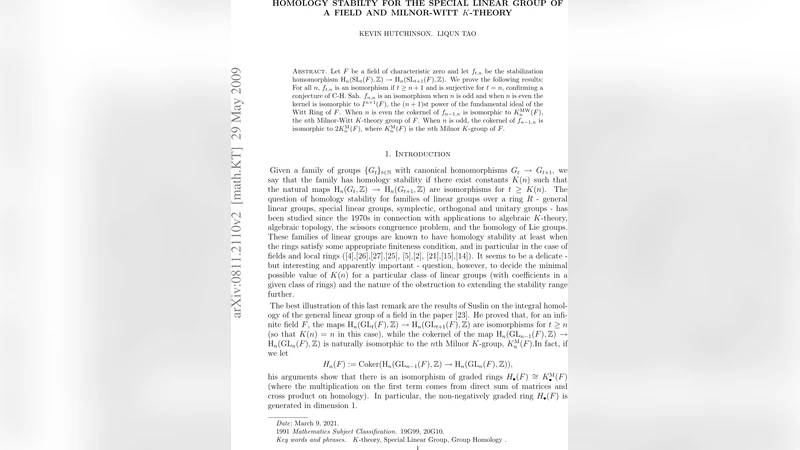
Let F be a field of characteristic zero and let f(t,n) be the stabilization homomorphism from the n-th integral homology of SL(t,F) to the n-th homology of SL(t+1,F). We prove the following results: For all n, f(t,n) is an isomorphism if t is at least n+1, and is surjective for t=n, confirming a conjecture of C-H. Sah. Furthermore if n is odd, then f(n,n) is an isomorphism and when n is even the kernel of f(n,n) is the (n+1)st power of the fundamental ideal of the Witt Ring of the field.. If n is even, then the cokernel of f(n-1,n) is naturally isomorphic to the n-th Milnor-Witt K-group of F, MWK(n,F) and when n>2 is odd the cokernel of f(n-1,n) is the square of the nth Milnor K-group of F.
💡 Research Summary
The paper investigates the stabilization maps (f(t,n): H_n(\mathrm{SL}(t,F),\mathbb Z) \to H_n(\mathrm{SL}(t+1,F),\mathbb Z)) for a field (F) of characteristic zero. Building on earlier work by van der Kallen, Suslin, and others, the author dramatically improves the range of homology stability. The first main theorem states that for every integer (n), the map (f(t,n)) is an isomorphism whenever (t\ge n+1) and is surjective when (t=n). This settles the conjecture of C‑H Sah that the stabilization should be surjective at the “critical” rank (t=n).
The second set of results concerns the kernel of the map at the critical rank. When (n) is odd, (f(n,n)) is already an isomorphism, so the kernel vanishes. When (n) is even, the kernel is identified with the ((n+1))‑st power (I^{,n+1}) of the fundamental ideal (I) in the Witt ring (W(F)). Thus quadratic‑form data encoded in the Witt ring controls precisely the failure of stability in even degrees.
The third major contribution describes the cokernel of the preceding stabilization map (f(n-1,n)). If (n) is even, the cokernel is naturally isomorphic to the Milnor‑Witt (K)-group (K_n^{\mathrm{MW}}(F)). If (n) is odd and (n>2), the cokernel is the square of the ordinary Milnor (K)-group, i.e. the subgroup (K_n(F)^2) generated by products of two Milnor symbols. Hence the “defect” of stability is measured either by Milnor‑Witt (K)-theory (in even degrees) or by a quadratic refinement of Milnor (K)-theory (in odd degrees).
Methodologically, the author works in the (\mathbb A^1)-homotopy category. The classifying space (B\mathrm{SL}(t,F)) is modeled as an (\mathbb A^1)-local object, and a corresponding motivic spectrum is constructed. A homological spectral sequence (the “Bott‑type” or “bar” spectral sequence) is then applied to this spectrum. Its (E_2)-page is identified with a combination of Milnor‑Witt (K)-groups and the graded pieces of the Witt ring, thanks to Morel’s identification of (\pi_{n,n}^{\mathbb A^1}) with Milnor‑Witt (K)-theory. The filtration induced by the spectral sequence yields the kernel and cokernel descriptions above. In particular, the filtration step corresponding to (I^{,n+1}) survives to (E_\infty) and accounts for the kernel when (n) is even, while the associated graded piece at the next level gives the Milnor‑Witt (K)-group that appears as the cokernel.
The paper also discusses several corollaries. For example, the isomorphism (H_n(\mathrm{SL}(n,F))\cong H_n(\mathrm{SL}(n+1,F))) for odd (n) recovers known results of Suslin, while the new description of the kernel for even (n) provides explicit generators in terms of Pfister forms. Moreover, the identification of the cokernel with (K_n^{\mathrm{MW}}(F)) links the homology of linear groups to the very recent developments in motivic homotopy theory and quadratic form theory.
Overall, the work unifies three strands of algebraic topology and algebraic K‑theory: classical homology stability for linear groups, Milnor‑Witt (K)-theory (the “quadratic” refinement of Milnor (K)-theory), and the Witt ring of quadratic forms. By doing so, it not only resolves Sah’s conjecture but also clarifies the precise algebraic objects that measure the failure of stability, opening new avenues for calculations in higher K‑theory, motivic cohomology, and the theory of quadratic forms.
Comments & Academic Discussion
Loading comments...
Leave a Comment