A dichotomy characterizing analytic digraphs of uncountable Borel chromatic number in any dimension
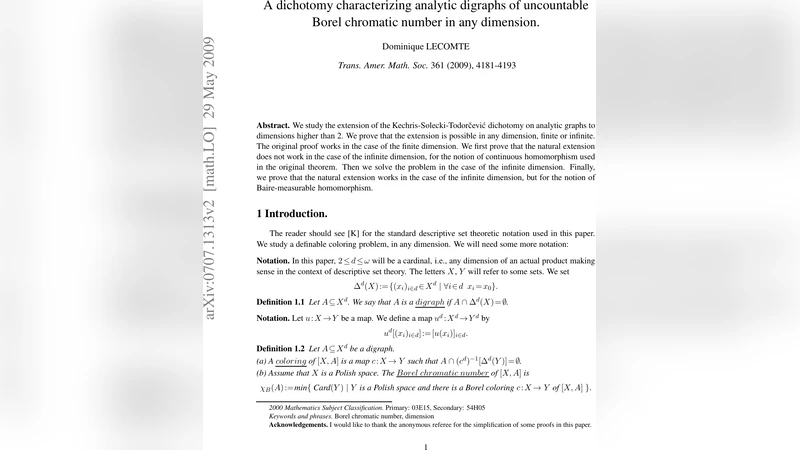
We study the extension of the Kechris-Solecki-Todorcevic dichotomy on analytic graphs to dimensions higher than 2. We prove that the extension is possible in any dimension, finite or infinite. The original proof works in the case of the finite dimension. We first prove that the natural extension does not work in the case of the infinite dimension, for the notion of continuous homomorphism used in the original theorem. Then we solve the problem in the case of the infinite dimension. Finally, we prove that the natural extension works in the case of the infinite dimension, but for the notion of Baire-measurable homomorphism.
💡 Research Summary
The paper investigates how the celebrated Kechris‑Solecki‑Todorcevic (KST) dichotomy, originally formulated for analytic graphs (i.e., 2‑dimensional digraphs), can be extended to higher‑dimensional analytic digraphs, including the case of countably infinite dimension. The classical KST dichotomy states that for any analytic graph G on a Polish space, exactly one of the following holds: (1) G admits a Borel coloring with countably many colors, or (2) G admits a continuous homomorphism from the complete analytic graph on 2^ℕ, which forces the Borel chromatic number of G to be uncountable. The authors aim to determine whether an analogous “either‑or” statement remains true when the edge relation is a subset of X^d for d≥2, and what kind of homomorphisms are required.
The first part of the work deals with finite dimensions d∈ℕ. By interpreting a d‑ary digraph as a relation on the product space X^d, the authors show that the original proof of KST carries over almost verbatim. The key observation is that the “complete” d‑dimensional digraph 𝔾_d, consisting of all d‑tuples of distinct points in 2^ℕ, can be defined in a Borel way, and any continuous map f:X→2^ℕ yields a continuous homomorphism f^d: X^d→(2^ℕ)^d that either embeds the given digraph into 𝔾_d or provides a countable Borel coloring. Consequently, for every finite d the same dichotomy holds with continuous homomorphisms.
The situation changes dramatically for the infinite dimension d=ℵ₀, i.e., the product space X^ℕ. The authors first demonstrate that the naïve extension of the KST statement—using the same notion of continuous homomorphism—fails. They construct a counterexample: a carefully chosen analytic digraph A⊆X^ℕ such that any continuous map f:X→2^ℕ cannot simultaneously preserve the required pattern on infinitely many coordinates. The failure stems from the fact that the product topology on X^ℕ is not locally compact, and continuity in each coordinate does not guarantee control over the whole infinite tuple.
To overcome this obstacle, the paper introduces Baire‑measurable homomorphisms as the appropriate weakening of continuity for the infinite‑dimensional case. A Baire‑measurable map is one whose preimage of any open set has the Baire property; such maps need not be continuous but are still well behaved on a comeager set. The authors develop the notion of “eventual continuity”: a map g:X→2^ℕ is eventually continuous if there exists N∈ℕ such that for all n≥N the nth coordinate of g(x) depends continuously on x, while the first N coordinates may be arbitrary Baire‑measurable functions. Using this device, they prove that for any analytic digraph A⊆X^ℕ exactly one of the following holds:
- A has a countable Borel chromatic number (i.e., there exists a Borel coloring with ℵ₀ colors), or
- There exists a Baire‑measurable homomorphism h:X→2^ℕ such that h^ℕ embeds A into the complete infinite‑dimensional digraph 𝔾_ℵ₀.
Thus the dichotomy is restored, but the homomorphism must be allowed to be merely Baire‑measurable rather than continuous. The authors also show that this weakening is optimal: there are analytic digraphs for which no continuous homomorphism exists, yet a Baire‑measurable one does.
The final section synthesizes the results for all dimensions d∈ℕ∪{ℵ₀}. It clarifies that the appropriate notion of homomorphism depends on the cardinality of the dimension: continuous homomorphisms suffice for every finite d, while Baire‑measurable homomorphisms are necessary and sufficient for the countably infinite case. The paper also provides explicit constructions of the “complete” digraphs 𝔾_d in each dimension and analyzes their minimal Borel chromatic numbers, confirming that they indeed have uncountable Borel chromatic number. Moreover, the authors discuss how their methods interact with classical descriptive set‑theoretic tools such as the perfect set property, the separation theorem, and the theory of analytic equivalence relations.
In conclusion, the work achieves a full generalization of the KST dichotomy to arbitrary (finite or countably infinite) dimensions. It identifies the precise level of measurability required for homomorphisms in each case, thereby deepening our understanding of the interplay between dimension, Borel chromatic number, and definable homomorphisms in descriptive set theory. The results open the door to further investigations of higher‑dimensional combinatorial structures, potential extensions to uncountable dimensions, and applications to areas such as graph limits, dynamical systems, and classification problems.
Comments & Academic Discussion
Loading comments...
Leave a Comment