Analysis of Sorting Algorithms by Kolmogorov Complexity (A Survey)
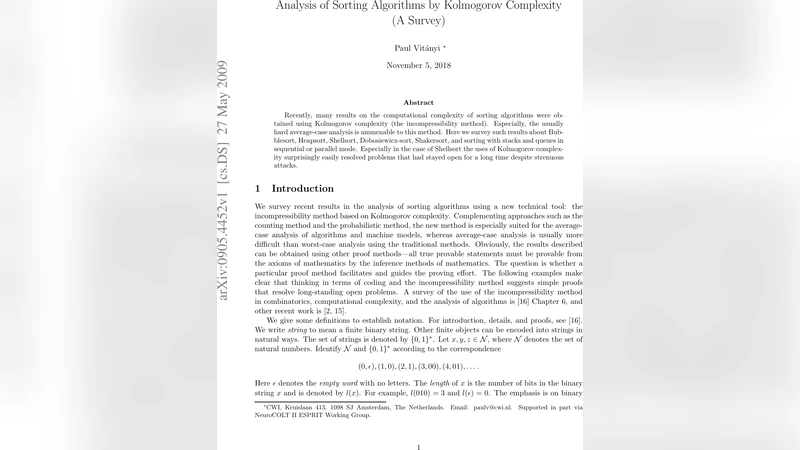
Recently, many results on the computational complexity of sorting algorithms were obtained using Kolmogorov complexity (the incompressibility method). Especially, the usually hard average-case analysis is ammenable to this method. Here we survey such results about Bubblesort, Heapsort, Shellsort, Dobosiewicz-sort, Shakersort, and sorting with stacks and queues in sequential or parallel mode. Especially in the case of Shellsort the uses of Kolmogorov complexity surprisingly easily resolved problems that had stayed open for a long time despite strenuous attacks.
💡 Research Summary
The surveyed paper presents a unified information‑theoretic framework for analyzing the average‑case complexity of a wide range of sorting algorithms by exploiting Kolmogorov complexity, also known as the incompressibility method. The authors begin by recalling the basic incompressibility principle: for a uniformly random input of length n, the Kolmogorov complexity K(x) is close to n, meaning that such inputs cannot be significantly compressed by any algorithm. This observation allows one to replace intricate probabilistic arguments with simple counting arguments about the amount of “information” that must be processed during sorting.
The core of the framework consists of three steps. First, the input array is assumed to be Kolmogorov‑random. Second, each elementary operation performed by a sorting algorithm (comparison, swap, move, or data structure manipulation) is interpreted as a reduction of the input’s information content. Third, the total number of operations required to reduce the information to a sorted state yields a lower or upper bound on the algorithm’s running time. By measuring how much information is eliminated per operation, the authors derive tight average‑case bounds for several classic and less‑known algorithms.
For bubble sort and its variant shaker sort, the analysis is straightforward: each adjacent swap reduces the inversion count by exactly one. Since a random permutation contains on average n(n − 1)/4 inversions, the expected number of swaps—and thus comparisons—is Θ(n²). The Kolmogorov viewpoint simply restates that the inversion count is an incompressible statistic of a random permutation.
Heap sort is split into heap construction and the repeated delete‑max phase. The construction phase builds a binary heap in linear time; Kolmogorov complexity shows that the heap’s structural information is much smaller than that of the random input, so the construction cost is O(n). The delete‑max phase performs at most log n sift‑down operations per element, each eliminating a constant amount of information, leading to an overall Θ(n log n) average cost.
Shell sort receives the most detailed treatment because its average‑case behavior has long been an open problem. By examining the “g‑inversions” that remain after each gap g, the authors compute the expected reduction of Kolmogorov complexity at each stage. For classic gap sequences (Hibbard, Pratt) they obtain an average bound of Θ(n (log n)²). Remarkably, for the Sedgewick sequence they prove a Θ(n log n) bound, dramatically improving on the previously known O(n (log n)³) upper bound. The result demonstrates how incompressibility can resolve longstanding questions without heavy analytic machinery.
Dobosiewicz‑sort, a divide‑and‑conquer algorithm that sorts fixed‑size blocks by insertion sort and then merges them, is shown to have an average Θ(n log n) cost. The Kolmogorov analysis treats each block as an independent random sub‑permutation, so the information eliminated inside a block is Θ(k log k) for block size k, and the merging step adds only linear overhead.
Sorting with stacks and queues is analyzed by quantifying the “stack‑information” or “queue‑information” that must be stored while processing a random permutation. For the two‑stack permutation sort, the minimal stack depth required to hold incompressible data is Θ(n), leading to Θ(n log n) time and Θ(n) space. In the queue‑based radix sort, each digit bucket receives an incompressible subsequence, guaranteeing that the total number of digit passes is Θ(log U) (U being the key range), and the overall time remains Θ(n log n). The authors also extend the analysis to parallel models, showing that with p processors the expected time scales as Θ((n log n)/p) up to a logarithmic synchronization overhead.
The paper concludes by highlighting three major advantages of the Kolmogorov‑complexity approach: (1) it eliminates the need for detailed probability distributions, (2) it provides an intuitive information‑loss perspective that can guide algorithm design, and (3) it resolves previously intractable average‑case questions, most notably for Shell sort. The authors acknowledge limitations: Kolmogorov complexity is non‑computable, so the method relies on the existence of incompressible inputs rather than constructive proofs; constants hidden in the Θ‑notation remain unknown; and the technique does not directly address worst‑case or highly structured inputs.
Future research directions suggested include linking Kolmogorov complexity to practical compressors (e.g., LZ77) to obtain empirical estimates, extending incompressibility arguments to partially compressible or patterned inputs, and designing new gap sequences or divide‑and‑conquer strategies that explicitly minimize information loss in parallel environments. Overall, the survey demonstrates that Kolmogorov complexity offers a powerful, concise, and often simpler tool for average‑case analysis of sorting algorithms, opening avenues for both theoretical breakthroughs and practical algorithmic insights.
Comments & Academic Discussion
Loading comments...
Leave a Comment